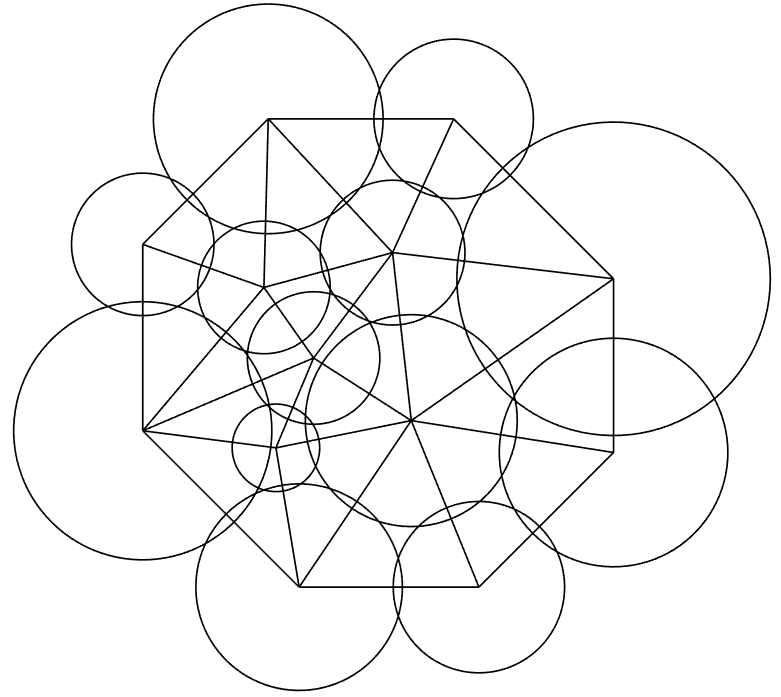
This paper presents a new algorithm for generating planar circle patterns. The algorithm employs gradient descent and conjugate gradient method to compute circle radii and centers separately. Compared with existing algorithms, the proposed method is more efficient in computing centers of circles and is applicable for realizing circle patterns with possible obtuse overlap angles.
Deep Dive into A gradient descent algorithm for computing circle patterns.
This paper presents a new algorithm for generating planar circle patterns. The algorithm employs gradient descent and conjugate gradient method to compute circle radii and centers separately. Compared with existing algorithms, the proposed method is more efficient in computing centers of circles and is applicable for realizing circle patterns with possible obtuse overlap angles.
Circle patterns are configurations of circles with prescribed combinatorial structures. They were first studied by Koebe [11] and received widespread attention when rediscovered by Thurston [16] in his study of 3manifolds. Thurston [17] further conjectured that circle patterns could be used to approximate conformal mappings. This was later confirmed by Rodin and Sullivan [14], paving the way for a wide range of practical applications of circle patterns in computational conformal geometry [10], medical imaging [8], mesh generation [2] and others. Many of these applications rely on constructing circle patterns on geometric structures, which has spurred the development of various computational approaches. Representative algorithms include those based on variational principle [18], Thurston's continuous method [5], Beurling's boundary value problem approach [19], and radius-center alternating iterations [13]. For a comprehensive survey, we refer to the works of Stephenson [15] and Bowers [3].
The aim of this paper is to develop a new algorithm for realizing planar circle patterns, offering a practical framework for constructing conformal mappings from a simply connected domain onto a polygon with prescribed interior angles.
- Computational Methods for Circle Patterns 2.1. Preparations. Let D be a topological polygon. Let T = (V, E, F) be a triangulation of D, and µ a metric on D such that (D, µ) is a Euclidean simple polygon. A circle pattern P on (D, µ) is a collection of circles centered in D and P is said to be T -type if there exists a geodesic triangulation T µ of (D, µ) satisfies the following properties: (i) T µ is isotopic with T ; (ii) The vertices of T µ coincide with the center of P. It has been shown by Stephenson [15] and generalized by Ge, Hua and Zhou [7] and by Jiang, Luo and Zhou [9] that for any triangulation T of D, there exists a unique (up to similarities) metric µ on D such that (D, µ) has prescribed interior angles and supports a T -type circle pattern P with prescribed overlap angles between each pair of intersecting circles.
To obtain such circle patterns, we first recall Thurston’s construction [16,Chap. 13]. Let Θ : E → [0, π) be an overlap angle weight and let r ∈ R |V| + be a vector assigning each v ∈ V a radius of r v . For each edge uv ∈ E, the edge length l uv is given by (2.1)
Then we can construct a Euclidean triangle ∆ uvw with side lengths l uv , l vw and l uw under the condition I vw u ≥ 0, I uw v ≥ 0 and I uv w ≥ 0 (see [7,9]). By gluing these triangles along their common edges, one obtains a cone metric on D with singularities at the vertices in V. For each vertex v ∈ V, let σ v denote the sum of the interior angles of all triangles incident to v and let V ∂ ⊂ V denote the set of boundary vertices. The discrete curvature at each vertex is defined by
where θ v is the prescribed interior angle at v ∈ V ∂ . We seek a radius vector r P such that the cone singularities vanish, i.e., K v (r P ) = 0 for each v ∈ V. With this radius vector, we can then construct the desired circle pattern realizing the prescribed data (see [16,Chap. 13]).
In this subsection, we present an algorithm for computing the radii and centers of P separately.
The first step is to compute the target radii. We introduce an energy function E : R |V| + → R defined by
Evidently, a radius vector of P is a critical point of E, as it attains its minimum. Moreover, Ge, Hua and Zhou [7], Li, Luo and Xu [12] proved that E admits no other critical points. Hence, gradient descent can be applied to E to approximate the target radius vector. Given a test radius vector r (0) ∈ R |V| + and a step size η > 0, the sequence of approximate radii {r (k) } k∈N is generated by r (k+1) = r (k) -η ∇E(r (k) ).
Remark 2.1. The approach of computing circle pattern radii by minimizing an energy function was introduced by Colin de Verdière [18] and developed by Chow and Luo [4]. As an improvement, the energy E can be optimized via nonlinear least-squares methods to speed up convergence.
The second step is to determine the circle centers of P. We first fix the centers of a pair of adjacent boundary circles. Then the center assignment z P ∈ C |V| of P is uniquely determined. Recall that θ v is the prescribed interior angle at v. Using the radius vector obtained in the first step, the centers of the remaining boundary circles can be successively computed, since each triple of consecutive boundary vertices u, v and w satisfies
Next, we define the discrete Dirichlet energy Ψ :
Owing to the results of Ge Hua and Zhou [7], the coefficient can be written as
, where l uv is given in equation (2.1), I vw u is given in equation (2.2) and A uvw is the area of the triangle with side lengths l uv , l vw , l uw . Dubejko [6] shows that (2.5)
Here u ∼ v means u is a neighbor of v. By substituting the center vector of boundary circles into Ψ, combining (2.4) and (2.5), we see that the center vector of the interior circles is a critical po
…(Full text truncated)…
This content is AI-processed based on ArXiv data.