The effective Chen ranks conjecture
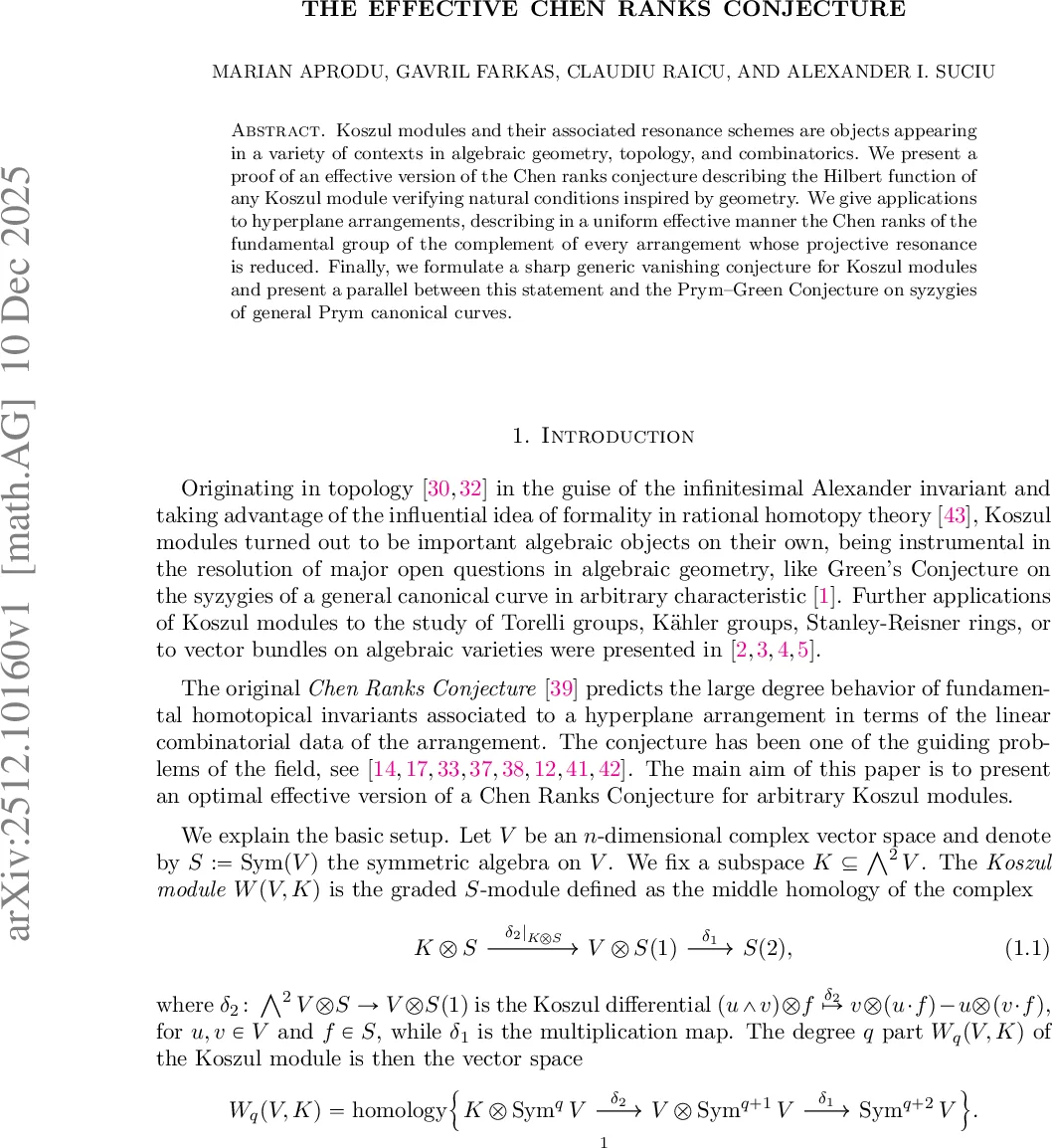
Koszul modules and their associated resonance schemes are objects appearing in a variety of contexts in algebraic geometry, topology, and combinatorics. We present a proof of an effective version of the Chen ranks conjecture describing the Hilbert function of any Koszul module verifying natural conditions inspired by geometry. We give applications to hyperplane arrangements, describing in a uniform effective manner the Chen ranks of the fundamental group of the complement of every arrangement whose projective resonance is reduced. Finally, we formulate a sharp generic vanishing conjecture for Koszul modules and present a parallel between this statement and the Prym–Green Conjecture on syzygies of general Prym canonical curves.
💡 Research Summary
This paper presents a comprehensive study of Koszul modules and their associated resonance schemes, with major breakthroughs in algebra, topology, and combinatorics. The central achievement is the proof of an effective version of the Chen ranks conjecture, providing explicit control over the Hilbert function of Koszul modules under natural geometric conditions.
The authors prove that if the resonance variety R(V, K) of a Koszul module W(V, K) is “strongly isotropic” – a condition ensuring it is a reduced union of linear subspaces satisfying specific algebraic constraints – then for all degrees q ≥ dim(V)-3, the module decomposes as a direct sum of simpler Koszul modules associated to each resonance component (Theorem 1.1). This result is sharp, and its proof relies on a geometric characterization: strong isotropicity is equivalent to the base locus B(V, K) being a scheme-theoretic disjoint union of sub-Grassmannians (Corollary 1.2). The paper also establishes a general formula for the Hilbert function when the base locus is finite, without any resonance assumptions (Theorem 1.4).
These algebraic theorems have profound topological applications. For a finitely generated 1-formal group G, the Chen ranks θ_q(G) – important invariants of the lower central series of its metabelian quotient – equal the dimensions of the corresponding Koszul module W(G). Therefore, Theorem 1.1 yields an effective formula for θ_q(G) when R(G) is strongly isotropic, expressing it as a sum of the Chen ranks of free groups over the resonance components (Theorem 1.5).
A major application is to hyperplane arrangement complements. While the resonance R(A) of an arrangement is always linear and isotropic, the authors identify significant classes where it is also strongly isotropic, including arrangements where all components are local or essential, and arrangements with only double and triple intersection points (Theorem 1.6). For these arrangements, Suciu’s Chen ranks conjecture is verified effectively, giving a combinatorial formula for θ_q(π_1(M(A))) for all q ≥ |A|-1. Explicit formulas are derived for groups like the pure braid group PΣ_n.
Finally, the paper formulates a sharp “generic vanishing conjecture” (Conjecture 1.7) for Koszul modules, predicting the vanishing of W_{n-4}(V, K) for a general (2n-2)-dimensional subspace K ⊆ ∧²V when n≥6. This is shown to hold for 6≤n≤10, n≠9, but interestingly fails for n=5 and is suspected to fail for n=9. The authors draw a compelling parallel between this failure pattern and the known failure of the Prym–Green conjecture for syzygies of general Prym canonical curves of genera 8 and 16, suggesting a deeper, unexplored connection between these areas.
Comments & Academic Discussion
Loading comments...
Leave a Comment