Dark Personality Traits and Online Toxicity: Linking Self-Reports to Reddit Activity
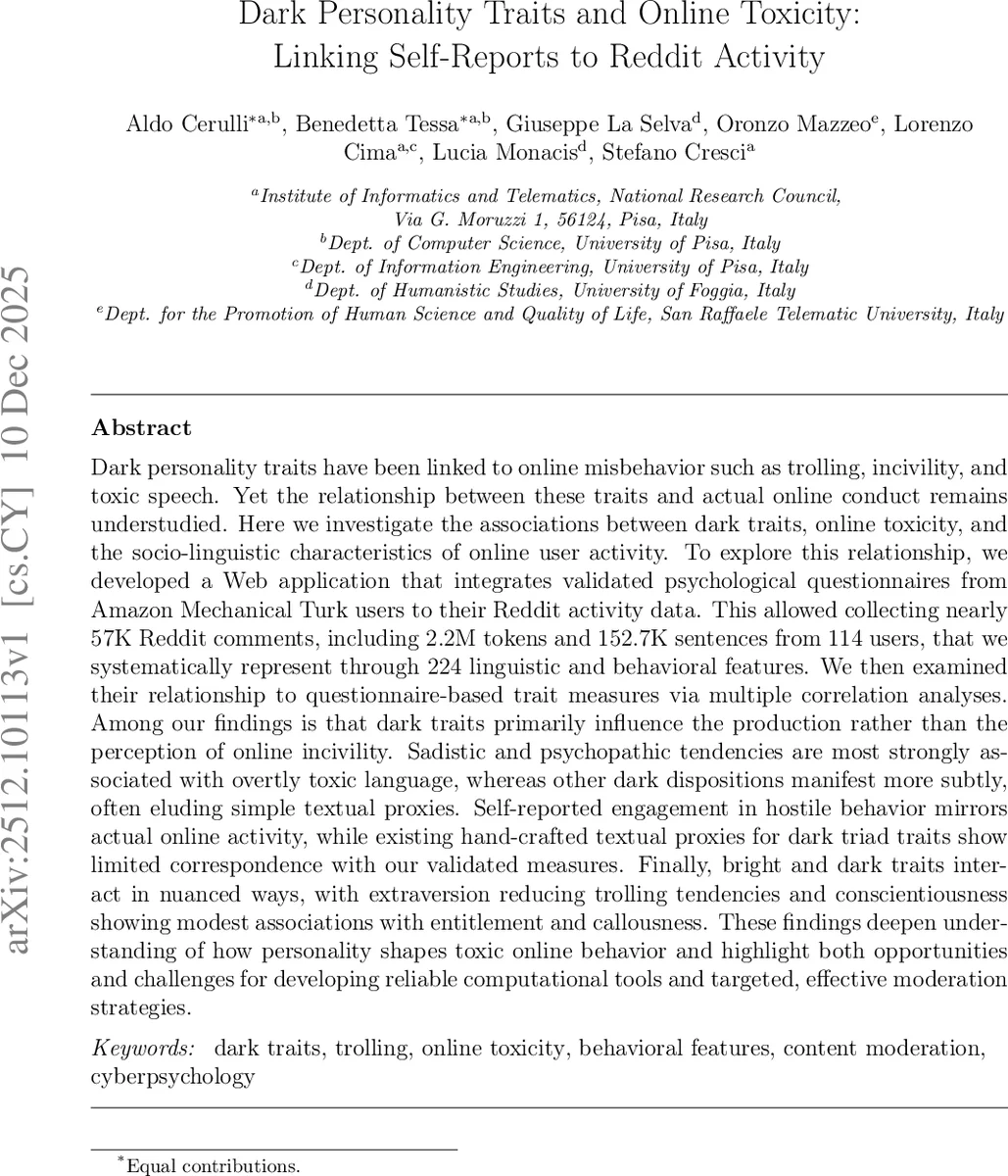
Dark personality traits have been linked to online misbehavior such as trolling, incivility, and toxic speech. Yet the relationship between these traits and actual online conduct remains understudied. Here we investigate the associations between dark traits, online toxicity, and the socio-linguistic characteristics of online user activity. To explore this relationship, we developed a Web application that integrates validated psychological questionnaires from Amazon Mechanical Turk users to their Reddit activity data. This allowed collecting nearly 57K Reddit comments, including 2.2M tokens and 152.7K sentences from 114 users, that we systematically represent through 224 linguistic and behavioral features. We then examined their relationship to questionnaire-based trait measures via multiple correlation analyses. Among our findings is that dark traits primarily influence the production rather than the perception of online incivility. Sadistic and psychopathic tendencies are most strongly associated with overtly toxic language, whereas other dark dispositions manifest more subtly, often eluding simple textual proxies. Self-reported engagement in hostile behavior mirrors actual online activity, while existing hand-crafted textual proxies for dark triad traits show limited correspondence with our validated measures. Finally, bright and dark traits interact in nuanced ways, with extraversion reducing trolling tendencies and conscientiousness showing modest associations with entitlement and callousness. These findings deepen understanding of how personality shapes toxic online behavior and highlight both opportunities and challenges for developing reliable computational tools and targeted, effective moderation strategies.
💡 Research Summary
This paper investigates how dark personality traits—particularly those comprising the Dark Triad (Machiavellianism, narcissism, psychopathy) and everyday sadism—relate to actual toxic behavior on Reddit. The authors recruited participants through Amazon Mechanical Turk, restricting the sample to U.S. Reddit users. After obtaining informed consent, a custom web application linked each participant’s Reddit account to a validated psychological questionnaire (the Dark Side of Humanity Scale, among others). Inclusion criteria required accounts to be at least 30 days old, to have posted a minimum of 50 comments, and to have generated at least 1,500 tokens, ensuring sufficient textual material for analysis. Of the 331 users who initially consented, 114 met all criteria and provided both questionnaire responses and Reddit data.
The collected corpus comprises roughly 57 000 comments (≈2.2 million tokens, 152 700 sentences). The authors extracted 224 linguistic and behavioral features from this corpus, including LIWC‑style psycholinguistic markers, sentiment scores, toxicity scores from the Perspective API, comment length, posting frequency, temporal patterns, and subreddit participation metrics. These features were aggregated at the user level to enable correlation with the questionnaire‑derived trait scores.
Multiple Pearson correlation analyses were conducted to assess the relationships between each dark‑trait dimension (successful psychopathy, grandiose entitlement, sadism, etc.) and the 224 feature set. The strongest positive associations emerged for sadism and psychopathy with overtly toxic language—measured by profanity rates, hate‑speech markers, and high toxicity scores—indicating that individuals high in these traits tend to produce explicitly hostile content. In contrast, Machiavellianism and narcissism showed weaker, more diffuse links to behavioral patterns such as comment length, posting frequency, and topic diversity, suggesting that these traits manifest in subtler ways that are not captured by simple profanity‑based proxies.
Self‑reported engagement in hostile behavior correlated with actual toxic activity, supporting the validity of the self‑report measures. The study also examined interactions between bright personality traits (the Big Five) and dark traits. Extraversion was negatively correlated with trolling‑like behavior, implying that socially active users may be less prone to deliberate provocation. Conscientiousness displayed modest positive links with entitlement and callousness, hinting that high self‑discipline can coexist with a sense of privilege and emotional coldness.
The authors discuss several implications. First, the clear link between sadism/psychopathy and explicit toxicity suggests that moderation tools could benefit from incorporating trait‑informed linguistic features to improve detection accuracy. Second, the more nuanced expression of Machiavellianism and narcissism underscores the need for multimodal data (e.g., voting patterns, temporal activity) and more sophisticated modeling beyond simple lexical cues. Third, the interaction effects with bright traits point to potential protective factors that could be leveraged in community‑building interventions.
Limitations include the modest sample size, the focus on a single platform (Reddit) with its unique culture of anonymity, and possible social desirability bias in questionnaire responses. Correlational analysis precludes causal inference, and the study does not explore longitudinal dynamics. Future work should expand to larger, cross‑platform datasets, employ causal or experimental designs, and explore deep‑learning approaches (e.g., fine‑tuned BERT or generative LLMs) to capture the subtle linguistic signatures of less overt dark traits.
In sum, the paper provides robust empirical evidence that dark personality traits, especially sadism and psychopathy, drive the production of toxic language on Reddit, while other dark traits manifest more covertly. These findings advance the theoretical understanding of the psychology of online aggression and offer practical guidance for developing more nuanced, ethically informed moderation systems.
Comments & Academic Discussion
Loading comments...
Leave a Comment