Concentration of Measure under Diffeomorphism Groups: A Universal Framework with Optimal Coordinate Selection
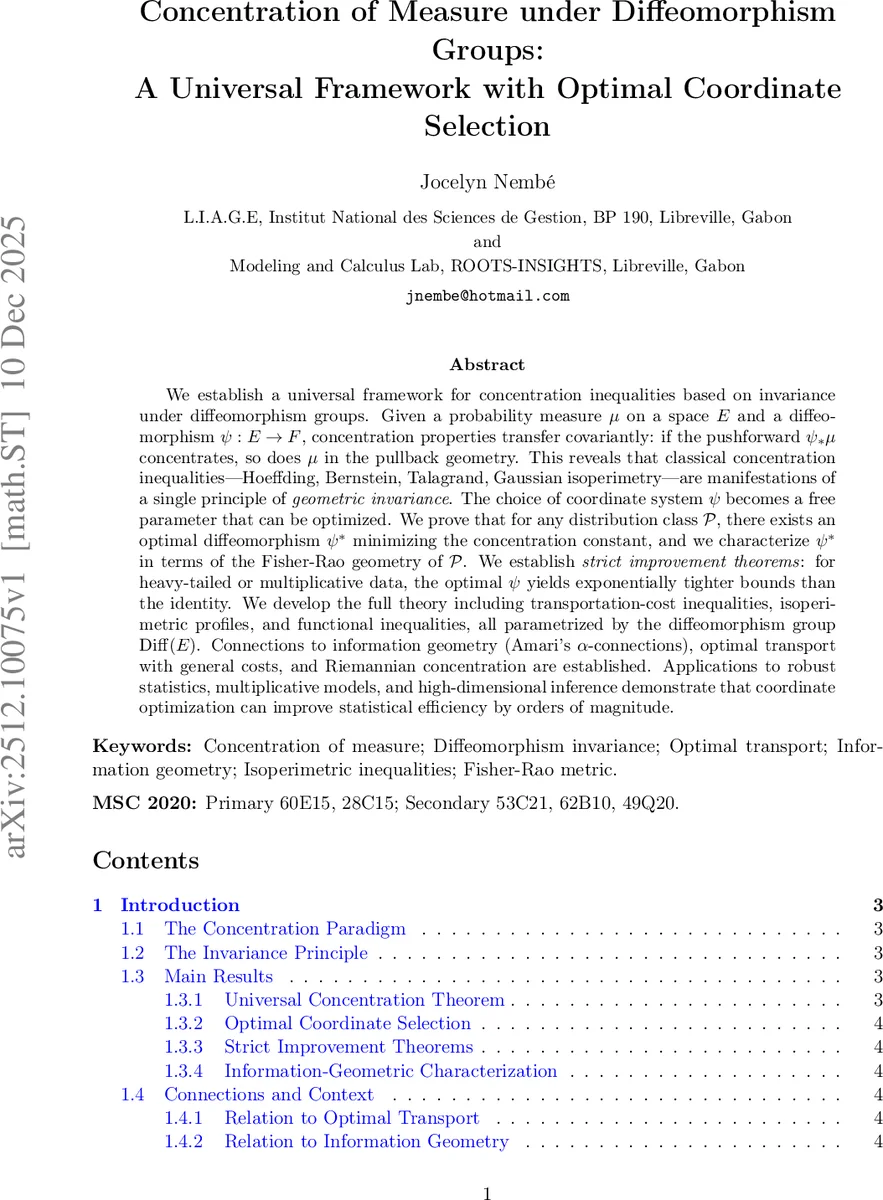
We establish a universal framework for concentration inequalities based on invariance under diffeomorphism groups. Given a probability measure $μ$ on a space $E$ and a diffeomorphism $ψ: E \to F$, concentration properties transfer covariantly: if the pushforward $ψ_μ$ concentrates, so does $μ$ in the pullback geometry. This reveals that classical concentration inequalities – Hoeffding, Bernstein, Talagrand, Gaussian isoperimetry – are manifestations of a single principle of \emph{geometric invariance}. The choice of coordinate system $ψ$ becomes a free parameter that can be optimized. We prove that for any distribution class $\Pc$, there exists an optimal diffeomorphism $ψ^$ minimizing the concentration constant, and we characterize $ψ^*$ in terms of the Fisher-Rao geometry of $\Pc$. We establish \emph{strict improvement theorems}: for heavy-tailed or multiplicative data, the optimal $ψ$ yields exponentially tighter bounds than the identity. We develop the full theory including transportation-cost inequalities, isoperimetric profiles, and functional inequalities, all parametrized by the diffeomorphism group $\Diff(E)$. Connections to information geometry (Amari’s $α$-connections), optimal transport with general costs, and Riemannian concentration are established. Applications to robust statistics, multiplicative models, and high-dimensional inference demonstrate that coordinate optimization can improve statistical efficiency by orders of magnitude.
💡 Research Summary
The paper proposes a universal framework for concentration of measure that is covariant under diffeomorphism groups. Starting from a probability measure μ on a space E and a smooth bijection ψ : E → F, the authors show that concentration properties of μ in the ψ‑induced geometry are exactly the same as those of the push‑forward ψ_*μ in the standard Euclidean geometry. This “geometric invariance principle” unifies Hoeffding, Bernstein, Talagrand, Gaussian isoperimetry and many other classical inequalities as special cases corresponding to particular choices of ψ (identity, logarithm, power maps, arctan, etc.).
The core technical contribution is the definition of ψ‑concentration functions α_{ψ,μ}(t) and ψ‑sub‑Gaussian norms, together with a master concentration theorem (Theorem 3.1) that yields Hoeffding‑type tail bounds for any ψ‑Lipschitz function. The authors prove that the concentration constant transforms affinely under linear changes of coordinates, composes naturally, and inverts under ψ⁻¹, establishing a full algebraic calculus for concentration constants.
A major novelty is the formulation of an optimization problem: for a given class of distributions ℙ, find the diffeomorphism ψ* that minimizes the worst‑case ψ‑sub‑Gaussian variance (or equivalently the concentration constant). Under mild regularity (uniform integrability of log‑moments and bounded Fisher information), existence of an optimal ψ* is proved via lower‑semicontinuity and compactness arguments. The optimal ψ* is characterized geometrically: it minimizes the Fisher‑Rao diameter of the statistical manifold ℙ when the pull‑back metric ψ*⁎g_Eucl is used. For exponential families, ψ* coincides with the Legendre‑dual (mean‑parameter) map ∇A⁎, which renders the Fisher‑Rao metric Euclidean. This links the framework to Amari’s α‑connections, showing that the α = 0 (mixture) connection yields optimal concentration for mixture families.
The authors derive strict improvement theorems: for heavy‑tailed or multiplicative data (e.g., positive variables on
Comments & Academic Discussion
Loading comments...
Leave a Comment