Connecting single-layer $t$-$J$ to Kondo lattice models: Exploration with cold atoms
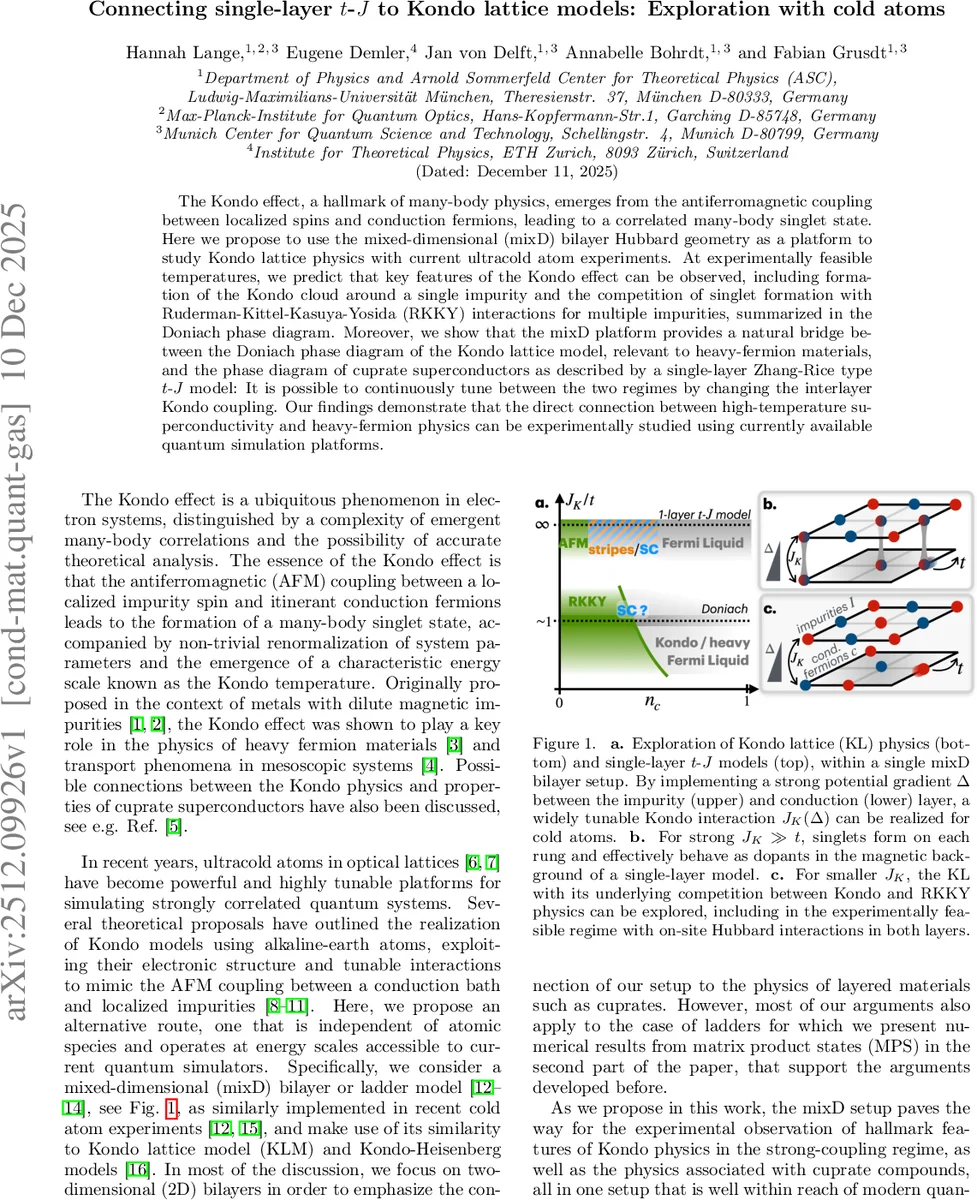
The Kondo effect, a hallmark of many-body physics, emerges from the antiferromagnetic coupling between localized spins and conduction fermions, leading to a correlated many-body singlet state. Here we propose to use the mixed-dimensional (mixD) bilayer Hubbard geometry as a platform to study Kondo lattice physics with current ultracold atom experiments. At experimentally feasible temperatures, we predict that key features of the Kondo effect can be observed, including formation of the Kondo cloud around a single impurity and the competition of singlet formation with Ruderman-Kittel-Kasuya-Yosida (RKKY) interactions for multiple impurities, summarized in the Doniach phase diagram. Moreover, we show that the mixD platform provides a natural bridge between the Doniach phase diagram of the Kondo lattice model, relevant to heavy-fermion materials, and the phase diagram of cuprate superconductors as described by a single-layer Zhang-Rice type $t$-$J$ model: It is possible to continuously tune between the two regimes by changing the interlayer Kondo coupling. Our findings demonstrate that the direct connection between high-temperature superconductivity and heavy-fermion physics can be experimentally studied using currently available quantum simulation platforms.
💡 Research Summary
This paper presents a groundbreaking theoretical proposal to bridge the gap between two fundamental pillars of strongly correlated electron physics: the $t$-$J$ model, which is central to understanding high-temperature cuprate superconductors, and the Kondo lattice model, which describes heavy-fermion systems. The authors introduce a “mixed-dimensional (mixD) bilayer Hubbard geometry” as a versatile quantum simulation platform using ultracold atoms in optical lattices.
The core of the research lies in demonstrating that the physics of high-temperature superconductivity and heavy-fermion physics are not isolated phenomena but can be continuously connected through the tuning of interlayer coupling. By utilizing a mixed-dimensional setup, the researchers propose a way to simulate the interaction between localized spins and itinerant conduction fermions. The study predicts that within experimentally accessible temperature regimes, several key many-body phenomena can be observed. Specifically, the formation of the “Kondo cloud” around a single impurity and the complex competition between the Kondo effect (singlet formation) and the Ruderman-Kittel-Kasuya-Yosida (RKKY) interaction (magnetic ordering) can be captured, effectively mapping out the Doniach phase diagram.
A significant highlight of this work is the realization of a “natural bridge” between the two regimes. The authors show that by adjusting the interlayer Kondo coupling strength, one can transition from a regime characterized by the Zhang-Rice singlet physics of the $t$-$J$ model to the regime of the Kondo lattice model. This continuous tunability allows for a systematic exploration of the phase transitions and the underlying unified physics of these two distinct classes of materials.
Furthermore, the paper emphasizes the experimental feasibility of this approach using current ultracold atom technologies. The ability to control parameters such as dimensionality and coupling strength in a highly controlled environment makes this mixD platform a powerful tool for quantum simulation. In conclusion, this research provides a roadmap for using quantum simulators to uncover the deep-seated connections between high-$T_c$ superconductivity and heavy-fermion physics, potentially leading to new insights into the fundamental nature of strongly correlated quantum matter.
Comments & Academic Discussion
Loading comments...
Leave a Comment