Gehring-Hayman Inequality for Meromorphic Univalent Mappings
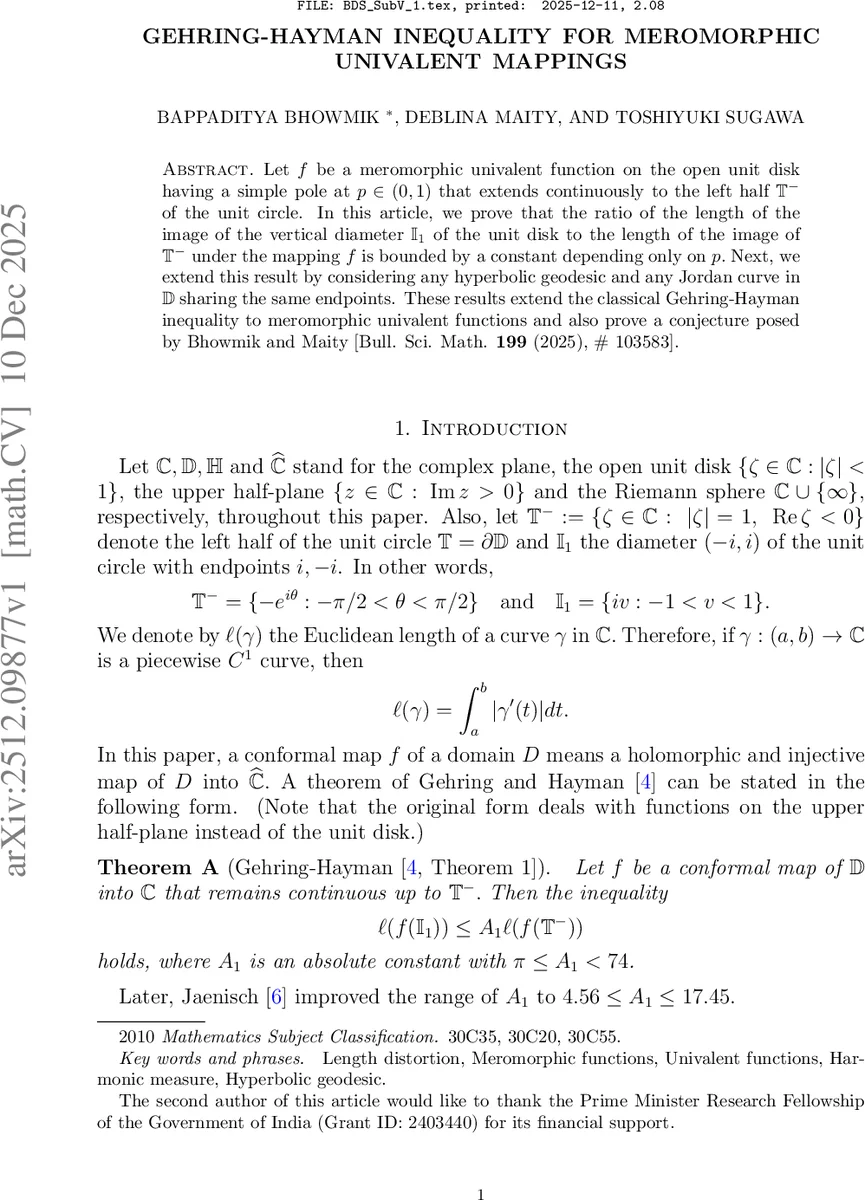
Let $f$ be a meromorphic univalent function on the open unit disk having a simple pole at $p\in (0,1)$ that extends continuously to the left half $\IT^{-}$ of the unit circle. In this article, we prove that the ratio of the length of the image of the vertical diameter $\IA$ of the unit disk to the length of the image of $\IT^{-}$ under the mapping $f$ is bounded by a constant depending only on $p.$ Next, we extend this result by considering any hyperbolic geodesic and any Jordan curve in $\D$ sharing the same endpoints. These results extend the classical Gehring-Hayman inequality to meromorphic univalent functions and also prove a conjecture posed by Bhowmik and Maity [Bull. Sci. Math. \textbf{199} (2025), # 103583].
💡 Research Summary
This paper, titled “Gehring-Hayman Inequality for Meromorphic Univalent Mappings,” successfully generalizes the classical Gehring-Hayman inequality to the class of meromorphic univalent functions with a simple pole inside the unit disk. The original Gehring-Hayman inequality, a fundamental result in geometric function theory, states that for a conformal map of the unit disk, the length of the image of the vertical diameter is bounded by an absolute constant times the length of the image of the left half of the unit circle. The authors extend this result to functions that are univalent and analytic except for a simple pole at a point p in (0,1), and which extend continuously to the boundary arc T⁻.
The primary achievement is the resolution of a conjecture posed in the authors’ prior work, which questioned whether the analogous ratio constant A_p remains finite for all pole locations p in (0,1), not just for p greater than √2-1. The paper affirmatively answers this conjecture and provides explicit, computable upper bounds for A_p.
The methodology is a sophisticated blend of complex analysis, hyperbolic geometry, and potential theory. A key step involves transforming the problem from the unit disk to the upper half-plane via a Möbius map. This transformation sends the pole to a boundary point of a specific hyperbolic half-plane Ω₁ within the upper half-plane. The core of the proof hinges on obtaining sharp estimates for harmonic measures within this domain Ω₁. Lemma 1 establishes a crucial lower bound for the harmonic measure of a real interval, as seen from points on a corresponding vertical segment. This lower bound depends explicitly on the pole position p and the aspect ratio of the interval.
This harmonic measure estimate is then combined with a lemma from the original Gehring-Hayman work (Lemma A), which relates harmonic measure to Euclidean distance to the boundary. By applying this to the transformed mapping and carefully integrating derivative estimates along families of segments, the authors derive an upper bound N_p(q) for the length distortion ratio (Theorem 2). This bound is expressed as an infimum over a parameter q>1. A simpler, albeit slightly weaker, bound is presented in Theorem 1, showing A_p is less than a constant times (1/p) * (1 + 20/(3p))², clearly demonstrating the dependence on the pole location and confirming finiteness for all p>0.
Furthermore, the authors leverage the proof technique to extend the second Gehring-Hayman theorem (Theorem B). They prove that for a meromorphic univalent function in the considered class, the length of the image of any hyperbolic geodesic is bounded by the same constant ˜A_p times the length of the image of any Jordan arc sharing the same endpoints (Theorem 3). This provides a complete generalization of the Gehring-Hayman theory to the meromorphic setting.
In summary, this work makes a significant contribution to geometric function theory by solving an open problem and providing precise quantitative bounds. It elegantly handles the complication introduced by an interior pole using harmonic measure techniques and conformal mapping, thereby extending the reach of a classical geometric principle.
Comments & Academic Discussion
Loading comments...
Leave a Comment