Atom and spin resolved imaging in a single shot
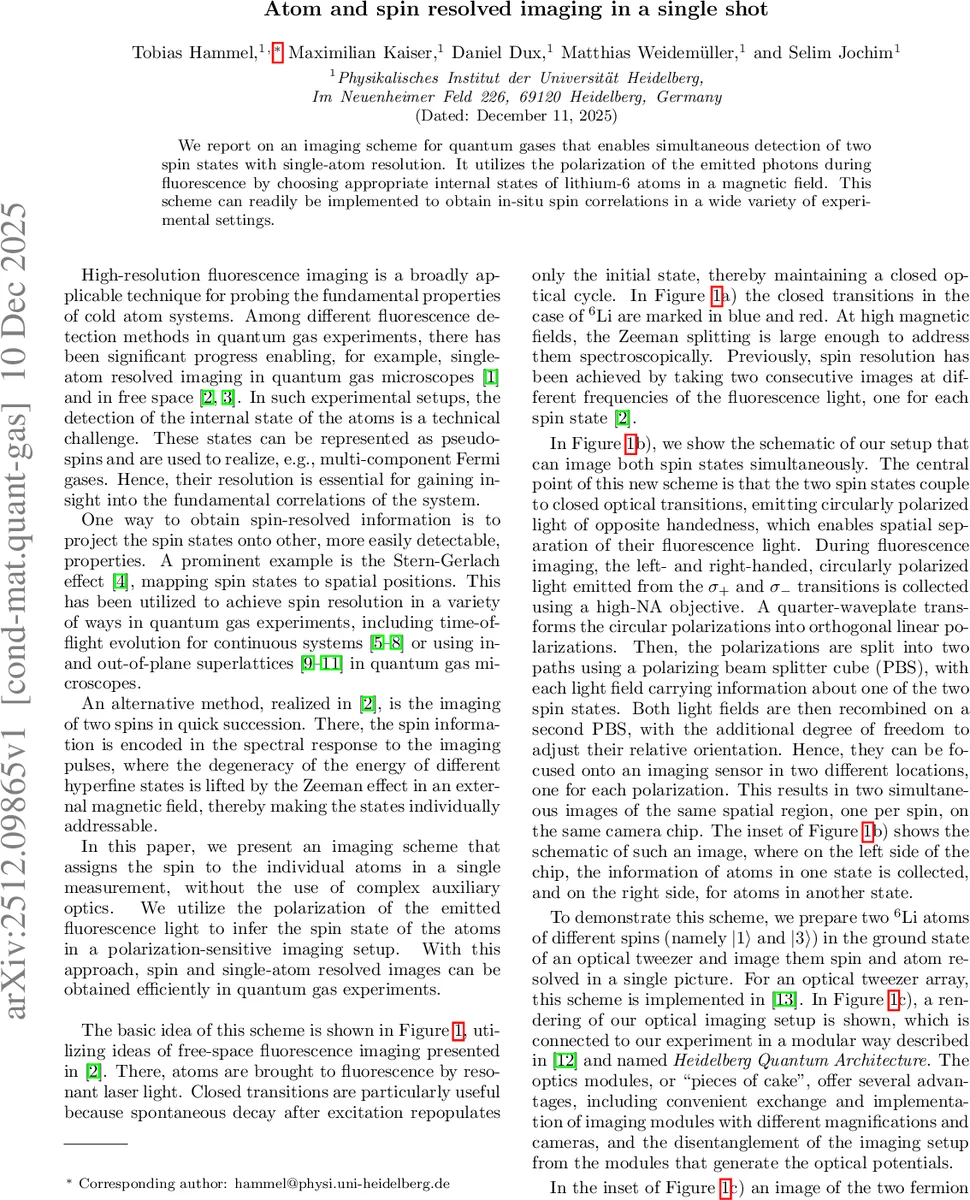
We report on an imaging scheme for quantum gases that enables simultaneous detection of two spin states with single-atom resolution. It utilizes the polarization of the emitted photons during fluorescence by choosing appropriate internal states of lithium-6 atoms in a magnetic field. This scheme can readily be implemented to obtain in-situ spin correlations in a wide variety of experimental settings.
💡 Research Summary
In this work the authors introduce a novel fluorescence‑based imaging technique that simultaneously resolves both the spatial position and the spin state of individual atoms in a quantum gas with single‑atom sensitivity. The method exploits the polarization of photons emitted during closed‑cycle optical transitions of 6Li atoms in a strong magnetic field. By preparing the atoms in the stretched hyperfine states |3⟩ (mJ = −½, mI = −1) and |6⟩ (mJ = +½, mI = +1), the σ⁺ and σ⁻ cycling transitions are addressed separately; each transition emits photons of opposite circular polarization (left‑handed versus right‑handed). Because the Zeeman splitting at several hundred gauss is larger than the natural linewidth, the two transitions can be spectrally isolated with a single resonant laser.
The optical detection chain consists of three stages. First, a high‑NA objective collects the fluorescence from the atomic sample. Second, a quarter‑wave plate converts the σ⁺/σ⁻ circular polarizations into orthogonal linear polarizations (horizontal and vertical). Two polarizing beam‑splitter cubes (PBS) then separate these linear components into distinct optical paths. Half‑wave plates placed in each arm ensure that each beam passes through a PBS only once, maximizing the extinction ratio and suppressing cross‑talk. Finally, the two beams are recombined at slightly different angles so that they are focused onto separate regions of the same camera sensor. In this way the camera records two simultaneous images of the identical physical area, each image containing only atoms of one spin state.
The authors demonstrate the scheme with two 6Li atoms confined in a single optical tweezer. One atom is prepared in state |3⟩, while the other is transferred from |1⟩ to |6⟩ using a microwave pulse before imaging. After a short fluorescence burst, the camera shows two well‑separated spots on its left and right halves, corresponding unambiguously to the two spin components despite the atoms occupying the same spatial location in the trap. Image analysis follows the standard pipeline used in previous Li‑6 free‑space imaging: binary thresholding, Gaussian low‑pass filtering, and peak‑finding to count atoms.
Key advantages of this approach are its simplicity and modularity. No Stern‑Gerlach magnetic field gradients or time‑sequential imaging pulses are required, eliminating timing jitter and mechanical drift. The entire polarization‑splitting module can be inserted into existing setups as a “plug‑and‑play” component of the Heidelberg Quantum Architecture, a modular platform where optical elements are arranged as interchangeable “cake pieces”. Because the technique relies only on a single camera, inexpensive high‑quantum‑efficiency CMOS or EMCCD sensors can be employed, relaxing the stringent specifications often demanded by dual‑camera schemes.
Limitations include the necessity of a sufficiently strong magnetic field to resolve the Zeeman components, precise control of laser polarization to maintain closed cycling, and careful alignment of the polarization optics to avoid leakage between the two channels. The authors discuss possible extensions to multi‑spin (>2) systems by employing additional wave‑plates or wavelength‑dependent polarizers, and to large‑scale lattice experiments where the same principle could be combined with quantum‑gas microscopes or magnifying objectives.
Overall, the paper provides a clear, experimentally validated protocol for spin‑resolved, single‑atom imaging in a single shot, opening the door to in‑situ measurements of spin correlations, magnetic ordering, and dynamical spin transport in a broad class of ultracold‑atom platforms. All data supporting the findings are publicly available via the cited GitHub repository.
Comments & Academic Discussion
Loading comments...
Leave a Comment