The Oxygen Valve on Hydrogen Escape Since the Great Oxidation Event
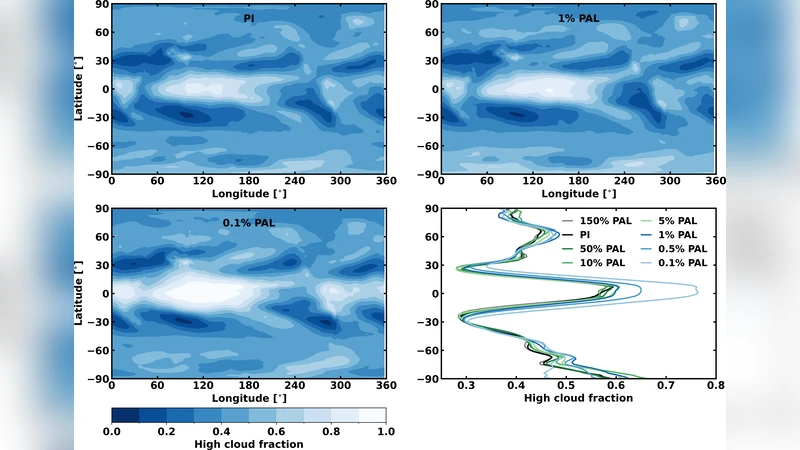
The Great Oxidation Event (GOE) was a 200 Myr transition circa 2.4 billion years ago that converted the Earth’s anoxic atmosphere to one where molecular oxygen (O 2 ) was abundant (volume mixing ratio > 10 -4 ). This significant rise in O 2 is thought to have substantially throttled hydrogen (H) escape and the associated water (H 2 O) loss. Atmospheric estimations from the GOE onward place O 2 concentrations ranging between 0.1% to 150% PAL, where PAL is the present atmospheric level of 21% by volume. In this study we use WACCM6, a three-dimensional Earth System Model to simulate Earth’s atmosphere and predict the diffusion-limited escape rate of hydrogen due to varying O 2 post-GOE. We find that O 2 indirectly acts as a control valve on the amount of hydrogen atoms reaching the homopause in the simulations: less O 2 leads to decreased O 3 densities, reducing local tropical tropopause temperatures by up to 18 K, which increases H 2 O freeze-drying and thus reduces the primary source of hydrogen in the considered scenarios. The maximum differences between all simulations in the total H mixing ratio at the homopause and the associated diffusion-limited escape rates are a factor of 3.2 and 4.7, respectively. The prescribed CH 4 mixing ratio (0.8 ppmv) sets a minimum diffusion escape rate of ≈ 2 × 10 10 mol H yr -1 , effectively a negligible rate when compared to pre-GOE estimates (∼ 10 12 -10 13 mol H yr -1 ). Because the changes in our predicted escape rates are comparatively minor, our numerical predictions support geological evidence that the majority of Earth’s hydrogen escape occurred prior to the GOE. Our work demonstrates that estimations of how the tropical tropopause layer and the associated hydrogen escape rate evolved through Earth’s history requires 3D chemistry-climate models which include a global treatment of water vapour microphysics.
💡 Research Summary
The paper investigates how post‑Great Oxidation Event (GOE) variations in atmospheric oxygen (O₂) influence the diffusion‑limited escape of hydrogen (H) using the Whole Atmosphere Community Climate Model version 6 (WACCM6), a state‑of‑the‑art three‑dimensional Earth system model that couples chemistry, radiation, dynamics, and cloud microphysics. The GOE, occurring around 2.4 billion years ago, marks the transition from an anoxic to an O₂‑rich atmosphere (mixing ratio >10⁻⁴). Geological proxies suggest that most of Earth’s hydrogen loss occurred before this event, but quantitative modeling of the post‑GOE regime has been limited, often relying on one‑dimensional or highly simplified frameworks that cannot capture the complex feedbacks among ozone (O₃), tropical tropopause layer (TTL) temperature, and water‑vapor transport.
Methodology
The authors set up a suite of ten simulations in which the background O₂ mixing ratio is systematically varied from 0.1 % of the present atmospheric level (PAL) up to 150 % PAL, encompassing the full range of estimates derived from sedimentary and isotopic records. Methane (CH₄) is held constant at 0.8 ppmv, a value representative of the late Archean‑early Proterozoic atmosphere, to provide a minimum photochemical source of H. Each simulation is spun up for 30 years, after which a 10‑year climatology is extracted for analysis. The model explicitly resolves the TTL, allowing the authors to diagnose changes in O₃ column density, tropical tropopause temperature, and the “freeze‑drying” of water vapor that controls the supply of H₂O to the homopause.
Key Findings
- O₂‑O₃‑Temperature Coupling – Lower O₂ leads to reduced O₃ production in the stratosphere. Because O₃ is the primary absorber of ultraviolet radiation, its depletion weakens radiative heating in the upper stratosphere and enhances radiative cooling in the TTL. The model shows tropical tropopause temperatures dropping by up to 18 K in the lowest‑O₂ scenario relative to the modern‑O₂ case.
- Freeze‑Drying Amplification – The cooler TTL increases the efficiency of water‑vapor freeze‑drying: water condenses and freezes out before it can be transported upward, effectively starving the homopause of its main hydrogen reservoir (H₂O). Consequently, the H mixing ratio at the homopause varies by a factor of ~3.2 across the O₂ suite.
- Diffusion‑Limited Escape – Using the classic diffusion‑limited flux formulation (F = b · n_H · (1 – H/H_sat)), the authors calculate escape rates that differ by up to a factor of 4.7 between the extreme O₂ cases. However, all rates remain on the order of 10¹⁰ mol H yr⁻¹, far below the 10¹²–10¹³ mol H yr⁻¹ inferred for the pre‑GOE Earth. The imposed CH₄ level sets a hard lower bound of ≈2 × 10¹⁰ mol H yr⁻¹, indicating that even in the most O₂‑depleted scenario, hydrogen loss is negligible compared with the Archean epoch.
- Implications for Geological Records – The modest variation in post‑GOE escape rates supports the prevailing geological interpretation that the bulk of Earth’s water loss and associated hydrogen escape occurred before the rise of atmospheric oxygen. The study also highlights that any substantial increase in early methane concentrations could have altered this balance, a point that warrants further exploration.
Significance and Future Directions
The work demonstrates that O₂ functions as a “control valve” for hydrogen escape, but the valve’s opening is mediated through a cascade of processes—ozone chemistry, radiative cooling, TTL temperature, and water‑vapor microphysics—that can only be captured in a fully three‑dimensional chemistry‑climate model. By quantifying the magnitude of these feedbacks, the authors provide a robust numerical foundation for the hypothesis that post‑GOE hydrogen loss was limited. The study also underscores the necessity of incorporating realistic TTL microphysics and global circulation when reconstructing ancient atmospheric states. Future research should explore the sensitivity to varying CH₄ levels, solar luminosity, and surface reservoir fluxes, thereby refining our understanding of how the Earth transitioned from a water‑rich, hydrogen‑losing world to the relatively stable, oxygen‑dominated atmosphere we observe today.