Relaxation limit and asymptotic stability for the Euler-Navier-Stokes equations
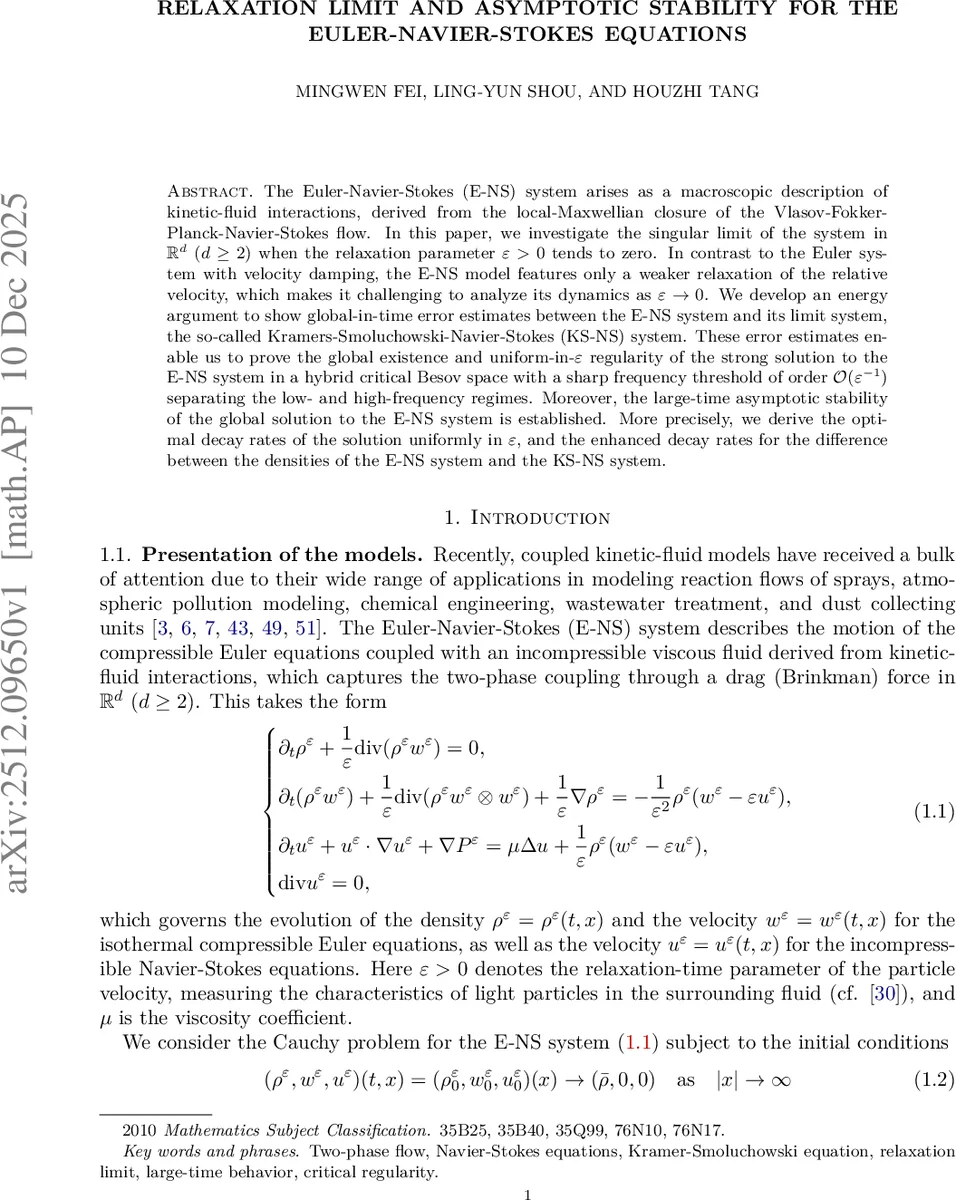
The Euler-Navier-Stokes (E-NS) system arises as a macroscopic description of kinetic-fluid interactions, derived from the local-Maxwellian closure of the Vlasov-Fokker-Planck-Navier-Stokes flow. In this paper, we investigate the singular limit of the system in $\mathbb{R}^d$ ($d\ge2$) when the relaxation parameter $\varepsilon>0$ tends to zero. In contrast to the Euler system with velocity damping, the E-NS model features only a weaker relaxation of the relative velocity, which makes it challenging to analyze its dynamics as $\varepsilon\rightarrow 0$. We develop an energy argument to show global-in-time error estimates between the E-NS system and its limit system, the so-called Kramers-Smoluchowski-Navier-Stokes (KS-NS) system. These error estimates enable us to prove the global existence and uniform-in-$\varepsilon$ regularity of the strong solution to the E-NS system in a hybrid critical Besov space with a sharp frequency threshold of order $\mathcal{O}(\varepsilon^{-1})$ separating the low- and high-frequency regimes. Moreover, the large-time asymptotic stability of the global solution to the E-NS system is established. More precisely, we derive the optimal decay rates of the solution uniformly in $\varepsilon$, and the enhanced decay rates for the difference between the densities of the E-NS system and the KS-NS system.
💡 Research Summary
This paper presents a rigorous mathematical analysis of the Euler-Navier-Stokes (E-NS) system, a macroscopic model describing the interaction between a cloud of particles and an incompressible viscous fluid. Derived from the Vlasov-Fokker-Planck-Navier-Stokes equations via a local Maxwellian closure, the E-NS system features a relaxation parameter ε representing the characteristic time scale of particle velocity adjustment. The central objective is to investigate the singular limit of this system as ε tends to zero and to justify its convergence to the so-called Kramers-Smoluchowski-Navier-Stokes (KS-NS) system, which is of parabolic type.
The analysis is challenging because, unlike the damped Euler equations where velocity is directly damped, the E-NS model only involves a weaker relaxation of the relative velocity between the particle and fluid phases. This makes controlling the dynamics uniformly in ε difficult. The authors’ primary contribution is developing a novel energy method based on Littlewood-Paley theory to establish global-in-time error estimates between solutions of the E-NS and KS-NS systems. A key innovation is the use of a hybrid critical Besov space with a sharp frequency threshold of order O(ε⁻¹), separating the analysis into low-frequency (|ξ| ≲ ε⁻¹) and high-frequency (|ξ| ≳ ε⁻¹) regimes.
In the low-frequency region, crucial for capturing the limiting diffusive behavior, the authors introduce two damped modes: Zε = P⊥wε + ε ρε ∇ρε and Rε = P wε - εuε. These modes allow them to reformulate the E-NS system to reveal the underlying KS-NS structure explicitly, facilitating direct error estimates. In the high-frequency region, a hypocoercivity-type energy argument is employed to control the regularity uniformly in ε.
Using this framework, the authors achieve three main goals. First, they prove the global existence and uniqueness of strong solutions to the E-NS system for small initial perturbations in the hybrid critical Besov space, with regularity estimates that are uniform in ε. Second, they rigorously justify the singular relaxation limit from the E-NS system to the KS-NS system as ε→0, including the derivation of the associated Darcy-type law. The convergence is global in time and holds for ill-prepared initial data. Third, they establish the large-time asymptotic stability of the E-NS solutions. They derive optimal time-decay rates for the solution, uniform in ε, which match those of the limit KS-NS system. Furthermore, they prove an enhanced stability property: the difference between the densities of the E-NS and KS-NS systems decays at a faster rate and converges to zero with an explicit O(ε) rate. This reveals a diffusion phenomenon, showing that the hyperbolic-type E-NS system is asymptotically equivalent to the parabolic KS-NS system in both the long-time behavior and the singular limit process.
The work bridges a gap in the macroscopic description of two-phase flows, providing the missing link between the E-NS and KS-NS systems. It offers new insights into analyzing systems with weak relaxation mechanisms and complex hyperbolic-parabolic coupling.
Comments & Academic Discussion
Loading comments...
Leave a Comment