Dual Effective Field Theory formulation of Metric--Affine and Symmetric Teleparallel Gravity
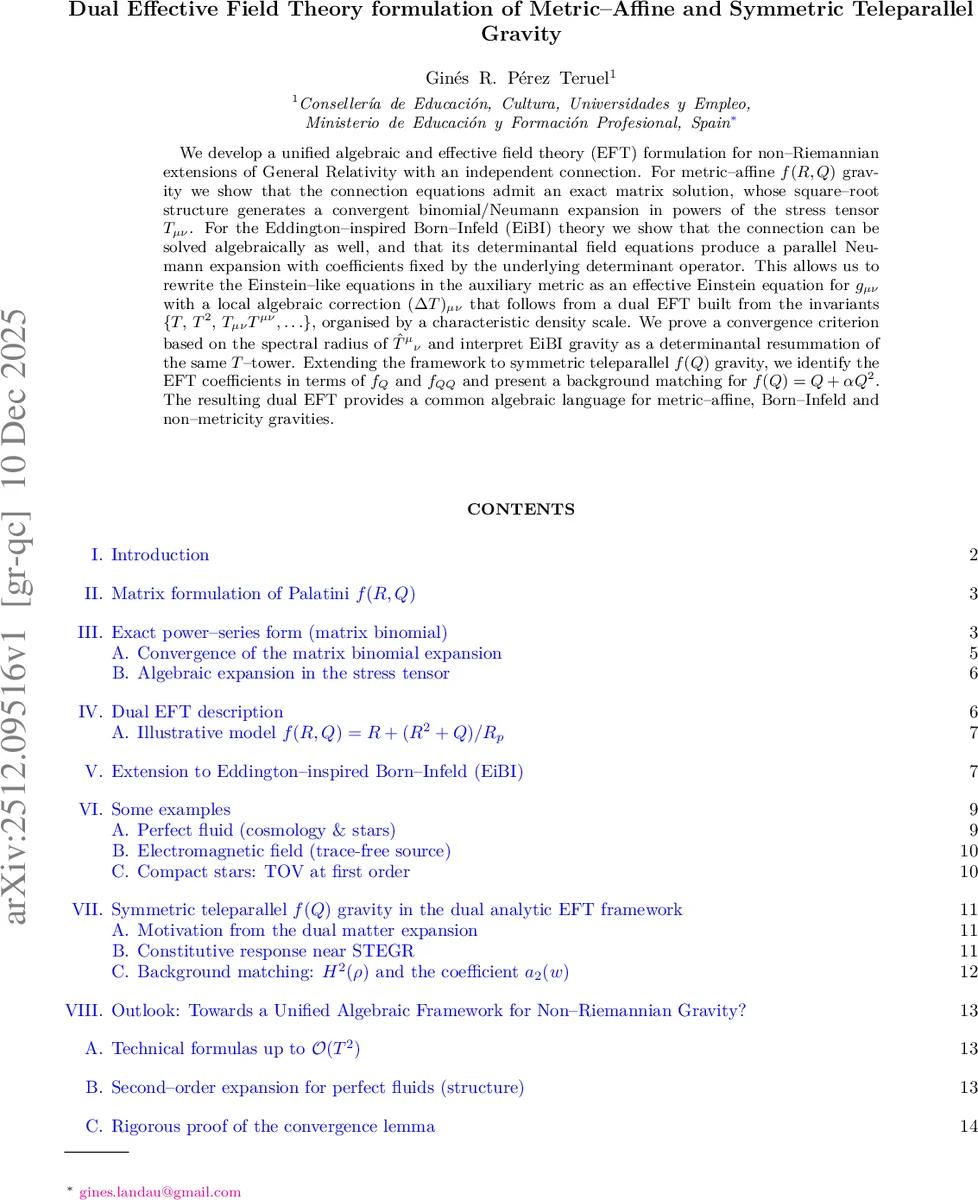
We develop a unified algebraic and effective field theory (EFT) formulation for non–Riemannian extensions of General Relativity with an independent connection. For metric–affine $f(R,Q)$ gravity we show that the connection equations admit an exact matrix solution, whose square–root structure generates a convergent binomial/Neumann expansion in powers of the stress tensor $T_{μν}$. For the Eddington–inspired Born–Infeld (EiBI) theory we show that the connection can be solved algebraically as well, and that its determinantal field equations produce a parallel Neumann expansion with coefficients fixed by the underlying determinant operator. This allows us to rewrite the Einstein–like equations in the auxiliary metric as an effective Einstein equation for $g_{μν}$ with a local algebraic correction $(ΔT){μν}$ that follows from a dual EFT built from the invariants ${T,,T^2,,T{μν}T^{μν},\ldots}$, organised by a characteristic density scale. We prove a convergence criterion based on the spectral radius of $\hat T^μ_ν$ and interpret EiBI gravity as a determinantal resummation of the same $T$–tower. Extending the framework to symmetric teleparallel $f(Q)$ gravity, we identify the EFT coefficients in terms of $f_Q$ and $f_{QQ}$ and present a background matching for $f(Q)=Q+αQ^2$. The resulting dual EFT provides a common algebraic language for metric–affine, Born–Infeld and non–metricity gravities.
💡 Research Summary
The paper presents a unified algebraic and effective‑field‑theory (EFT) framework for a broad class of non‑Riemannian extensions of General Relativity in which the metric and an independent affine connection are treated as separate dynamical variables. The authors focus on three families of theories: Palatini‑type metric‑affine $f(R,Q)$ gravity, the Eddington‑inspired Born‑Infeld (EiBI) model, and symmetric teleparallel $f(Q)$ gravity.
In the metric‑affine sector, variation of the action $S=\frac{1}{2\kappa^{2}}\int d^{4}x\sqrt{-g},f(R,Q)+S_{m}
Comments & Academic Discussion
Loading comments...
Leave a Comment