The Dirac and Rarita-Schwinger equations on scalar flat metrics of Taub-NUT type
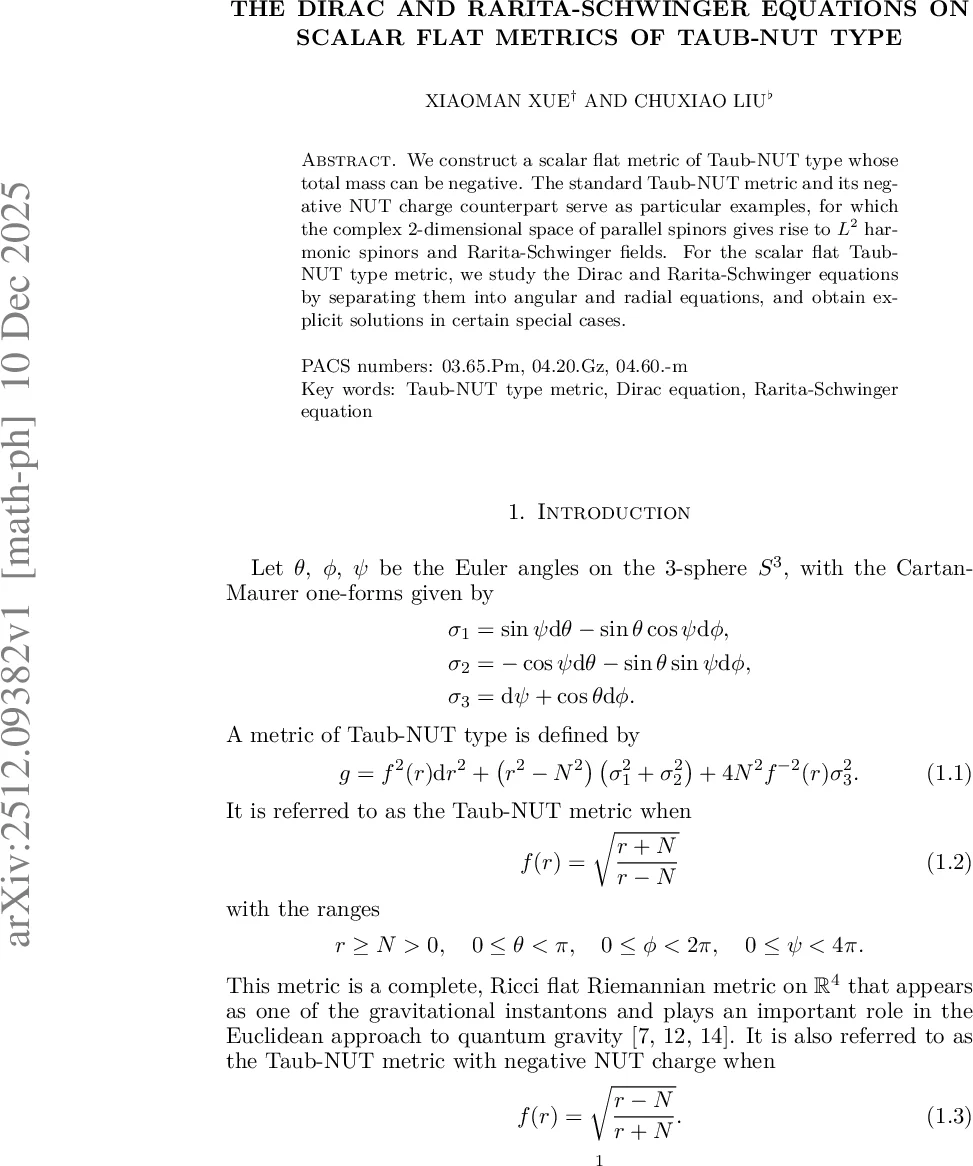
We construct a scalar flat metric of Taub-NUT type whose total mass can be negative. The standard Taub-NUT metric and its negative NUT charge counterpart serve as particular examples, for which the complex 2-dimensional space of parallel spinors gives rise to $L^2$ harmonic spinors and Rarita-Schwinger fields. For the scalar flat Taub-NUT type metric, we study the Dirac and Rarita-Schwinger equations by separating them into angular and radial equations, and obtain explicit solutions in certain special cases.
💡 Research Summary
The paper introduces a new class of four‑dimensional Riemannian metrics of Taub‑NUT type that are scalar‑flat but allow a negative total mass. Starting from the standard co‑frame on the three‑sphere, the authors define a metric
g = f²(r) dr² + (r² − N²)(σ₁² + σ₂²) + 4N² f⁻²(r) σ₃²,
where σ_i are the left‑invariant one‑forms on S³. Imposing the scalar‑flat condition R = 0 leads to a differential equation for f(r) whose general solution is
f(r) = √(r² − N²) / (r² − N² + C₁ r + C₂).
The constants C₁ and C₂ must satisfy C₁ ≥ −2N and −N² − N C₁ ≤ C₂ ≤ C₁²/4. For C₂ = −N² − N C₁ the metric is geodesically complete; otherwise a curvature singularity appears at r = N. Computing the ADM‑type mass yields E = −4 N C₁, which is negative when C₁ > 0, thereby providing an explicit counter‑example to the positivity‑of‑mass theorem in the context of Witten’s spinorial proof.
The authors then study spinor fields on this background. They write down the spin connection in the orthonormal frame and formulate the twistor equation ∇_k u = −¼ e_k·D u. Solving this system shows that non‑trivial twistor spinors exist only when f(r) reduces to the standard Taub‑NUT function (C₁ = ±2N, C₂ = N²) or its negative‑NUT‑charge counterpart. In these special cases the twistor spinors are actually parallel spinors, forming a complex two‑dimensional space. Explicit expressions for the parallel spinors are given in equations (3.12) and (3.13).
Using these parallel spinors, the paper constructs L² harmonic spinors and Rarita‑Schwinger fields. Following the method of Açık and Ertem, a harmonic spinor can be written as Ψ = dφ·u or Ψ = F·u, where φ is a harmonic function and F a self‑dual Maxwell 2‑form. For the standard Taub‑NUT metric the resulting spinor is not square‑integrable, whereas for the negative‑NUT‑charge metric two distinct L² harmonic spinors are obtained (equations (4.4) and (4.5)). Similarly, L² Rarita‑Schwinger fields are built as σ = F·e_i·u⊗e_i or σ = ∇_{e_i}F·u⊗e_i, and their L² nature is verified.
The core analytical part concerns the Dirac and Rarita‑Schwinger equations on the general scalar‑flat Taub‑NUT metric. The Dirac operator D = e^k·∇_{e_k} is separated into angular and radial parts. The angular dependence is governed by SU(2) spherical harmonics, yielding eigenvalues λ_ℓ = ℓ(ℓ + 1). The radial equation for the zero‑mode (λ = 0) with the general f(r) (1.4) and C₂ > −N² − N C₁ can be integrated directly, producing explicit power‑law solutions that are L² on r > N. For non‑zero eigenvalues (λ ≠ 0) in the case f(r) = r/(r + N) (the standard Taub‑NUT), the radial ODE reduces to a confluent hypergeometric (Kummer) equation; solutions are expressed in terms of the Kummer function 1F1(a; b; z). Appropriate choices of parameters ensure square‑integrability at infinity.
The Rarita‑Schwinger equation is treated analogously. The field is represented as a 3/2‑spinor Ψ_i⊗e_i satisfying the projection condition e^i·Ψ_i = 0. After projecting the twisted Dirac operator onto the 3/2‑spinor bundle, the resulting equation again separates into angular and radial parts. The angular sector coincides with the Dirac case, while the radial sector yields the same type of ODEs: direct integration for λ = 0 and Kummer‑function solutions for λ ≠ 0. Explicit L² solutions are obtained for both the standard and negative‑NUT‑charge metrics.
In summary, the paper achieves three main results: (1) construction of a scalar‑flat Taub‑NUT‑type metric with potentially negative mass; (2) identification of parallel spinors and the consequent existence of L² harmonic spinors and Rarita‑Schwinger fields in the special Taub‑NUT and negative‑NUT cases; (3) complete separation of the Dirac and Rarita‑Schwinger equations on these backgrounds, with explicit analytic solutions in several parameter regimes, including those expressed via confluent hypergeometric functions. These findings illuminate the interplay between geometry, spinor fields, and energy conditions, and suggest that Witten’s spinorial proof of the positive‑energy theorem does not extend to scalar‑flat manifolds with negative mass.
Comments & Academic Discussion
Loading comments...
Leave a Comment