389.3-Tb/s 1017-km C-band Transmission over Field-Installed 12-Coupled-Core Fiber Cable with >12-Tb/s Spatial MIMO Channels
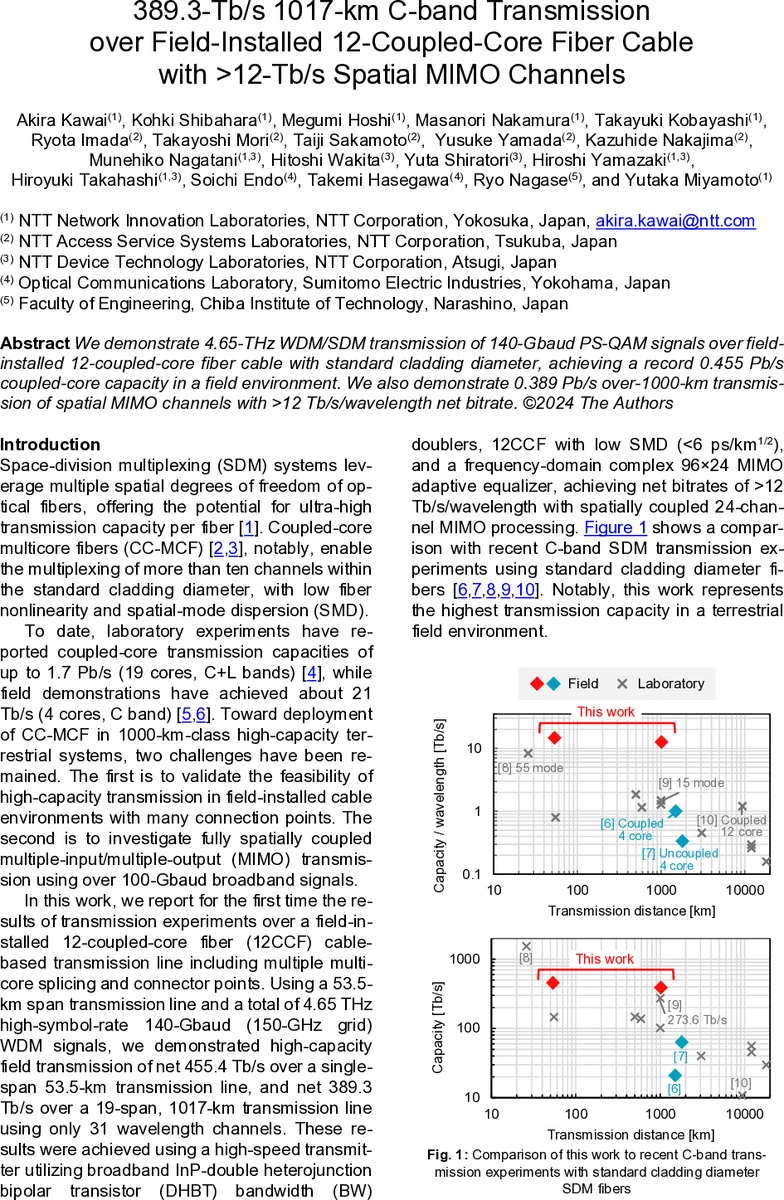
We demonstrate 4.65-THz WDM/SDM transmission of 140-Gbaud PS-QAM signals over field-installed 12-coupled-core fiber cable with standard cladding diameter, achieving a record 0.455 Pb/s coupled-core capacity in a field environment. We also demonstrate 0.389 Pb/s over-1000-km transmission of spatial MIMO channels with >12 Tb/s/wavelength net bitrate.
💡 Research Summary
This paper presents a landmark field‑deployed demonstration of space‑division multiplexing (SDM) using a 12‑core coupled‑core fiber (12CCF) to achieve unprecedented transmission capacities over both short (53.5 km) and ultra‑long (1017 km) distances. The authors generated 140 GBaud probabilistically shaped 36‑QAM (PS‑36QAM) signals with a 2‑dimensional entropy of 4.688 bits/symbol, placed on a 4.65 THz wavelength‑division multiplexed (WDM) grid comprising 31 channels spaced at 150 GHz. The signals were launched into a field‑installed cable consisting of a 4.86 km length of standard‑cladding 12‑core fiber, which includes a 0.2 km aerial segment and roughly 4.1 km of underground tunnel, with 15 splice points and SC‑type connectors per span. By interconnecting 11 fibers in series, the authors built a 53.5 km transmission line that was recirculated 19 times to emulate a total distance of 1017 km.
Key physical parameters include a fiber attenuation of 0.176 dB/km (excluding fan‑in/fan‑out), an average splice/connector loss of 0.12 dB, and a spatial mode dispersion (SMD) of less than 6 ps/√km across the entire C‑band (average 5.3 ps/√km). Input power was set to 20 dBm per core (total 30.8 dBm). Amplification and gain flattening were provided by EDFAs and wavelength‑selective switches (WSS) placed before and after each span.
At the receiver, a single high‑speed coherent front‑end (70 GHz balanced photodiodes and a 70 GHz oscilloscope) captured the combined 12‑core signal, which was then demultiplexed in time using an SDM‑TDM converter (acousto‑optic modulators and delay lines). Offline digital signal processing (DSP) performed chromatic‑dispersion compensation, followed by a 96 × 24 complex‑domain MIMO adaptive equalizer (FFT size 2048) to jointly recover the 24 spatial‑polarization channels (12 cores × 2 polarizations). Forward error correction (FEC) was applied across all spatial streams to mitigate mode‑dependent loss (MDL).
Performance results are striking. For the single‑span 53.5 km link, each wavelength achieved an average net bitrate of 14.69 Tb/s, yielding a total net capacity of 455.4 Tb/s (0.455 Pb/s). Over the 19‑span (1017 km) link, the average net bitrate per wavelength was 12.55 Tb/s, for a total net capacity of 389.3 Tb/s (0.389 Pb/s). The measured impulse‑response width (memory length) remained low (≈2.1 ns for 1 span, ≈1.70 ns for 19 spans) and exhibited a √distance scaling consistent with strong coupling theory. The rms MDL was stable at ~2 dB, with a per‑km increase of only 0.35 dB, and both metrics showed negligible drift over a 1‑hour, 428 km test (standard deviations 0.04 ns and 0.07 dB).
These findings demonstrate that (1) high‑capacity SDM transmission is feasible in a realistic field‑installed cable with numerous splices and connectors, (2) broadband 140 GBaud PS‑QAM combined with wide‑band WDM can deliver >12 Tb/s per wavelength even after >1000 km, (3) a 96 × 24 MIMO equalizer can efficiently untangle 24 spatial streams with modest computational complexity, and (4) the system exhibits robust temporal stability, essential for commercial deployment.
The authors conclude that the demonstrated 0.389 Pb/s over 1017 km and 0.455 Pb/s over 53.5 km set new records for terrestrial SDM systems using standard‑cladding fibers, paving the way toward petabit‑class backbone networks where each core can support >10 Tb/s. Future work will focus on improving power efficiency, scaling to higher‑core-count fibers (e.g., 19‑core), and integrating real‑time DSP to transition the technology from laboratory proof‑of‑concept to operational telecom infrastructure.
Comments & Academic Discussion
Loading comments...
Leave a Comment