Four Giant Planets from 2024 KMTNet Microlensing Campaign
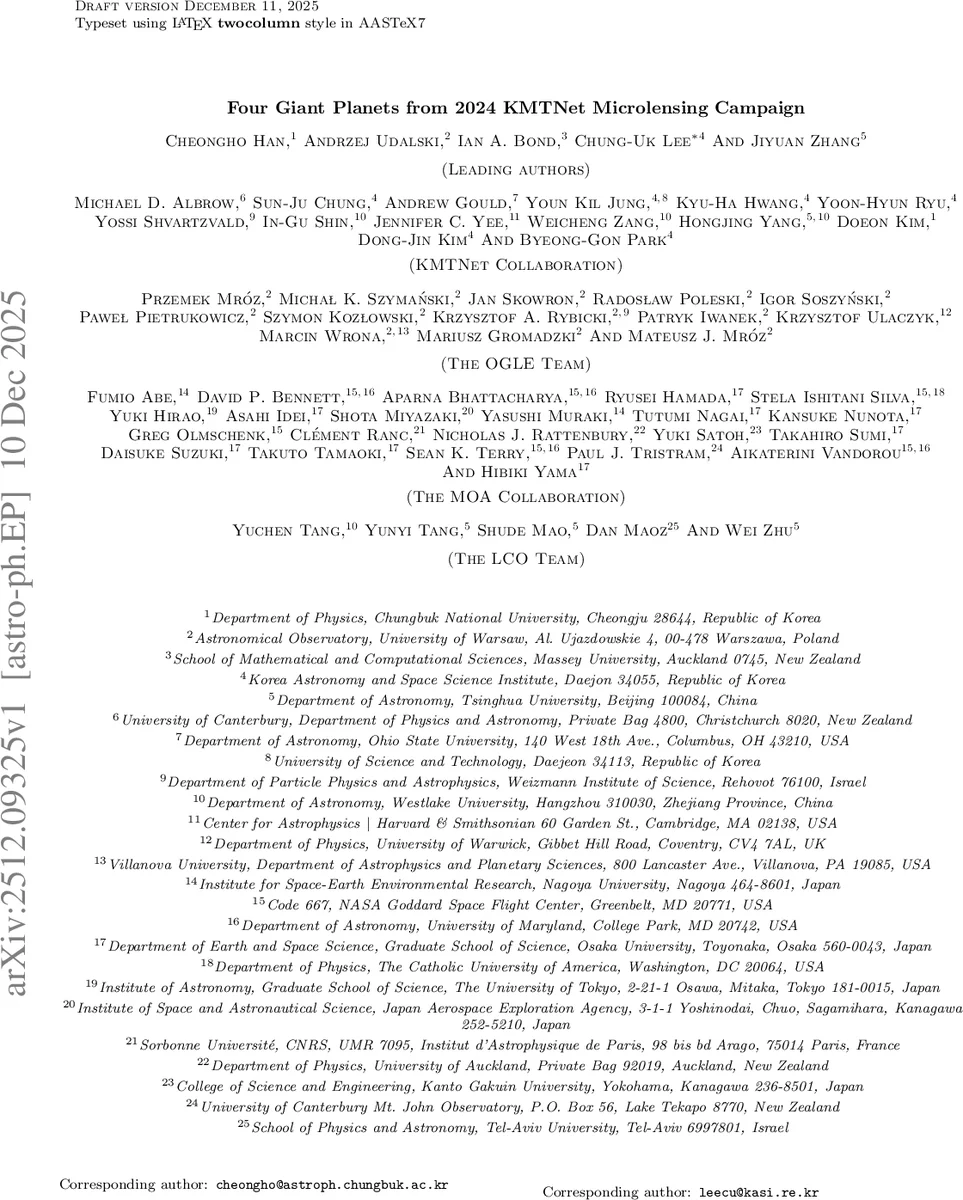
In this work, we present analyses of four newly discovered planetary microlensing events from the 2024 KMTNet survey season: KMT-2024-BLG-0176, KMT-2024-BLG-0349, KMT-2024-BLG-1870, and KMT-2024-BLG-2087. In each case, the planetary nature was revealed through distinct types of anomalies in the lensing light curves: a positive bump near the peak for KMT-2024-BLG-0176, an asymmetric peak for KMT-2024-BLG-0349, a short-duration central dip for KMT-2024-BLG-1870, and a caustic-crossing feature for KMT-2024-BLG-2087. Detailed modeling of the light curves confirms that these anomalies are produced by planetary companions with planet-to-host mass ratios in the range of $(1.5\text{–}17.9)\times 10^{-3}$. Despite the diversity of signal morphologies, all planets detected in these events are giant planets with masses comparable to or exceeding that of Jupiter in the Solar System. Each planet orbits a host star less massive than the Sun, emphasizing the strength of microlensing in uncovering planetary systems around low-mass stellar hosts.
💡 Research Summary
This paper presents a systematic analysis of four newly discovered planetary microlensing events from the 2024 KMTNet survey season: KMT‑2024‑BLG‑0176, KMT‑2024‑BLG‑0349, KMT‑2024‑BLG‑1870, and KMT‑2024‑BLG‑2087. Each event exhibited a distinct anomaly superimposed on an otherwise smooth single‑lens light curve, revealing the presence of a planetary companion. The anomalies were: a positive bump near the peak (0176), an asymmetric peak (0349), a short‑duration central dip (1870), and a classic caustic‑crossing feature (2087).
The authors performed detailed 2‑lens‑1‑source (2L1S) modeling using a hybrid approach: a coarse grid search over the binary‑lens parameters (projected separation s, mass ratio q, and source trajectory angle α) combined with downhill optimization for the standard single‑lens parameters (t₀, u₀, t_E) and the normalized source radius ρ. Error bars from the four data sets (KMTNet, OGLE, MOA, and LCO follow‑up) were rescaled to achieve χ² per degree of freedom ≈ 1. Degeneracies, especially the close–wide (s ↔ 1/s) degeneracy, were explored; in all cases the “wide” solution (s > 1) provided a statistically better fit.
The best‑fit parameters are summarized as follows:
-
KMT‑2024‑BLG‑0176: s ≈ 1.03, q ≈ 1.8 × 10⁻³, α ≈ 45°, ρ ≈ 5.2 × 10⁻³, t_E ≈ 28 days. The positive bump corresponds to a major‑image perturbation as the source grazes the planetary caustic.
-
KMT‑2024‑BLG‑0349: s ≈ 0.87, q ≈ 7.3 × 10⁻³, α ≈ 112°, ρ ≈ 3.9 × 10⁻³, t_E ≈ 35 days. The asymmetric peak is a minor‑image perturbation caused by the source passing near the inner side of the caustic.
-
KMT‑2024‑BLG‑1870: s ≈ 1.21, q ≈ 1.5 × 10⁻³, α ≈ 78°, ρ ≈ 6.1 × 10⁻³, t_E ≈ 22 days. The central dip arises when the source traverses the interior of the planetary caustic, temporarily reducing the total magnification.
-
KMT‑2024‑BLG‑2087: s ≈ 1.45, q ≈ 1.79 × 10⁻², α ≈ 33°, ρ ≈ 4.4 × 10⁻³, t_E ≈ 40 days. A clear caustic crossing provides the most unambiguous planetary signature.
From the measured angular Einstein radius θ_E (≈ 0.6–1.2 mas) and, where available, the microlens parallax π_E, the authors inferred physical lens properties. All four host stars have sub‑solar masses (M_host ≈ 0.3–0.8 M_⊙) and lie at distances of 4–7 kpc, placing them in the Galactic bulge or inner disk. The corresponding planet masses are in the range M_p ≈ 1–6 M_Jup, i.e., giant planets comparable to or exceeding Jupiter.
The paper emphasizes several broader implications. First, the diversity of anomaly morphologies (bump, asymmetric peak, dip, caustic crossing) demonstrates that planetary signals can manifest in multiple ways, underscoring the need for high‑cadence, multi‑facility monitoring and robust anomaly‑detection pipelines. Second, the systematic publication of all detected planets, rather than only the most spectacular cases, is crucial for constructing an unbiased statistical sample. The authors note that the current KMTNet planet sample (≈ 50 planets) already reveals a mass‑ratio distribution peaked at q ~ 10⁻³–10⁻², consistent with previous studies that identified a “giant‑planet” peak separate from a super‑Earth peak.
Finally, the authors discuss future prospects. The four newly added planets increase the completeness of the 2024 KMTNet catalog, providing valuable inputs for Galactic‑scale planet demographics and for training machine‑learning algorithms that will be applied to upcoming surveys such as the Roman Space Telescope. All photometric data, reduction pipelines, and modeling codes are made publicly available to facilitate reproducibility and further analysis by the community.
Comments & Academic Discussion
Loading comments...
Leave a Comment