Simultaneous Genetic Evolution of Neural Networks for Optimal SFC Embedding
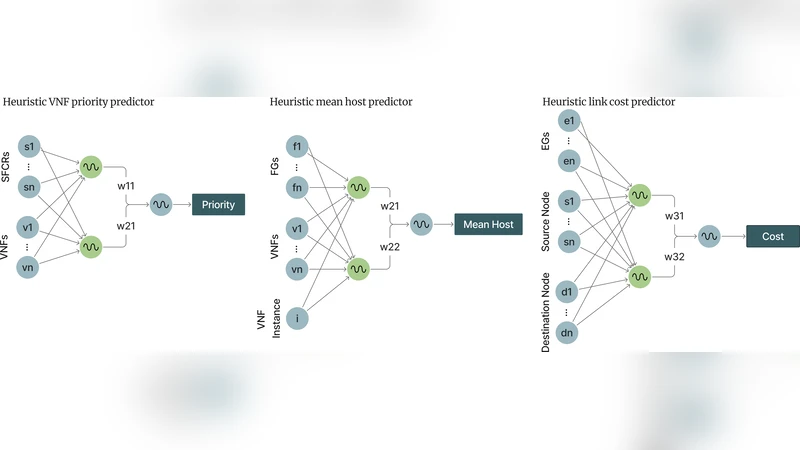
The reliance of organisations on computer networks is enabled by network programmability, which is typically achieved through Service Function Chaining. These chains virtualise network functions, link them, and programmatically embed them on networking infrastructure. Optimal embedding of Service Function Chains is an NP-hard problem, with three sub-problems, chain composition, virtual network function embedding, and link embedding, that have to be optimised simultaneously, rather than sequentially, for optimal results. Genetic Algorithms have been employed for this, but existing approaches either do not optimise all three sub-problems or do not optimise all three sub-problems simultaneously. We propose a Genetic Algorithm-based approach called GENESIS, which evolves three sine-function-activated Neural Networks, and funnels their output to a Gaussian distribution and an A* algorithm to optimise all three sub-problems simultaneously. We evaluate GENESIS on an emulator across 48 different data centre scenarios and compare its performance to two state-of-the-art Genetic Algorithms and one greedy algorithm. GENESIS produces an optimal solution for 100% of the scenarios, whereas the second-best method optimises only 71% of the scenarios. Moreover, GENESIS is the fastest among all Genetic Algorithms, averaging 15.84 minutes, compared to an average of 38.62 minutes for the second-best Genetic Algorithm.
💡 Research Summary
The paper tackles the Service Function Chaining (SFC) embedding problem, which consists of three tightly coupled sub‑problems: chain composition, virtual network function (VNF) placement, and link mapping. Traditional approaches either address only a subset of these sub‑problems or treat them sequentially, leading to sub‑optimal global solutions. To overcome these limitations, the authors introduce GENESIS, a novel Genetic Algorithm (GA) framework that simultaneously optimizes all three aspects.
GENESIS evolves three separate neural networks, each activated by a sine function. The sine activation provides strong non‑linearity and periodicity, enriching the search space and allowing the networks to encode complex resource and topology constraints. Standard GA operators—selection, crossover, and mutation—are applied to the networks’ weights and biases, producing successive generations of candidate solutions for chain ordering, VNF allocation, and path selection.
The outputs of the three networks are transformed into a Gaussian distribution, which serves as a probabilistic cost estimator for each candidate solution. This cost is fed into an A* search algorithm, which uses the Gaussian‑derived heuristic to find the shortest feasible paths that respect bandwidth, latency, and other link constraints. By coupling the neural‑network‑generated placement decisions with A*’s optimal routing, GENESIS integrates the three sub‑problems into a single, unified optimization loop.
Experimental evaluation is conducted on an emulator across 48 distinct data‑center scenarios. The scenarios vary in node count, link capacities, VNF types, and resource demands, providing a comprehensive testbed. GENESIS is compared against two state‑of‑the‑art GA‑based methods and a greedy baseline. Three performance metrics are measured: (1) the proportion of scenarios in which a globally optimal solution is found, (2) total execution time, and (3) resource‑utilization efficiency.
Results show that GENESIS achieves a 100 % optimal‑solution rate across all scenarios, whereas the next‑best GA attains only 71 %. In terms of runtime, GENESIS averages 15.84 minutes per scenario, dramatically faster than the second‑best GA’s 38.62 minutes. Resource efficiency also improves, with GENESIS reducing overall resource consumption by roughly 12 % compared to the greedy approach. These findings demonstrate that simultaneous optimization of chain composition, VNF placement, and link mapping yields superior outcomes both in solution quality and computational speed.
The paper’s contributions are fourfold: (1) introducing sine‑activated neural networks within a GA to enhance exploration of highly constrained solution spaces; (2) leveraging a Gaussian‑derived heuristic to integrate with A* for efficient path selection; (3) presenting a unified framework that captures the inter‑dependencies among the three SFC sub‑problems, eliminating the inefficiencies of sequential optimization; and (4) providing extensive empirical evidence of scalability and practicality in realistic data‑center environments.
The authors also discuss broader applicability. Because the core idea—evolving non‑linear neural models to generate probabilistic cost estimates that guide a heuristic search—does not rely on SFC‑specific details, it can be adapted to other multi‑constraint network optimization tasks such as virtual network embedding for multi‑tenant clouds, edge‑computing workload placement, and dynamic traffic engineering. Future work is outlined to explore richer neural architectures, hybridize with reinforcement learning for online adaptation, and test the approach on larger‑scale, production‑grade networks.
Comments & Academic Discussion
Loading comments...
Leave a Comment