SITP: A High-Reliability Semantic Information Transport Protocol Without Retransmission for Semantic Communication
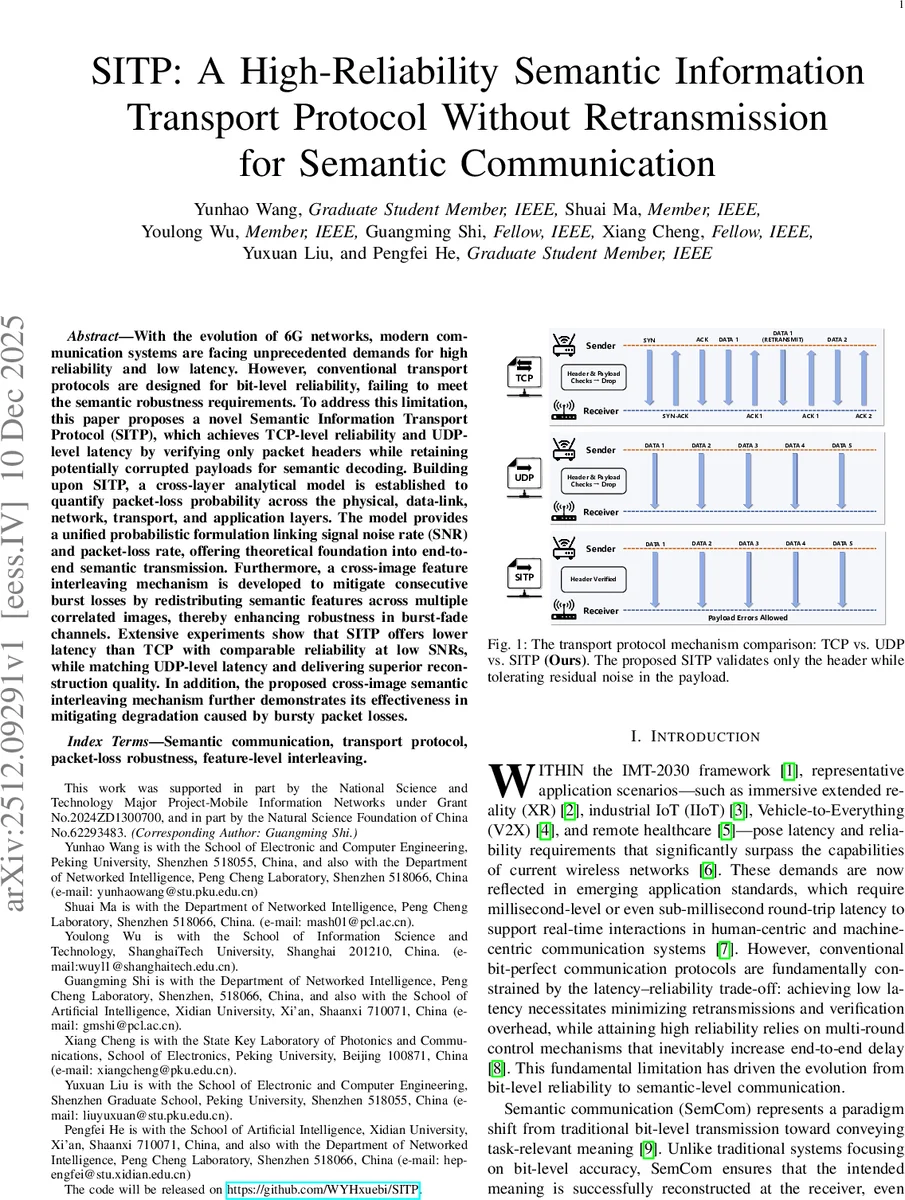
With the evolution of 6G networks, modern communication systems are facing unprecedented demands for high reliability and low latency. However, conventional transport protocols are designed for bit-level reliability, failing to meet the semantic robustness requirements. To address this limitation, this paper proposes a novel Semantic Information Transport Protocol (SITP), which achieves TCP-level reliability and UDP level latency by verifying only packet headers while retaining potentially corrupted payloads for semantic decoding. Building upon SITP, a cross-layer analytical model is established to quantify packet-loss probability across the physical, data-link, network, transport, and application layers. The model provides a unified probabilistic formulation linking signal noise rate (SNR) and packet-loss rate, offering theoretical foundation into end-to-end semantic transmission. Furthermore, a cross-image feature interleaving mechanism is developed to mitigate consecutive burst losses by redistributing semantic features across multiple correlated images, thereby enhancing robustness in burst-fade channels. Extensive experiments show that SITP offers lower latency than TCP with comparable reliability at low SNRs, while matching UDP-level latency and delivering superior reconstruction quality. In addition, the proposed cross-image semantic interleaving mechanism further demonstrates its effectiveness in mitigating degradation caused by bursty packet losses.
💡 Research Summary
This paper proposes a novel Semantic Information Transport Protocol (SITP) designed to overcome the fundamental latency-reliability trade-off in conventional protocols for semantic communication (SemCom). Recognizing that TCP’s retransmission mechanisms incur high latency and UDP’s discarding of entire packets upon checksum failure wastes semantically valuable information, SITP introduces a paradigm shift. Its core innovation is to restrict error detection (e.g., CRC) to only the packet header at the data-link layer, while allowing potentially corrupted payloads to be passed up to the application layer. This enables the semantic decoder at the receiver to exploit the inherent robustness of deep learning models to extract and reconstruct meaningful information from noisy payloads, eliminating the need for retransmissions. Consequently, SITP achieves TCP-level reliability with UDP-level latency.
Building upon the SITP architecture, the authors establish a comprehensive cross-layer analytical model to quantify end-to-end packet loss probability. The model integrates impairments across the physical, data-link, network, transport, and application layers into a unified probabilistic framework. It provides a closed-form formulation linking the physical-layer Signal-to-Noise Ratio (SNR) to the final semantic feature segment loss rate at the application layer. This model offers a crucial theoretical tool for analyzing and optimizing the performance of practical digital SemCom systems, moving beyond the common physical-layer-only abstraction in prior work.
To further enhance robustness against consecutive packet losses—a common scenario in burst-fade channels—the paper proposes a cross-image feature-level interleaving mechanism. Instead of interleaving semantic features within a single image, this technique redistributes feature elements across multiple correlated images (e.g., video frames) before packetization. When a burst loss occurs, the damage is spread across several images rather than being concentrated in one, preventing a complete semantic collapse of any single frame. The decoder can then leverage spatio-temporal correlations between frames to better recover the lost information, significantly improving reconstruction quality under bursty loss conditions.
Extensive experimental results validate the effectiveness of the proposed solutions. SITP demonstrates significantly lower latency than TCP while maintaining comparable reliability, especially at low SNRs. Compared to UDP, it achieves similar ultra-low latency but delivers far superior reconstruction quality (measured by PSNR and SSIM) by preserving and utilizing noisy payloads. Furthermore, the cross-image semantic interleaving scheme is shown to substantially mitigate performance degradation caused by burst packet losses, outperforming traditional intra-image interleaving methods. The work provides a holistic and practical framework for implementing high-reliability, low-latency semantic communication in future networks.
Comments & Academic Discussion
Loading comments...
Leave a Comment