ROI-Packing: Efficient Region-Based Compression for Machine Vision
This paper introduces ROI-Packing, an efficient image compression method tailored specifically for machine vision. By prioritizing regions of interest (ROI) critical to end-task accuracy and packing them efficiently while discarding less relevant data, ROI-Packing achieves significant compression efficiency without requiring retraining or fine-tuning of end-task models. Comprehensive evaluations across five datasets and two popular tasks-object detection and instance segmentation-demonstrate up to a 44.10% reduction in bitrate without compromising end-task accuracy, along with an 8.88 % improvement in accuracy at the same bitrate compared to the state-of-the-art Versatile Video Coding (VVC) codec standardized by the Moving Picture Experts Group (MPEG).
💡 Research Summary
This paper introduces “ROI-Packing,” a novel image compression framework explicitly designed for machine vision tasks rather than human perception. The core premise is that for automated analysis—such as object detection or instance segmentation—preserving every visual detail is unnecessary. Instead, the method focuses on efficiently encoding only the Regions of Interest (ROIs) critical to the end-task’s accuracy while discarding irrelevant background data, all without requiring retraining or fine-tuning of the existing deep learning models.
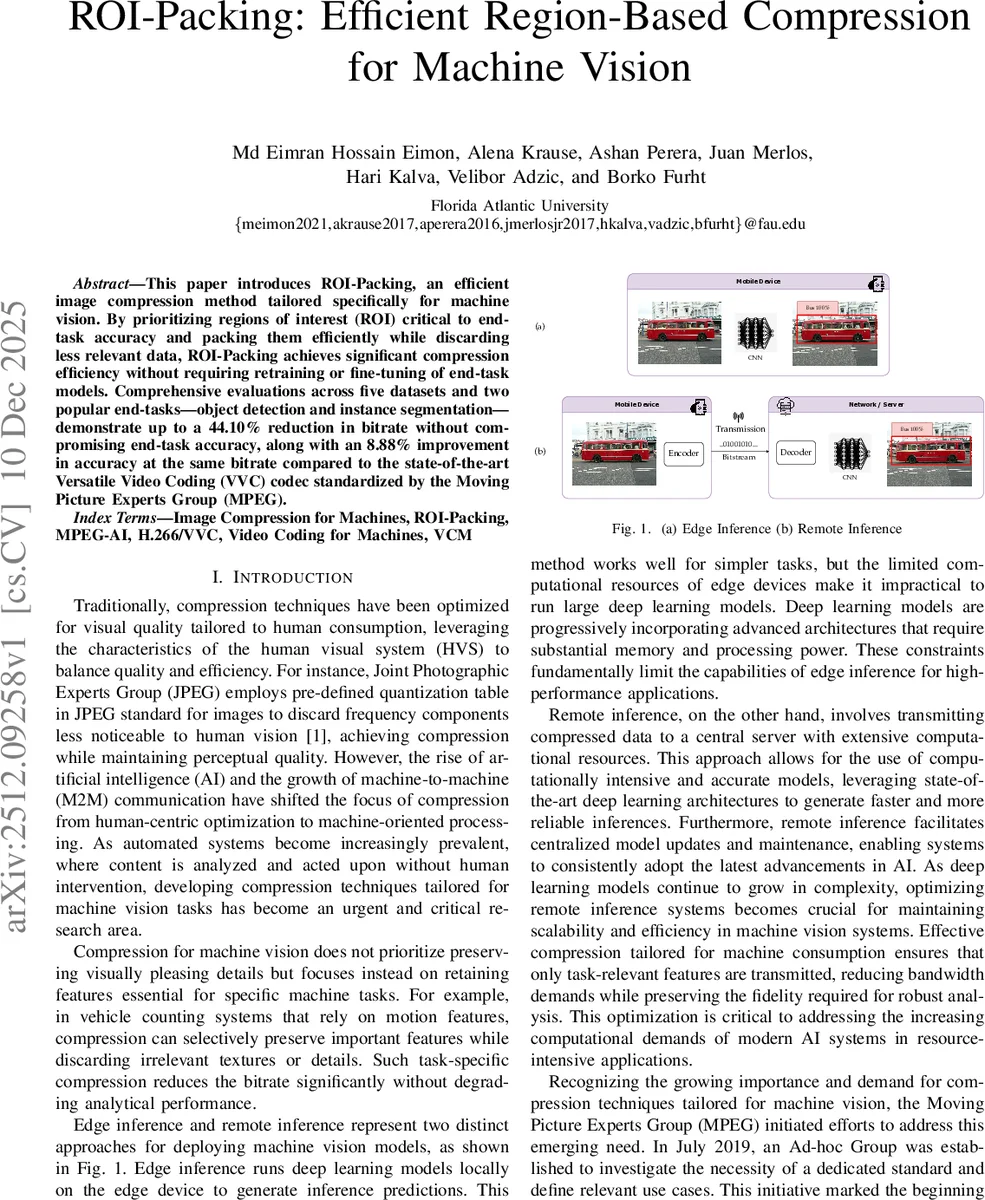
The proposed encoder pipeline involves several key steps. First, a Region Detector (e.g., YOLOv7) identifies bounding boxes for objects relevant to the end-task. These regions are then padded to include contextual information. A Top-down Region Extractor merges overlapping areas into a minimal convex polygon, aligns it to a coding-friendly grid, and splits it into rectangular sub-boxes. Some regions may be adaptively down-scaled (Region Scaling) for further bitrate savings. Crucially, all processed ROIs are efficiently assembled into a single, smaller composite image using a Bin Packing algorithm, which optimizes spatial layout to minimize empty space. This packed image is finally compressed using the state-of-the-art Versatile Video Coding (VVC) standard. Metadata describing the original positions, sizes, and scale factors of each ROI is multiplexed into the bitstream. The decoder simply reverses the process: it decodes the packed frame using VVC, extracts each ROI using the metadata, up-scales them if needed, and places them back into their original positions within a full-frame canvas (with black background) for input to the end-task network.
The evaluation rigorously follows the Common Test Conditions (CTC) and framework established by MPEG for Video Coding for Machines (VCM). Experiments span five datasets (including infrared and RGB) and two tasks—object detection (using Faster R-CNN) and instance segmentation (using Mask R-CNN)—across multiple compression levels (QPs) and input image sizes. The proposed method is compared against a remote inference anchor, where the full image is compressed using VVC.
Results demonstrate significant improvements. Measured in BD-Rate, ROI-Packing consistently requires fewer bits than the anchor to achieve the same end-task accuracy, with bitrate reductions of up to 44.10%. Conversely, at equivalent bitrates, it improves task accuracy (BD-mAP) by up to 8.88%. These findings validate that selectively preserving and efficiently packing task-critical regions can outperform compressing the entire image, even when using the same advanced VVC codec. The work positions ROI-Packing as a practical and effective contribution to the emerging field of machine-oriented compression, addressing the growing need for bandwidth efficiency in remote inference scenarios for AI systems.
Comments & Academic Discussion
Loading comments...
Leave a Comment