The three kinds of three-qubit entanglement
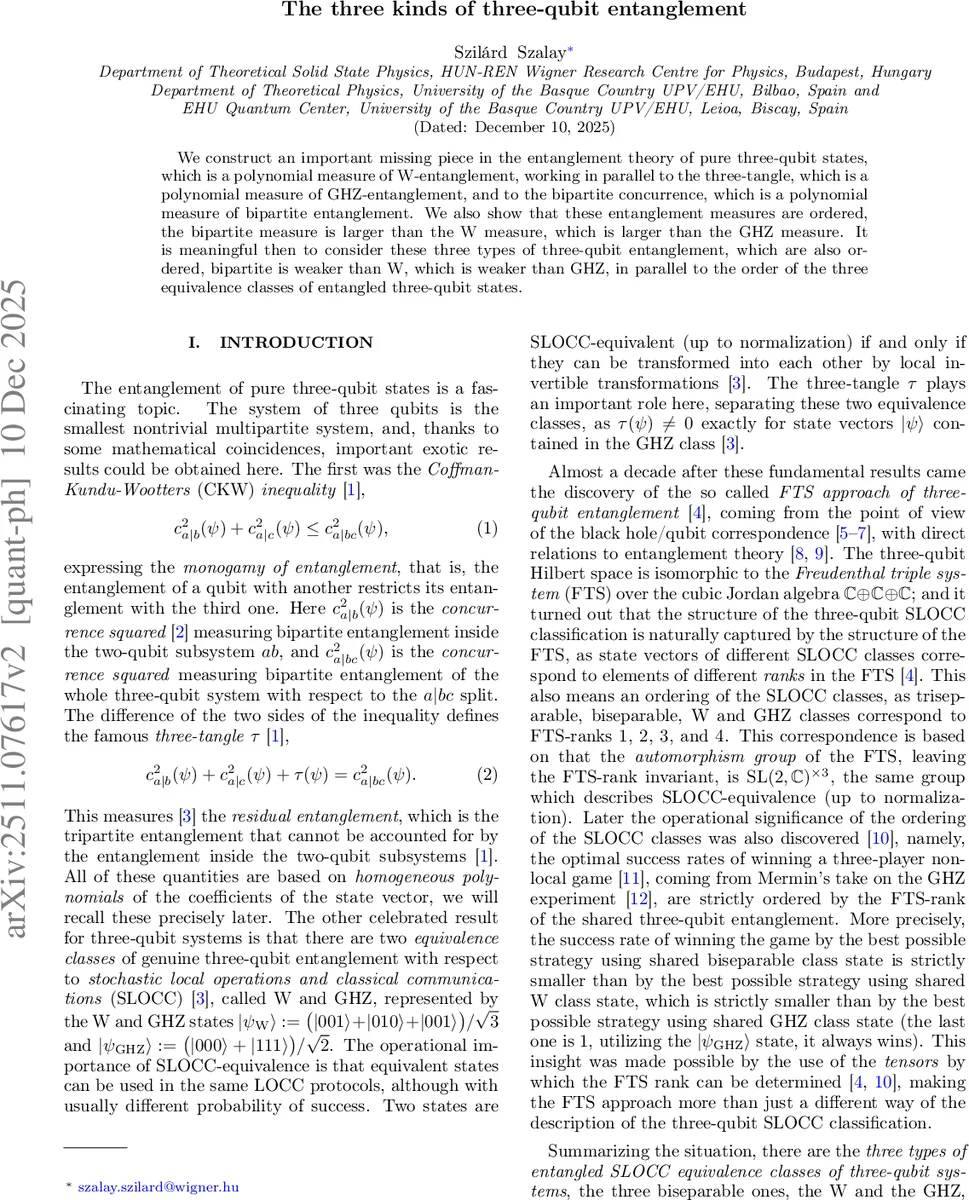
We construct an important missing piece in the entanglement theory of pure three-qubit states, which is a polynomial measure of W-entanglement, working in parallel to the three-tangle, which is a polynomial measure of GHZ-entanglement, and to the bipartite concurrence, which is a polynomial measure of bipartite entanglement. We also show that these entanglement measures are ordered, the bipartite measure is larger than the W measure, which is larger than the GHZ measure. It is meaningful then to consider these three types of three-qubit entanglement, which are also ordered, bipartite is weaker than W, which is weaker than GHZ, in parallel to the order of the three equivalence classes of entangled three-qubit states.
💡 Research Summary
The study of entanglement in multi-qubit systems is a cornerstone of quantum information science, particularly as we move beyond the relatively simple bipartite systems. In three-qubit systems, entanglement manifests in distinct, non-interchangeable forms, categorized into specific equivalence classes under Stochastic Local Operations and Classical Communication (SLOCC). While the scientific community had previously established polynomial measures for certain types of entanglement—specifically the ’three-tangle’ for GHZ-type entanglement and ‘bipartite concurrence’ for bipartite entanglement—a critical piece of the puzzle was missing: a polynomial measure capable of quantifying W-type entanglement.
This paper successfully addresses this theoretical gap by constructing a new polynomial measure for W-entanglement. The authors present a complete set of polynomial measures that work in parallel to describe the full spectrum of pure three-qubit entanglement. The significance of this work extends beyond mere measurement; it reveals a profound structural hierarchy within quantum entanglement. The researchers demonstrate that these three entanglement measures are not independent but are strictly ordered. Specifically, the magnitude of bipartite entanglement is greater than or equal to that of W-entanglement, which in turn is greater than or equal to that of GHZ-entanglement.
Crucially, this mathematical ordering of measures mirrors the physical ordering of the three equivalence classes of three-qubit entanglement. This alignment between the quantitative measures and the qualitative classes provides a unified framework for understanding the complexity of multi-qubit states. By establishing that the hierarchy of entanglement strength (Bipartite $\ge$ W $\ge$ GHZ) corresponds to the hierarchy of entanglement types, the paper provides a rigorous foundation for the classification of quantum resources.
The implications of this discovery are far-reaching for the field of quantum computing and quantum communication. The ability to precisely quantify and order different types of entanglement allows for more sophisticated resource management in quantum networks. Furthermore, this theoretical advancement provides essential tools for developing more robust quantum error correction codes and optimizing quantum protocols that rely on specific entanglement architectures. This paper effectively completes a fundamental chapter in the entanglement theory of three-qubit pure states.
Comments & Academic Discussion
Loading comments...
Leave a Comment