Group Representations of Lorentz Transformations Extended to Superluminal Observers
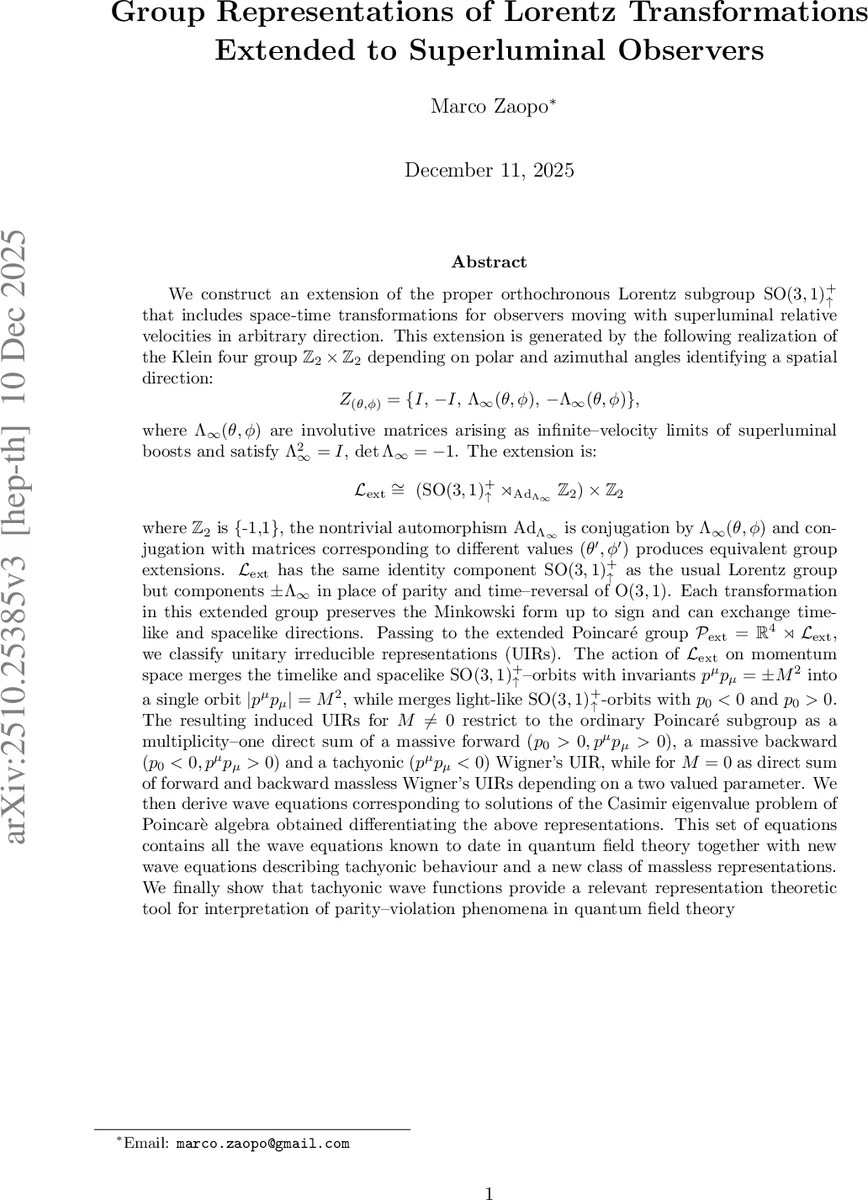
We construct an extension of the proper orthochronous Lorentz group that includes space-time transformations for observers moving with superluminal relative velocities in arbitrary direction. This extension is generated by a realization of the Klein four group depending on polar and azimuthal angles identifying a spatial direction and is obtained with matrices representing infinite velocity limits of superluminal Lorentz boosts. The resulting group has the same identity component of the whole Lorentz group O(3,1) but involutive operators corresponding to an infinite speed boost and its negative in place of parity and time reversal. Different spatial directions in the definition of Klein group realization give rise to equivalent group extensions. We then define the extended Poincare group including translations and classify its unitary irreducible representations (UIRs). The resulting UIRs are induced from Wigner’s UIRs of standard Poincare group and depend on the action of the extended Lorentz group defined on momentum space. UIRs corresponding to non lightlike orbits restrict to the ordinary Poincare subgroup as a multiplicity one direct sum of a massive forward, a massive backward and a tachyonic Wigner UIR while for lightlike orbits as two inequivalent direct sum representations combiningh linearly a forward and backward massless Wigner UIR. We then derive wave equations corresponding to solutions of the Casimir eigenvalue problem of Poincare algebra obtained differentiating the above representations. This set of equations contains all the wave equations known to date in quantum field theory together with new wave equations describing tachyonic behaviour and a new class of massless representations. We finally show that tachyonic wave functions provide a relevant representation theoretic tool for interpretation of parity violation phenomena in quantum field theory
💡 Research Summary
The paper presents a mathematically rigorous extension of the proper orthochronous Lorentz group that accommodates observers moving with superluminal relative velocities in any direction. The construction begins with the standard real‑matrix representation of subluminal Lorentz boosts ( \Lambda_s(\mathbf v) ) and introduces a parallel set of real matrices ( \Lambda_S(\mathbf V) ) for velocities ( |\mathbf V|>c ). These superluminal boosts are related to subluminal ones by the involutive map ( \mathbf V = c^{2}\mathbf v/|\mathbf v|^{2} ); consequently ( \Lambda_S(\mathbf V) ) flips the sign of the Minkowski metric while retaining determinant (-1).
Taking the limit ( |\mathbf V|\to\infty ) yields direction‑dependent involutive matrices ( \Lambda_{\infty}(\theta,\phi) ) that satisfy ( \Lambda_{\infty}^{2}=I ) and ( \det\Lambda_{\infty}=-1 ). The four elements ({I,-I,\Lambda_{\infty},-\Lambda_{\infty}}) form a Klein four‑group ( Z_{2}\times Z_{2} ). By adjoining this discrete group to the usual Lorentz group via a semidirect product (the non‑trivial automorphism being conjugation by ( \Lambda_{\infty} )), the author defines an extended Lorentz group \
Comments & Academic Discussion
Loading comments...
Leave a Comment