Anderson-type acceleration method for Deep Neural Network optimization
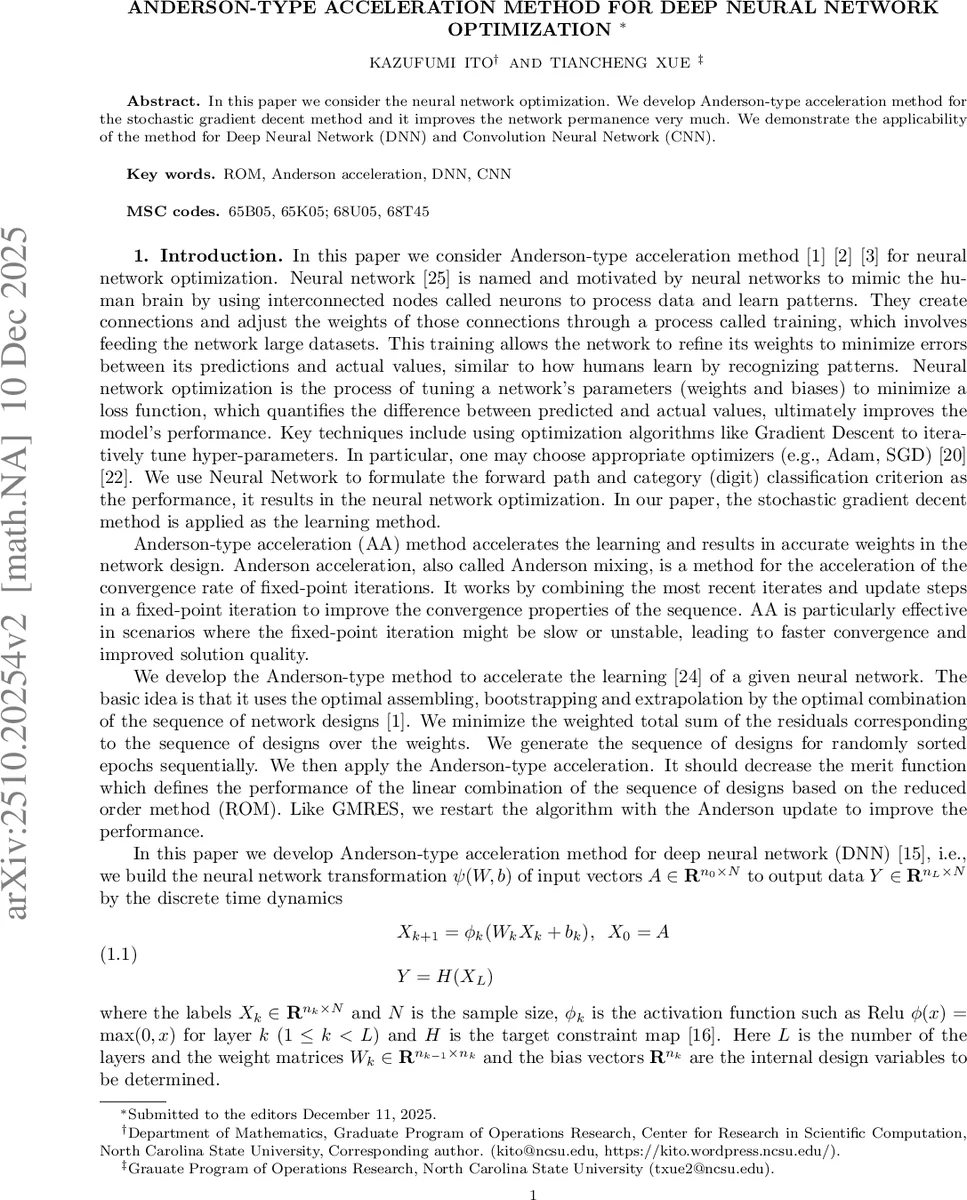
In this paper we consider the neural network optimization. We develop Anderson-type acceleration method for the stochastic gradient decent method and it improves the network permanence very much. We demonstrate the applicability of the method for Deep Neural Network (DNN) and Convolution Neural Network (CNN).
💡 Research Summary
The research presented in this paper addresses one of the most critical challenges in modern artificial intelligence: the efficient optimization of deep neural architectures. As deep learning models grow in complexity and parameter count, the reliance on Stochastic Gradient Descent (SGD) has become ubiquitous. However, despite its widespread use, SGD faces significant hurdles, including slow convergence rates in plateau regions and instability caused by the inherent noise of mini-batch sampling. To overcome these limitations, the authors propose an innovative optimization framework that integrates Anderson-type acceleration into the SGD process.
Anderson Acceleration (AA) is a well-established technique in numerical analysis, originally designed to accelerate the convergence of fixed-point iterations. The core mechanism of AA involves utilizing information from a sequence of previous iterates to construct a more accurate update step. By computing a linear combination of past residuals, the algorithm seeks to minimize the residual error in a subspace, effectively approximating the behavior of quasi-Newton methods without the prohibitive computational cost of calculating the Hessian matrix. The integration of this technique into the stochastic regime allows the optimizer to “smooth out” the stochastic noise and navigate the complex, non-convex loss landscapes of deep networks more effectively.
The paper demonstrates the practical utility of this method across two fundamental architectures: Deep Neural Networks (DNN) and Convolutional Neural Networks (CNN). A significant claim of the research is the substantial improvement in “network permanence,” which refers to the enhanced stability and robustness of the learning process and the resulting model performance. By applying Anderson-type acceleration, the researchers show that the optimization trajectory becomes more directed and less prone to the erratic oscillations typical of standard SGD.
The implications of this work are profound for the field of large-scale machine learning. As the industry moves toward training increasingly massive models, reducing the number of epochs required for convergence and improving the stability of the training process are paramount for reducing both time and computational expenditures. The proposed method provides a mathematically grounded, computationally efficient, and versatile solution that can be seamlessly integrated into existing deep learning pipelines. Ultimately, this research paves the way for more reliable and accelerated training of next-generation AI models, offering a robust tool for navigating the increasingly complex optimization landscapes of deep learning.
Comments & Academic Discussion
Loading comments...
Leave a Comment