Polka-dotted Stars II: Starspots and obliquities of Kepler-17 and Kepler-63
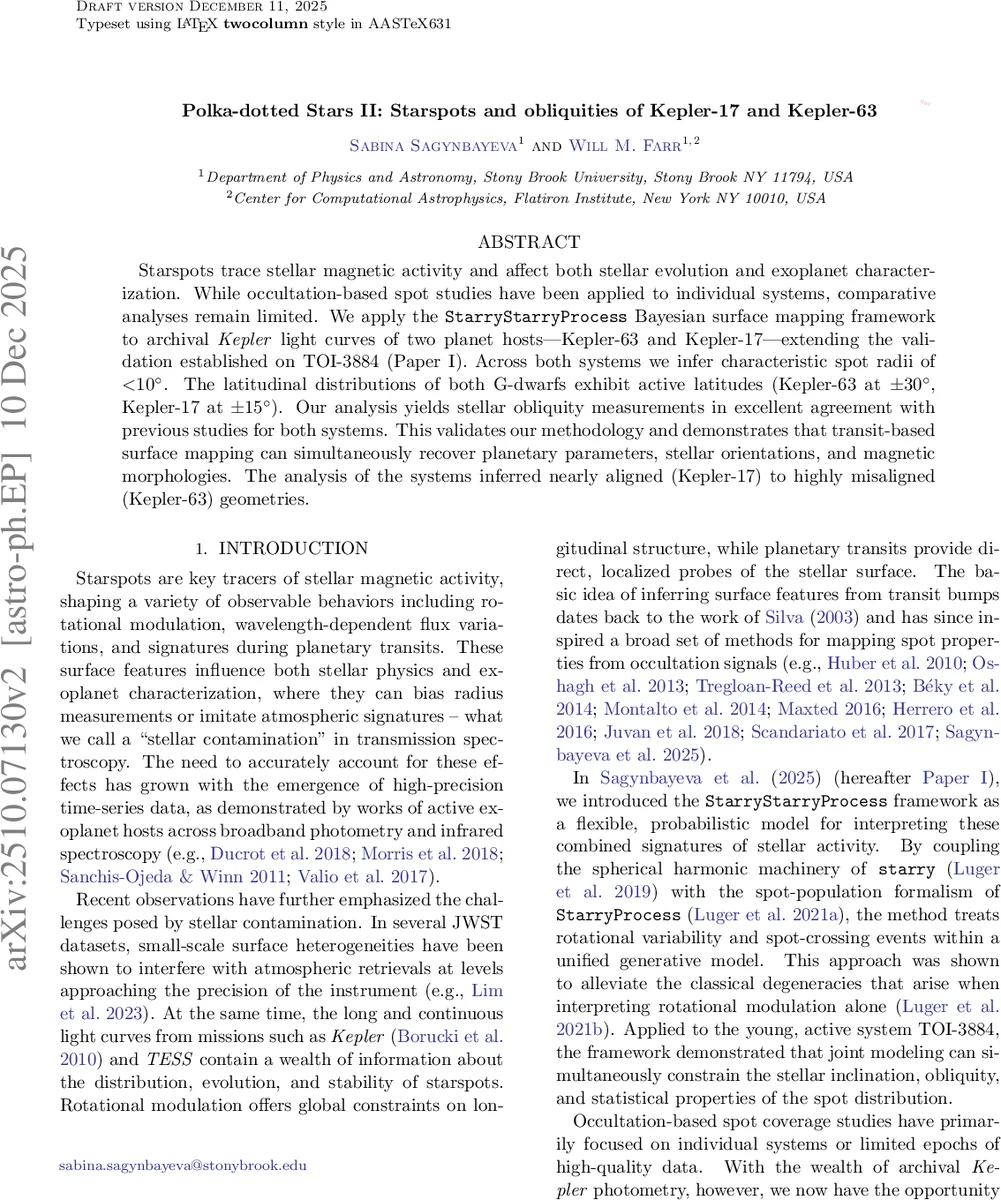
Starspots trace stellar magnetic activity and influence both stellar evolution and exoplanet characterization. While occultation-based spot analyses have been applied to individual systems, comparative studies remain limited. We apply the StarryStarryProcess Bayesian surface-mapping framework to archival Kepler light curves of two planet hosts, Kepler-63 and Kepler-17, extending the validation established on TOI-3884 (Paper I). Across both systems, we infer characteristic spot radii smaller than 10 degrees. The latitudinal spot distributions of these G dwarfs show active latitudes: Kepler-63 near 30 degrees and Kepler-17 near 15 degrees. Our analysis yields stellar obliquity measurements in excellent agreement with previous studies, validating our methodology and demonstrating that transit-based surface mapping can simultaneously recover planetary parameters, stellar orientations, and magnetic morphologies. Together, these results reveal a range of stellar geometries from nearly aligned (Kepler-17) to highly misaligned (Kepler-63).
💡 Research Summary
This paper presents a comprehensive Bayesian surface‑mapping analysis of two active Kepler planet‑hosting stars, Kepler‑63 and Kepler‑17, using the newly developed StarryStarryProcess framework. The method combines the spherical‑harmonic engine of the starry code with the statistical spot‑population model of StarryProcess, allowing simultaneous fitting of rotational modulation and transit‑spot occultation signals. By dividing each light curve into independent chunks of length half the stellar rotation period (P_rot/2), the authors capture spot evolution on timescales comparable to the rotation while keeping the inference tractable.
Key methodological innovations include the replacement of traditional contrast (c) and spot‑count (n) parameters with observable quantities: the fractional flux decrement d = n·c·(r/R★)², which measures the overall dimming caused by spots, and RMS_spot = d/√n, which quantifies the amplitude of rotational variability. This choice directly links model parameters to measurable photometric signatures, improving interpretability.
For Kepler‑63, an 80‑day representative segment was modeled with 200 MCMC samples. The posterior yields a mean spot radius of 10.02° (+0.03/‑0.02), consistent with earlier estimates but limited by the prior’s upper bound due to the finite spherical‑harmonic degree used. The flux decrement d peaks around 0.03–0.04, indicating that spots reduce the stellar flux by 3–4 % on average, while RMS_spot ≈ 0.009 reflects the strong rotational modulation. The latitude distribution shows two active bands centered at ±30°, suggesting a solar‑like butterfly pattern shifted to higher latitudes. The stellar obliquity is measured as ψ = 163.9° (+3.8/‑4.2), in excellent agreement with the previously reported value of 145° +9/‑14, confirming a highly misaligned system.
Kepler‑17 exhibits a markedly different magnetic geometry. Spot radii are smaller (≈ 8°), and the latitude distribution peaks near ±15°. The flux decrement is lower (d ≈ 0.02) and RMS_spot ≈ 0.006, indicating weaker variability. The derived obliquity ψ = 5.2° (+3.5/‑3.0) shows the planetary orbit is nearly aligned with the stellar equator. All fundamental system parameters (planetary radius, orbital period, stellar density, rotation period, etc.) agree with literature values within 1σ, validating the joint modeling approach.
The comparative analysis reveals that the younger, faster‑rotating Kepler‑63 hosts larger, higher‑latitude spots and a highly tilted spin‑orbit axis, whereas the older Kepler‑17 displays smaller, lower‑latitude spots and near‑alignment. These differences likely reflect evolutionary trends in stellar magnetic activity and angular‑momentum exchange during planet formation and migration.
The authors discuss limitations, notably the use of independent time chunks rather than a fully correlated Gaussian‑process prior on spherical‑harmonic coefficients, which would better enforce smooth temporal evolution but is computationally prohibitive at present. They also note that the spot‑radius posterior hits the prior limit, suggesting that higher‑order spherical harmonics would be needed for more precise size constraints.
In conclusion, the study demonstrates that StarryStarryProcess can robustly recover spot size distributions, active latitudes, and three‑dimensional stellar orientations from long‑baseline photometry, simultaneously refining planetary parameters. The framework offers a powerful tool for building comparative magnetic activity catalogs across exoplanet hosts and sets the stage for future extensions incorporating Gaussian‑process temporal regularization and application to the extensive Kepler and TESS datasets.
Comments & Academic Discussion
Loading comments...
Leave a Comment