Higher-order asymptotic expansion with error estimate for the multidimensional Laplace-type integral under perturbations
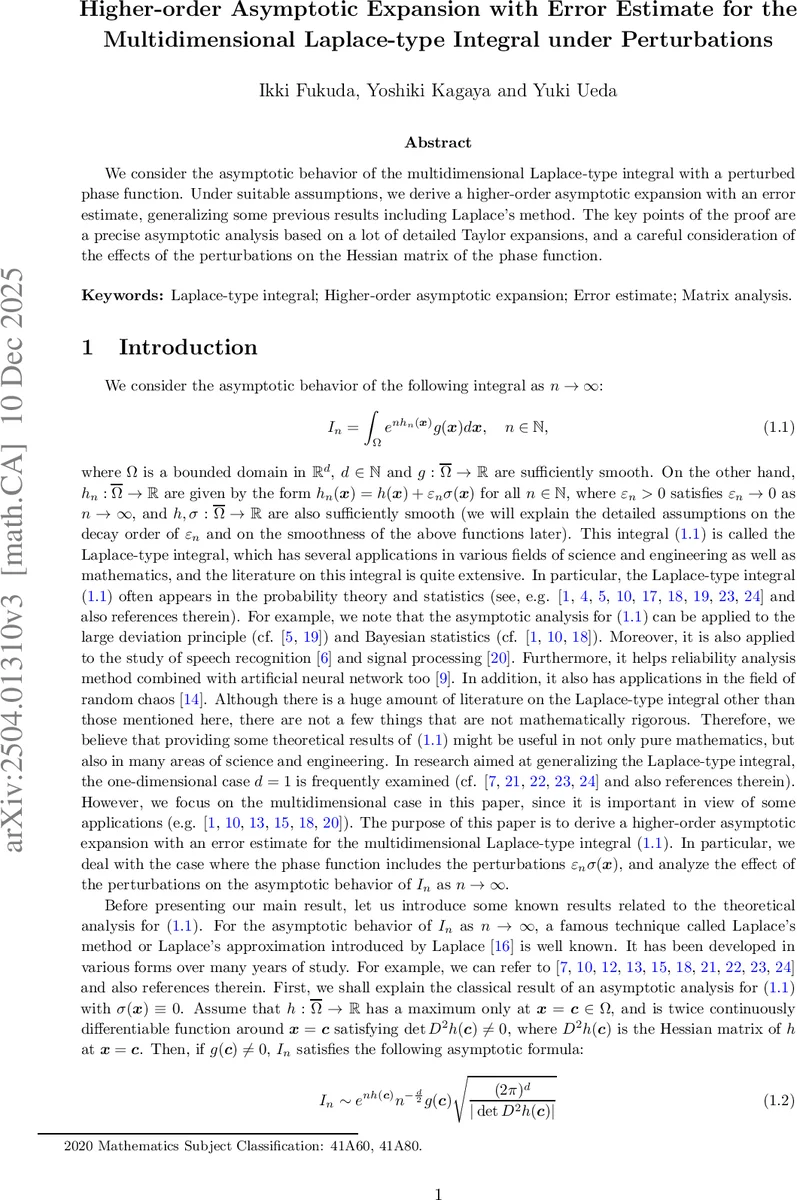
We consider the asymptotic behavior of the multidimensional Laplace-type integral with a perturbed phase function. Under suitable assumptions, we derive a higher-order asymptotic expansion with an error estimate, generalizing some previous results including Laplace’s method. The key points of the proof are a precise asymptotic analysis based on a lot of detailed Taylor expansions, and a careful consideration of the effects of the perturbations on the Hessian matrix of the phase function.
💡 Research Summary
This paper presents a rigorous mathematical investigation into the asymptotic behavior of multidimensional Laplace-type integrals subject to perturbations in the phase function. Laplace-type integrals are fundamental tools in various scientific disciplines, including statistical mechanics, quantum physics, and probability theory, where the value of the integral is primarily determined by the behavior of the integrand near its maximum points.
The primary challenge addressed in this research is the impact of perturbations on the asymptotic expansion. While the classical Laplace method provides a reliable approximation by focusing on the leading-order terms of a fixed phase function, real-world applications often involve phase functions that are subject to small, unpredictable fluctuations or perturbations. These perturbations can shift the location of critical points and, more significantly, alter the local geometry—specifically the curvature—of the phase function at these points.
The authors’ core contribution lies in the derivation of a generalized higher-order asymptotic expansion that explicitly accounts for these perturbations. To achieve this, the researchers employed a highly sophisticated and detailed application of multidimensional Taylor expansions. A critical component of their analytical process was the investigation of how perturbations affect the Hessian matrix of the phase function. Since the Hessian matrix dictates the second-order derivatives and thus the local curvature at the critical points, any perturbation-induced change in its structure directly influences the coefficients of the asymptotic expansion.
Furthermore, the paper distinguishes itself by providing a precise error estimate alongside the higher-order expansion. In the field of asymptotic analysis, knowing the approximation itself is insufficient without a rigorous bound on the error. By establishing a clear error estimate, the authors provide a mathematical guarantee regarding the reliability of the expansion, even when the phase function is perturbed. This is particularly vital for high-precision computational physics and statistical modeling, where understanding the bounds of uncertainty is as important as the approximation itself.
In summary, this work extends the boundaries of classical asymptotic theory by moving beyond the static assumptions of the standard Laplace method. By successfully integrating the effects of perturbations into a higher-order framework and providing rigorous error bounds, the authors have developed a robust mathematical toolset for analyzing complex, multidimensional systems characterized by inherent uncertainty and structural fluctuations. This research holds significant implications for anyone working with high-precision numerical integration and the analysis of perturbed dynamical systems.
Comments & Academic Discussion
Loading comments...
Leave a Comment