Non relativistic limit of the nonlinear Klein-Gordon equation: Uniform in time approximation of KAM solutions
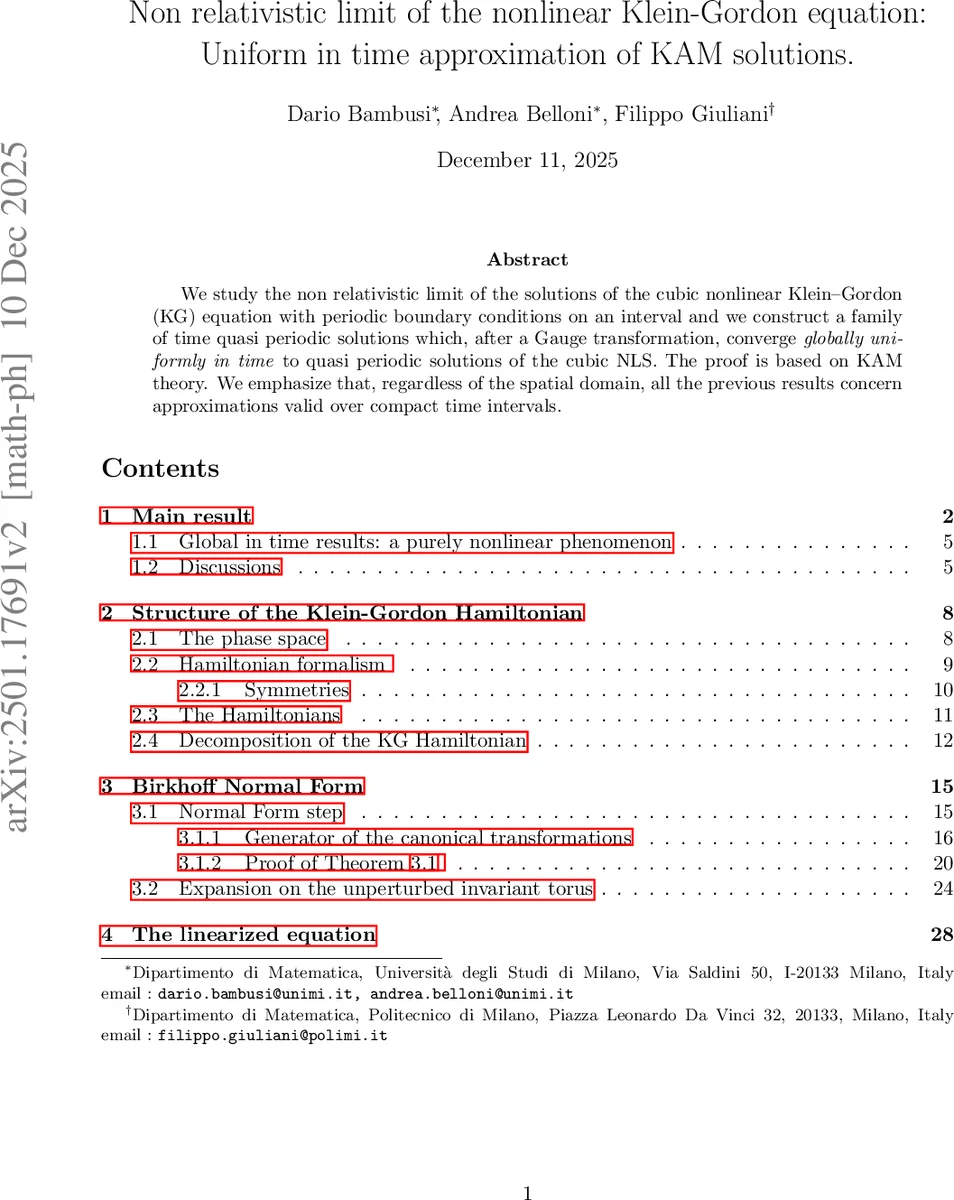
We study the non relativistic limit of the solutions of the cubic nonlinear Klein–Gordon (KG) equation with periodic boundary conditions on an interval and we construct a family of time quasi periodic solutions which, after a Gauge transformation, converge globally uniformly in time to quasi periodic solutions of the cubic NLS. The proof is based on KAM theory. We emphasize that, regardless of the spatial domain, all the previous results concern approximations valid over compact time intervals.
💡 Research Summary
This paper investigates the singular “non-relativistic limit” (where the speed of light c tends to infinity) for the cubic nonlinear Klein-Gordon (KG) equation on a one-dimensional spatial domain with periodic boundary conditions. The central aim is to demonstrate that, after a specific Gauge transformation, certain quasi-periodic in time solutions of the KG equation converge uniformly for all time to quasi-periodic solutions of the cubic nonlinear Schrödinger (NLS) equation. This constitutes a significant advancement, as all prior convergence results for this limit, regardless of the spatial domain, were only valid over compact intervals of time.
The main result, Theorem 1.1, establishes the existence of a family of small-amplitude, quasi-periodic solutions for both the KG and NLS equations. For sufficiently large c and small amplitude parameter R, there exists a set of parameters Ω with positive measure. For each parameter ω in Ω, one can construct an embedding Ψ^KG_ω (for KG) and Ψ^NLS_ω (for NLS) from an N-dimensional torus into the phase space. The key estimates show that the Gauge-transformed KG solution e^(ic²t)ψ^KG_c,ω(t) and the NLS solution φ^NLS_ω(t) are close uniformly for all t ∈ R, with the difference controlled by a negative power of c and R. Corollary 1.2 confirms the actual convergence in the limit c → ∞.
The proof is a sophisticated application of Hamiltonian perturbation theory, specifically KAM theory and Birkhoff normal forms, carefully tailored to remain valid uniformly in the singular parameter c. The authors overcome several major technical hurdles:
- Diverging Linear Frequencies: The linear frequencies of KG diverge like c². The analysis carefully separates this divergent part from the finite, c-dependent corrections.
- Parameter-Dependent Resonances: The limit introduces new resonances between tangential and arbitrarily high normal modes. A detailed analysis of resonance sets, leveraging symmetries like space translation invariance, is conducted to show that the “bad” parameter set where small divisors are too small has small measure.
- Lack of Gauge Invariance: The KG equation is not gauge invariant, unlike the NLS. A crucial part of the proof involves showing that the non-gauge-invariant terms in the KG Hamiltonian contribute at order c⁻², ensuring they vanish in the limit.
- Uniform Estimates: The Birkhoff normal form transformation and the iterative KAM procedure are developed so that all bounds are independent of c, allowing for the uniform convergence result.
The authors emphasize that this global-in-time convergence is a purely nonlinear phenomenon, impossible at the linear level. The nonlinearity provides the necessary frequency shifts to align the invariant tori of the KG and NLS systems. The work opens avenues for applying similar techniques to other singular limit problems in Hamiltonian PDEs, such as the Maxwell-Klein-Gordon system or the study of almost-periodic solutions.
Comments & Academic Discussion
Loading comments...
Leave a Comment