Automation as a Catalyst for Geothermal Energy Adoption in Qatar: A Techno-Economic and Environmental Assessment
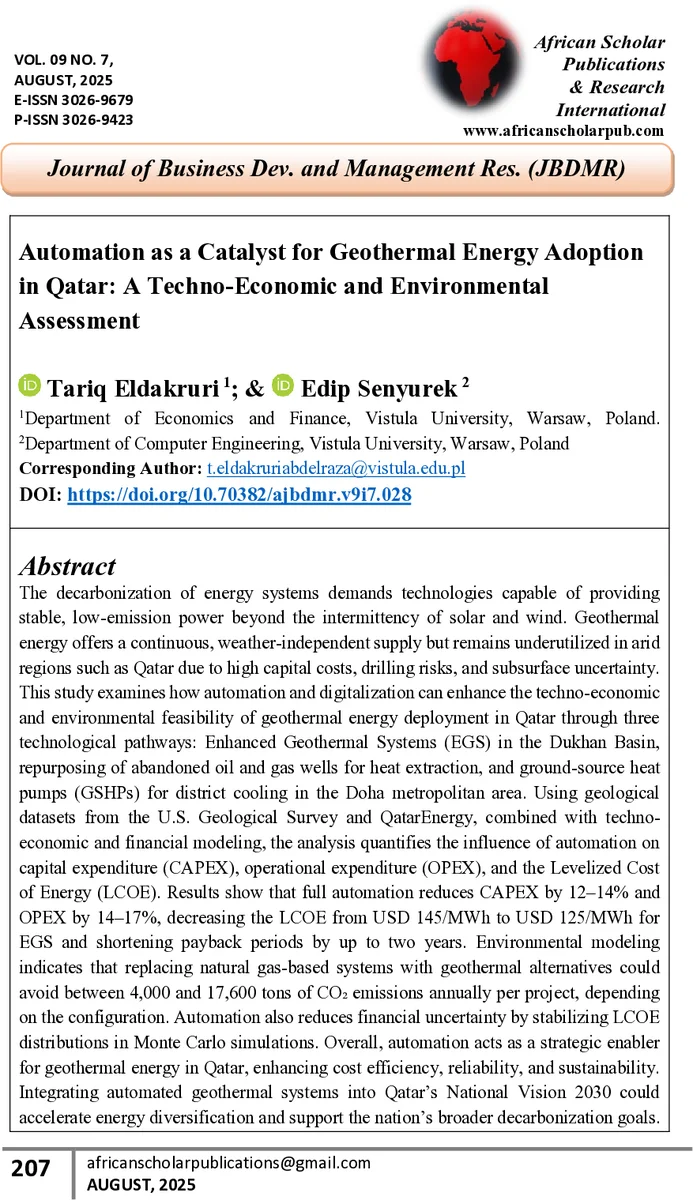
Geothermal energy provides continuous low emission potential but is underused in Qatar because of high capital costs, drilling risks, and uncertainty in subsurface conditions. This study examines how automation can improve the techno economic and environmental feasibility of geothermal deployment through three pathways: Enhanced Geothermal Systems in the Dukhan Basin, repurposed oil and gas wells, and ground source heat pumps for district cooling. Using geological datasets and financial modeling, the analysis shows that full automation reduces capital expenditure by 12 to 14 percent and operating expenditure by 14 to 17 percent. The Levelized Cost of Energy decreases from 145 USD per MWh to 125 USD per MWh, and payback periods shorten by up to two years. Environmental results indicate that geothermal substitution can avoid between 4000 and 17600 tons of CO2 per year for each project. Automation also reduces uncertainty in investment outcomes based on Monte Carlo simulations. Overall, the results show that automation strengthens the economic viability of geothermal systems and supports their integration into Qatars long term energy diversification and decarbonization strategies.
💡 Research Summary
The paper investigates how automation can act as a catalyst for the adoption of geothermal energy in Qatar by evaluating three deployment pathways: (1) Enhanced Geothermal Systems (EGS) in the Dukhan Basin, (2) repurposing of abandoned oil and gas wells for heat extraction, and (3) district‑scale ground‑source heat pumps (GSHP) for cooling in Doha. Using publicly available geological data from the USGS, QatarEnergy, and the Qatar Open Data Portal, the authors model subsurface temperature gradients, rock properties, and resource volumes. They then construct financial models with a 6 % real discount rate, 2 % inflation, and a 25‑year project life, incorporating cost benchmarks from Cleantech Group and Beckers.
Automation is examined under three scenarios: baseline (manual operations), moderate automation (IoT‑based monitoring and predictive maintenance), and full automation (AI‑driven autonomous drilling and maintenance). The analysis assumes that automation reduces drilling time, improves precision, and enables real‑time subsurface monitoring, leading to a 12‑14 % reduction in capital expenditures (CAPEX) and a 14‑17 % reduction in operating expenditures (OPEX).
Key techno‑economic results are summarized in Table 1. For EGS, full automation lowers CAPEX from USD 25 million to USD 21.5 million, OPEX from USD 1.2 million yr⁻¹ to USD 1.0 million yr⁻¹, and the levelized cost of energy (LCOE) from USD 145 MWh⁻¹ to USD 125 MWh⁻¹, shortening the payback period from 12.5 to 10.5 years. Repurposed wells see CAPEX drop from USD 8 million to USD 7.2 million, OPEX from USD 350 kyr⁻¹ to USD 300 kyr⁻¹, and LCOE from USD 95 MWh⁻¹ to USD 85 MWh⁻¹, with payback improving from 8 to 7 years. The GSHP pathway experiences similar proportional benefits, with LCOE decreasing from USD 110 MWh⁻¹ to USD 95 MWh⁻¹ under full automation.
Sensitivity analysis identifies drilling cost variability (±20 %) as the most influential factor on LCOE, while automation efficiency variations (±5 %) affect LCOE by an additional 3‑5 %. Monte Carlo simulations (10,000 runs) reveal that full automation narrows the LCOE distribution, reducing its standard deviation by about 18 %, thereby lowering investment risk.
Environmental assessment employs a simplified life‑cycle analysis covering construction, operation, and decommissioning. Using Qatar’s grid emission factor of 0.503 kg CO₂ kWh⁻¹, the study estimates that each geothermal project can avoid 4,000‑17,600 tons of CO₂ annually, depending on scale and technology. GSHPs also cut cooling‑related electricity demand by 30‑50 %, delivering roughly 3,000 tons of CO₂ savings per year.
Policy recommendations stress the need for targeted incentives (tax credits, subsidies) for automation technologies, pilot‑project funding, and the creation of a shared data platform to improve subsurface information transparency. The authors argue that repurposing existing wells offers the quickest return on investment and should be prioritized in public‑private partnership schemes.
In conclusion, the research demonstrates that automation substantially improves the economic viability and reduces the uncertainty of geothermal projects in Qatar. By cutting both CAPEX and OPEX, lowering LCOE, shortening payback periods, and delivering measurable CO₂ reductions, automation emerges as a strategic enabler for integrating geothermal energy into Qatar’s national vision for energy diversification and decarbonization.
Comments & Academic Discussion
Loading comments...
Leave a Comment