Numerical Behavior of the Riemann Zeta Function Using Real-to-Complex Conversion Without Gram Points or Bracketing
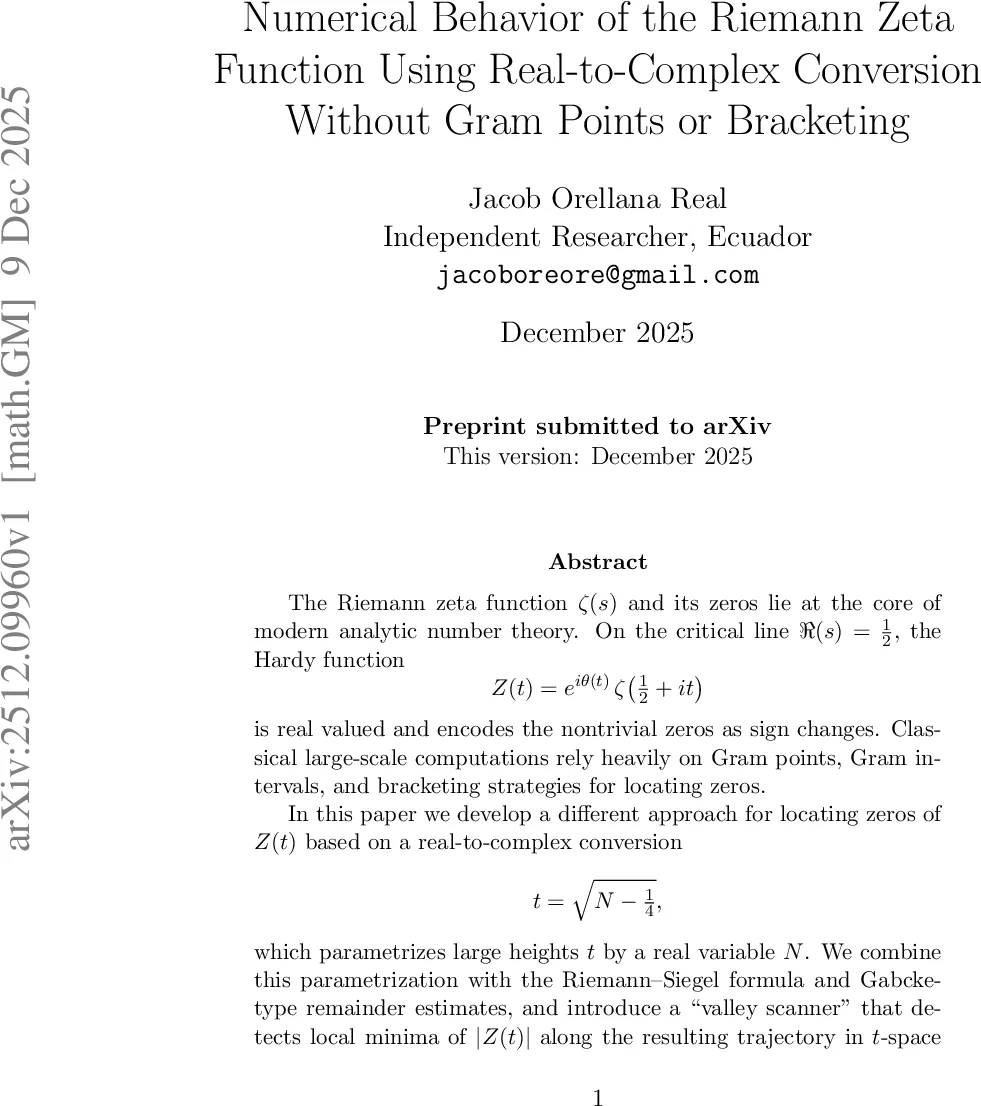
The Riemann zeta function and the distribution of its nontrivial zeros on the critical line remain central topics in analytic number theory and large-scale computation. This work develops a numerical framework that replaces classical Gram-point bracketing with a real-to-complex parametrization of the critical line. Combined with high-precision evaluation of the Hardy Z function using the Riemann-Siegel formula with Gabcke type remainder control, this parametrization induces a Valley Scanner algorithm that identifies local minima of the absolute value of Z and refines them using safeguarded Newton iterations. The method exploits the mountain-valley geometry of the Z function rather than sign changes, and is implemented in a cloud based C language and MPFR pipeline with parallel execution on multi-core CPU instances. The paper reports Zero computations from the classical low lying range up to heights near 1e20, compares the observed spacing of zeros with Riemann - von Mangoldt predictions across several test windows, and summarizes consistency checks based on independent datasets and a local ball test. The work also introduces a fully real staircase formulation of the explicit-formula correction term for the Chebyshev function, expressed directly in terms of the zero ordinates and derived quantities. All numerical datasets, Docker images, and reproducibility materials are publicly archived via Zenodo and GitHub.
💡 Research Summary
The paper introduces a novel numerical framework for locating the non‑trivial zeros of the Riemann zeta function that completely bypasses the traditional Gram‑point and bracketing techniques. The core idea is a simple real‑to‑complex mapping
\
Comments & Academic Discussion
Loading comments...
Leave a Comment