Mitigating Individual Skin Tone Bias in Skin Lesion Classification through Distribution-Aware Reweighting
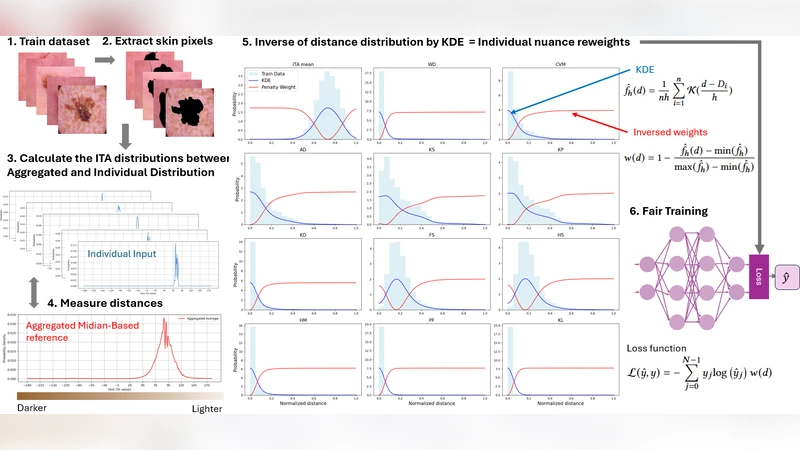
Skin color has historically been a focal point of discrimination, yet fairness research in machine learning for medical imaging often relies on coarse subgroup categories, overlooking individual-level variations. Such group-based approaches risk obscuring biases faced by outliers within subgroups. This study introduces a distribution-based framework for evaluating and mitigating individual fairness in skin lesion classification. We treat skin tone as a continuous attribute rather than a categorical label, and employ kernel density estimation (KDE) to model its distribution. We further compare twelve statistical distance metrics to quantify disparities between skin tone distributions and propose a distance-based reweighting (DRW) loss function to correct underrepresentation in minority tones. Experiments across CNN and Transformer models demonstrate: (i) the limitations of categorical reweighting in capturing individual-level disparities, and (ii) the superior performance of distribution-based reweighting, particularly with Fidelity Similarity (FS), Wasserstein Distance (WD), Hellinger Metric (HM), and Harmonic Mean Similarity (HS). These findings establish a robust methodology for advancing fairness at individual level in dermatological AI systems, and highlight broader implications for sensitive continuous attributes in medical image analysis.
💡 Research Summary
The paper tackles the persistent problem of racial and skin‑tone bias in automated dermatology systems by moving away from coarse, categorical subgroup definitions toward a truly continuous treatment of skin tone. Instead of using the traditional Fitzpatrick types, the authors extract a luminance‑based skin‑tone score from each image (L* value in CIELAB space normalized to
Comments & Academic Discussion
Loading comments...
Leave a Comment