The Monge-Ampère system in dimension two is fully flexible in codimension two
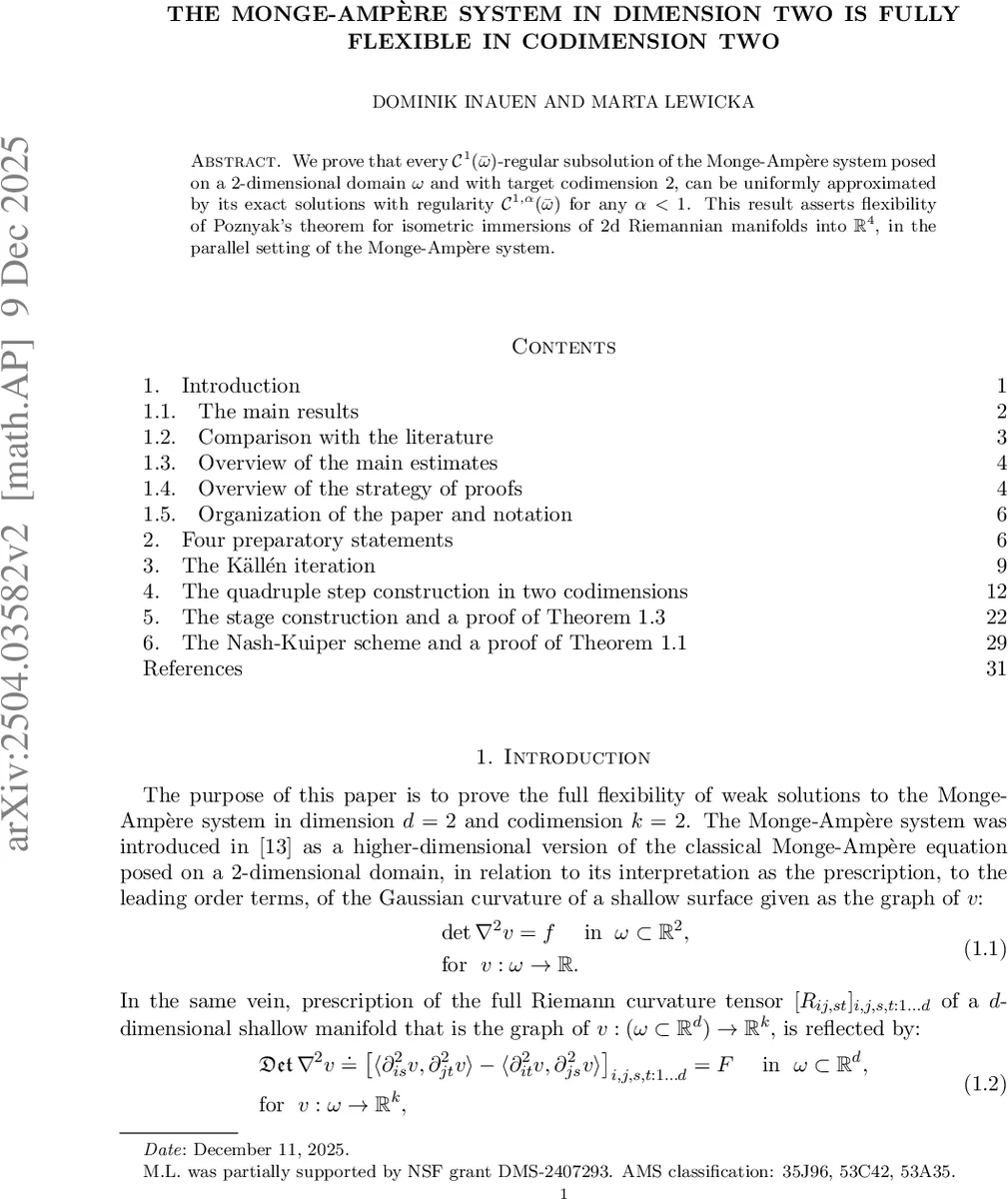
We prove that every $\mathcal{C}^1(\barω)$-regular subsolution of the Monge-Ampère system posed on a $2$-dimensional domain $ω$ and with target codimension $2$, can be uniformly approximated by its exact solutions with regularity $\mathcal{C}^{1,α}(\barω)$ for any $α<\min{1, \frac{s+β}{2}}$, where $\mathcal{C}^{s,β}$ is the assumed regularity of the system’s right hand side. This result suggests the full flexibility of Poznyak’s theorem for isometric immersions of $2$d Riemannian manifolds into $\mathbb{R}^4$, and asserts it in the parallel setting of the Monge-Ampère system.
💡 Research Summary
This paper presents a significant breakthrough in the study of the Monge-Ampère system, specifically focusing on its structural properties in a two-dimensional setting with codimension two. The core achievement of the research is the mathematical proof of the “full flexibility” of the Monage-Ampère system, demonstrating that any $C^1(\bar{\omega})$-regular subsolution can be uniformly approximated by exact solutions possessing $C^{1,\alpha}$ regularity.
The technical heart of the paper lies in the precise determination of the regularity of these approximating solutions. The authors establish that the Hölder exponent $\alpha$ must satisfy the condition $\alpha < \min{1, \frac{s+\beta}{2}}$, where $s$ and $\beta$ represent the assumed regularity of the system’s right-hand side. This result is profound because it provides a quantitative link between the regularity of the input data (the right-hand side) and the achievable regularity of the approximating solutions, ensuring that the space of exact solutions is dense within the space of subsolutions under appropriate regularity constraints.
Beyond the analytical implications, the paper carries heavy geometric significance. The authors connect their findings to the theory of isometric immersions, specifically suggesting the full flexibility of Poznyak’s theorem regarding the isometric immersion of 2D Riemannian manifolds into $\mathbb{R}^4$. By proving this property within the parallel framework of the Monge-Ampère system, the research bridges the gap between the analytical properties of non-linear partial differential equations and the geometric properties of manifold embeddings.
In essence, the paper moves beyond mere existence proofs to characterize the density and approximation capabilities of solutions. By establishing that the system lacks the “rigidity” typically found in lower-codimension problems, the authors provide a new understanding of how Monge-Ampère systems behave in higher-dimensional target spaces. This work serves as a fundamental contribution to the field of non-linear analysis and differential geometry, offering a robust framework for future investigations into the flexibility of complex geometric structures.
Comments & Academic Discussion
Loading comments...
Leave a Comment