LENVIZ: A High-Resolution Low-Exposure Night Vision Benchmark Dataset
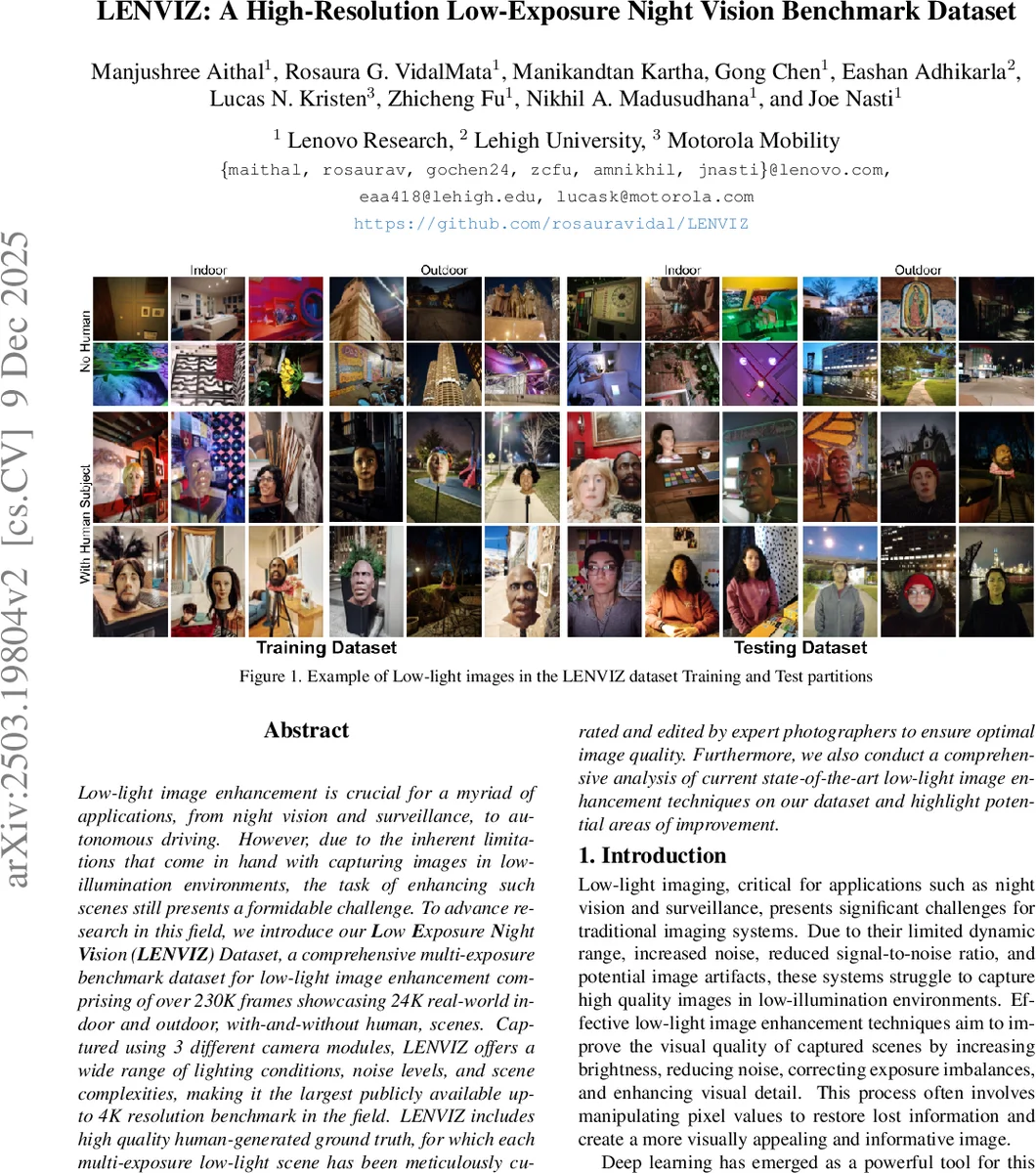
Low-light image enhancement is crucial for a myriad of applications, from night vision and surveillance, to autonomous driving. However, due to the inherent limitations that come in hand with capturing images in low-illumination environments, the task of enhancing such scenes still presents a formidable challenge. To advance research in this field, we introduce our Low Exposure Night Vision (LENVIZ) Dataset, a comprehensive multi-exposure benchmark dataset for low-light image enhancement comprising of over 230K frames showcasing 24K real-world indoor and outdoor, with-and without human, scenes. Captured using 3 different camera sensors, LENVIZ offers a wide range of lighting conditions, noise levels, and scene complexities, making it the largest publicly available up-to 4K resolution benchmark in the field. LENVIZ includes high quality human-generated ground truth, for which each multi-exposure low-light scene has been meticulously curated and edited by expert photographers to ensure optimal image quality. Furthermore, we also conduct a comprehensive analysis of current state-of-the-art low-light image enhancement techniques on our dataset and highlight potential areas of improvement.
💡 Research Summary
The paper addresses the chronic shortage of high‑quality, large‑scale paired data for low‑light image enhancement by introducing the Low Exposure Night Vision (LENVIZ) dataset. LENVIZ comprises 24 000 real‑world indoor and outdoor scenes captured with three distinct mobile camera modules (a front‑facing module optimized for close‑range selfies and two rear modules for medium‑to‑long range). For each scene, up to nine low‑exposure frames and one long‑exposure ground‑truth (GT) frame are provided, yielding a total of 234 688 frames (≈230 K images) and a maximum resolution of 4K (4080 × 3072).
A key contribution is the systematic quantification of ambient illuminance using camera parameters (ISO, exposure time, aperture) via the formula L′ = β · f² · 10¹¹ · t_exp · ISO⁻¹, where β is a camera‑specific constant. Based on the estimated illuminance, exposure brackets (γ values) are empirically calibrated (γ₁ = 48, γ₂ = 48, γ₃ = 52, γ₄ = 60) to compute the long‑exposure time for the GT image. This explicit, reproducible exposure calculation distinguishes LENVIZ from prior datasets that often lack such metadata.
Ground‑truth images are not merely ISP‑processed JPEGs but are manually edited by professional photographers from RAW captures. The experts perform color correction, noise reduction, and detail restoration, ensuring that the GT reflects human visual standards rather than algorithmic post‑processing. This high‑quality GT is crucial for both training loss functions and for reliable quantitative evaluation.
The dataset’s scale and diversity are unprecedented. Table 1 in the paper shows that existing benchmarks (MIT‑5K, LOL, SICE, etc.) are limited either in the number of paired images, resolution, or the presence of multi‑exposure sequences. LENVIZ surpasses them with over 80 000 scenes, multi‑exposure brackets, and three hardware platforms, making it the largest publicly available low‑light benchmark at up to 4K resolution.
To facilitate robust evaluation, the authors also release a curated test set of 1 468 frames covering 203 unique scenes. The test set is designed using external standards such as DxOMark, ensuring a balanced distribution of illuminance levels, noise conditions, and scene complexities (including human subjects, accessories, and varied backgrounds).
The paper includes an extensive benchmark of state‑of‑the‑art low‑light enhancement methods (e.g., KinD, RetinexNet, LLNet, and recent transformer‑based models). All models are retrained on LENVIZ and evaluated on the dedicated test set. Results indicate that multi‑exposure input models consistently outperform single‑frame baselines, achieving average PSNR gains of ~1.2 dB and SSIM improvements of ~0.03. Nevertheless, challenges remain: high ISO and very long exposure GTs still exhibit residual color shifts and noise, highlighting areas for future research such as better noise modeling and color constancy under extreme low light.
In summary, LENVIZ makes four major contributions: (1) a massive, high‑resolution, multi‑exposure low‑light dataset captured with three distinct camera modules; (2) expert‑edited, human‑curated ground‑truth images; (3) a transparent, physics‑based illuminance and exposure calculation framework; and (4) a standardized test suite for fair benchmarking. By providing these resources, the authors aim to accelerate the development of more robust low‑light enhancement algorithms, HDR fusion techniques, and camera ISP research. The dataset is publicly released on GitHub, and the authors invite the community to extend it with additional scenes, sensor types, or novel evaluation protocols.
Comments & Academic Discussion
Loading comments...
Leave a Comment