Automatic Inference for Value-Added Regressions
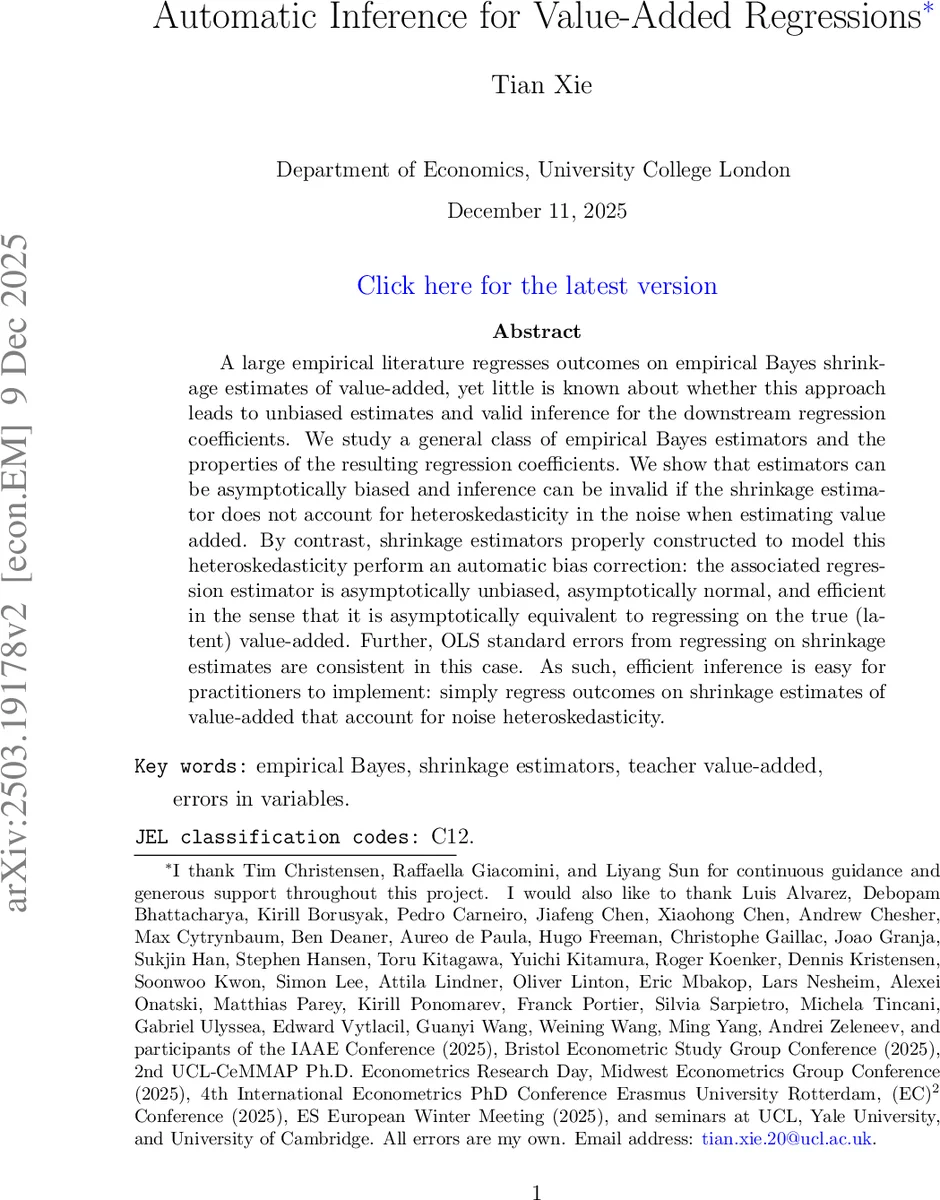
A large empirical literature regresses outcomes on empirical Bayes shrinkage estimates of value-added, yet little is known about whether this approach leads to unbiased estimates and valid inference for the downstream regression coefficients. We study a general class of empirical Bayes estimators and the properties of the resulting regression coefficients. We show that estimators can be asymptotically biased and inference can be invalid if the shrinkage estimator does not account for heteroskedasticity in the noise when estimating value added. By contrast, shrinkage estimators properly constructed to model this heteroskedasticity perform an automatic bias correction: the associated regression estimator is asymptotically unbiased, asymptotically normal, and efficient in the sense that it is asymptotically equivalent to regressing on the true (latent) value-added. Further, OLS standard errors from regressing on shrinkage estimates are consistent in this case. As such, efficient inference is easy for practitioners to implement: simply regress outcomes on shrinkage estimates of value-added that account for noise heteroskedasticity.
💡 Research Summary
The research paper “Automatic Inference for Value-Added Regressions” addresses a critical methodological gap in the widespread econometric practice of using Empirical Bayes (EB) shrinkage estimates as predictors in downstream regression models. In many empirical studies, particularly those involving “value-added” metrics such as teacher effectiveness or school performance, researchers use EB shrinkage to mitigate the impact of measurement error and small sample sizes. However, the paper investigates whether using these shrinkage-adjusted estimates as independent variables in subsequent regressions leads to biased coefficients and invalid statistical inference.
The core finding of the paper is a warning against the improper use of shrinkage estimators. The authors demonstrate that if the shrinkage process fails to account for the heteroskedasticity of the noise (i.e., the varying levels of measurement error across different observations), the resulting regression coefficients in the downstream model can be asymptotically biased. This bias undermines the validity of hypothesis testing, as the standard errors and p-values derived from such models may not accurately reflect the true underlying uncertainty, potentially leading to false-positive or false-negative conclusions.
Crucially, the paper provides a mathematically robust solution. The authors prove that a specific class of EB estimators, which explicitly models the heteroskedasticity of the noise, performs an “automatic bias correction.” When these properly constructed shrinkage estimators are used in a regression, the resulting estimators are not only asymptotically unbiased and asymptotically normal but also achieve asymptotic efficiency. This efficiency is particularly noteworthy because it implies that the regression results are asymptotically equivalent to a scenario where the true, unobserved latent values are used as regressors.
The practical implications of this research are profound and highly accessible for practitioners. The authors show that achieving high-precision, valid inference does not require complex new econometric frameworks. Instead, the solution lies in the initial estimation stage: by ensuring that the shrinkage estimator accounts for the variance of the noise, researchers can use standard Ordinary Least Squares (OLS) procedures with confidence. In such cases, the OLS standard errors are consistent, and the resulting estimates are as reliable as if the measurement error had been eliminated entirely. This contribution provides a clear, actionable pathway for researchers to enhance the robustness and accuracy of value-added regression analyses.
Comments & Academic Discussion
Loading comments...
Leave a Comment