📝 Original Info
- Title: A Lightweight Transfer Learning-Based State-of-Health Monitoring with Application to Lithium-ion Batteries in Autonomous Air Vehicles
- ArXiv ID: 2512.08512
- Date: 2025-12-09
- Authors: Jiang Liu, Yan Qin, Wei Dai, Chau Yuen
📝 Abstract
Accurate and rapid state-of-health (SOH) monitoring plays an important role in indicating energy information for lithium-ion battery-powered portable mobile devices. To confront their variable working conditions, transfer learning (TL) emerges as a promising technique for leveraging knowledge from data-rich source working conditions, significantly reducing the training data required for SOH monitoring from target working conditions. However, traditional TL-based SOH monitoring is infeasible when applied in portable mobile devices since substantial computational resources are consumed during the TL stage and unexpectedly reduce the working endurance. To address these challenges, this paper proposes a lightweight TL-based SOH monitoring approach with constructive incremental transfer learning (CITL). First, taking advantage of the unlabeled data in the target domain, a semi-supervised TL mechanism is proposed to minimize the monitoring residual in a constructive way, through iteratively adding network nodes in the CITL. Second, the cross-domain learning ability of node parameters for CITL is comprehensively guaranteed through structural risk minimization, transfer mismatching minimization, and manifold consistency maximization. Moreover, the convergence analysis of the CITL is given, theoretically guaranteeing the efficacy of TL performance and network compactness. Finally, the proposed approach is verified through extensive experiments with a realistic autonomous air vehicles (AAV) battery dataset collected from dozens of flight missions. Specifically, the CITL outperforms SS-TCA, MMD-LSTM-DA, DDAN, BO-CNN-TL, and AS$^3$LSTM, in SOH estimation by 83.73%, 61.15%, 28.24%, 87.70%, and 57.34%, respectively, as evaluated using the index root mean square error.
💡 Deep Analysis
Deep Dive into A Lightweight Transfer Learning-Based State-of-Health Monitoring with Application to Lithium-ion Batteries in Autonomous Air Vehicles.
Accurate and rapid state-of-health (SOH) monitoring plays an important role in indicating energy information for lithium-ion battery-powered portable mobile devices. To confront their variable working conditions, transfer learning (TL) emerges as a promising technique for leveraging knowledge from data-rich source working conditions, significantly reducing the training data required for SOH monitoring from target working conditions. However, traditional TL-based SOH monitoring is infeasible when applied in portable mobile devices since substantial computational resources are consumed during the TL stage and unexpectedly reduce the working endurance. To address these challenges, this paper proposes a lightweight TL-based SOH monitoring approach with constructive incremental transfer learning (CITL). First, taking advantage of the unlabeled data in the target domain, a semi-supervised TL mechanism is proposed to minimize the monitoring residual in a constructive way, through iteratively
📄 Full Content
T O provide a safe and stable energy supply for successful ongoing tasks, lithium-ion batteries (LiBs) have been widely adopted in portable mobile devices due to the advantages of a low self-discharge rate and high energy density [1]. However, LiBs' health status inevitably degrades during continuous charging and discharging cycles, caused by electrochemical side reactions over time [2]. Consequently, industrial mobile devices with degraded LiBs will unexpectedly shorten the nominal service life and increase the failure risk of ongoing tasks. Therefore, accurate and rapid monitoring of the state-of-health (SOH) for LiBs has attracted extensive attention in guaranteeing safe operation for portable mobile devices [3].
The SOH is quantitatively evaluated by the maximum available capacity over its nominal capacity within a specific cycle [4]. Leveraging historical charging/discharging data, data-driven approaches for SOH monitoring hold a dominant position without the establishment of internal circuit models and electrochemical reaction mechanisms. A wide range of machine learning approaches have been reported for SOH monitoring, including back propagation network [5], convolutional neural network (CNN) [6], recurrent neural network [7], long short-term memory (LSTM) network [8]. Although the aforementioned approaches gained remarkable successes, they necessitate similar working conditions to satisfy the data distribution consistency. In practice, the changing working conditions of industrial portable mobile devices, including variable loads, various charging power, and environmental temperatures, yield inconsistent data distributions, failing the SOH monitoring model trained with a specific condition to work well under other working conditions [9]. As a result, the data distribution discrepancy among different working conditions challenge the performance of the existing approaches.
Transfer learning (TL) emerges as a promising paradigm to address the data discrepancy challenge between the training data in the source domain and testing data in the target domain, which usually takes advantage of the strengths of deep learning models. The basic idea of TL is to learn transferable features or network structure from the source domain. Subsequently, these features or structures are modified for the challenging tasks in the target domain. Consequently, a feasible solution is to leverage the valuable aging information in source data to assist in the training procedure of SOH monitoring model and then boost the estimator’s generalization ability in the target domain with few-shot samples. For instance, Fu et al. [10] pre-trained a multilayer perceptron-based source model using voltage and current data from various working conditions. The target SOH estimator is gained by fine-tuning the source model using the correlation alignment strategy, which explores the consistent characteristics across different working conditions. The strong temporal correlations within battery data motivate the wide application of LSTM for feature extraction and network construction of TL [11]. To further enhance the transfer transparency, Ma et al. [12] employed the maximum mean discrepancy (MMD) strategy to minimize distribution discrepancies of features and labels between source data and target data. Afterwards, a CNN is implemented for domain adaptation via updating the final fully connected layer, and the performance is verified experimentally with typical battery materials and environmental temperatures. To confront the overfitting on limited data with a fully connected layer, Lu et al. [13] used random forest to replace the fully connected layer in the pre-trained CNN source model and subsequently applied fine-tuning techniques to achieve TL-based SOH estimation across different batteries. It is worth pointing out that sufficient labeled battery data in the target domain may not be accessible in practice. On the contrary, it is affordable to collect unlabeled battery cycling data. Therefore, Li et al. [9] introduced a semi-supervised TL method for SOH estimation of LiBs. This approach leverages the regularization technique and MMD to realize the manifold embedding of battery data from other operating conditions, enabling high-precision estimation with limited target data. Han et al. [14] integrated LSTM with MMD to develop a parameter-sharing domain adaptation approach for semi-supervised SOH estimation with few-shot target cyclic data consisting of 10 randomly selected samples. Wang et al. [15] applied cross-entropy to establish consistent regularization between labeled and unlabeled data in the target domain for effective domain transfer.
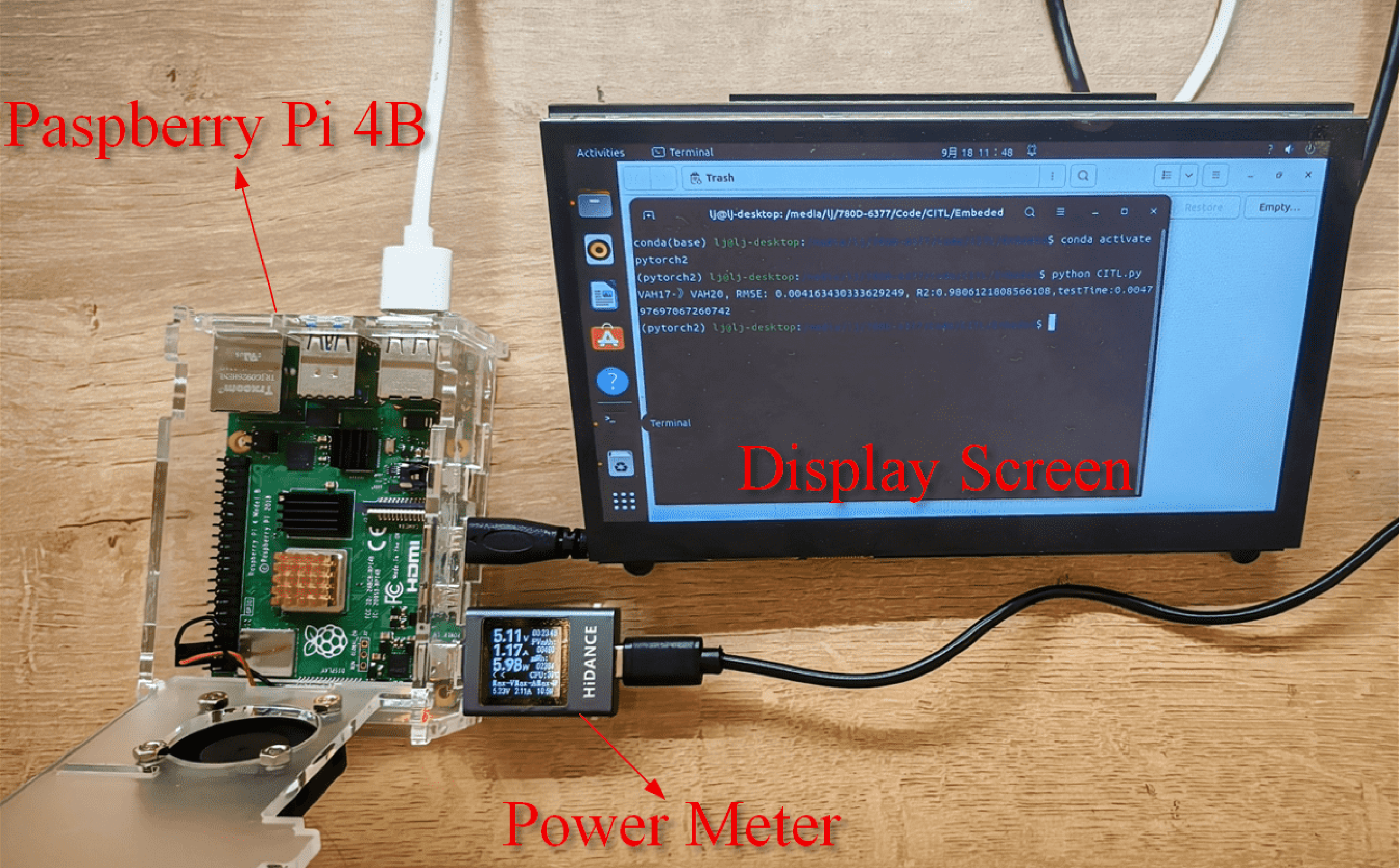
The aforementioned battery SOH monitoring approaches achieve remarkable performance under scenarios with rich computation and storage resources, such as laboratory environments, electric vehicles, and large-scale energy storage. However, the LiB’s storable energy capacity and computation capabilit
…(Full text truncated)…
📸 Image Gallery
Reference
This content is AI-processed based on ArXiv data.