📝 Original Info
- Title: 이더리움 거래 경제적 의도 파악을 위한 TxSum 데이터셋과 MATEX 멀티에이전트 시스템
- ArXiv ID: 2512.06933
- Date: 2025-12-07
- Authors: Zifan Peng, Jingyi Zheng, Yule Liu, Huaiyu Jia, Qiming Ye, Jingyu Liu, Xufeng Yang, Mingchen Li, Qingyuan Gong, Xuechao Wang, Xinlei He
📝 Abstract
Understanding the economic intent of Ethereum transactions is critical for user safety, yet current tools expose only raw on-chain data, leading to widespread "blind signing" (approving transactions without understanding them). Through interviews with 16 Web3 users, we find that effective explanations should be structured, risk-aware, and grounded at the token-flow level. Based on interviews, we propose TxSum, a new task and dataset of 100 complex Ethereum transactions annotated with natural-language summaries and step-wise semantic labels (intent, mechanism, etc.). We then introduce MATEX, a multiagent system that emulates human experts' dual-process reasoning. MATEX achieves the highest faithfulness and intent clarity among strong baselines. It boosts user comprehension by 23.6% on complex transactions and doubles users' ability to find real attacks, significantly reducing blind signing.
💡 Deep Analysis
Deep Dive into 이더리움 거래 경제적 의도 파악을 위한 TxSum 데이터셋과 MATEX 멀티에이전트 시스템.
Understanding the economic intent of Ethereum transactions is critical for user safety, yet current tools expose only raw on-chain data, leading to widespread “blind signing” (approving transactions without understanding them). Through interviews with 16 Web3 users, we find that effective explanations should be structured, risk-aware, and grounded at the token-flow level. Based on interviews, we propose TxSum, a new task and dataset of 100 complex Ethereum transactions annotated with natural-language summaries and step-wise semantic labels (intent, mechanism, etc.). We then introduce MATEX, a multiagent system that emulates human experts’ dual-process reasoning. MATEX achieves the highest faithfulness and intent clarity among strong baselines. It boosts user comprehension by 23.6% on complex transactions and doubles users’ ability to find real attacks, significantly reducing blind signing.
📄 Full Content
MATEX: A Multi-Agent Framework for Explaining Ethereum Transactions
Zifan Peng1
Jingyi Zheng1
Yule Liu1
Huaiyu Jia1
Qiming Ye1
Jingyu Liu1
Xufeng Yang2
Mingchen Li3
Qingyuan Gong4
Xuechao Wang1
Xinlei He1*
1Hong Kong University of Science and Technology (Guangzhou)
2Independent Researcher
3University of North Texas
4Fudan University
Abstract
Understanding the economic intent of Ethereum transactions
is critical for user safety, yet current tools expose only raw
on-chain data, leading to widespread “blind signing” (ap-
proving transactions without understanding them). Through
interviews with 16 Web3 users, we find that effective expla-
nations should be structured, risk-aware, and grounded at the
token-flow level.
Based on interviews, we propose TxSum, a new task and
dataset of 100 complex Ethereum transactions annotated with
natural-language summaries and step-wise semantic labels
(intent, mechanism, etc.). We then introduce MATEX, a multi-
agent system that emulates human experts’ dual-process rea-
soning. MATEX achieves the highest faithfulness and intent
clarity among strong baselines. It boosts user comprehension
by 23.6% on complex transactions and doubles users’ ability
to find real attacks, significantly reducing blind signing.
1
Introduction
Understanding the economic intent of an Ethereum transac-
tion is crucial for both proactive risk mitigation and post-
incident analysis. It enables users to preview outcomes and
avoid irreversible errors before signing, and supports regula-
tory compliance, anti-money laundering, and forensic diag-
nosis after exploits—such as the TraceLLM [1] case, where
on-chain analysis uncovered attack vectors in major DeFi
incidents.
However, this understanding is critically lacking in practice.
Modern DeFi transactions are highly compositional, leading
to widespread “blind signing” [2, 3]—a phenomenon with se-
vere consequences. In early 2025, attackers stole $1.5B from
Bybit by tricking operators into approving a malicious trans-
action that appeared innocuous in their interface [4]. Even in
routine interactions, users struggle: new users are confused by
dual-sign patterns (approve + swap), while experienced users
rely on fragile heuristics like “reject unlimited approvals,”
which fail in multi-contract scenarios.
These incidents reveal a fundamental gap: current tools
expose raw on-chain data but fail to translate it into human-
understandable economic narratives. While tools like Meta-
*Corresponding author.
Suites [5], EigenPhi [6], and Tenderly [7] expose detailed to-
ken flows and contract interactions, they stop at the syntactic
level. They do not interpret what these low-level events mean
economically [8].
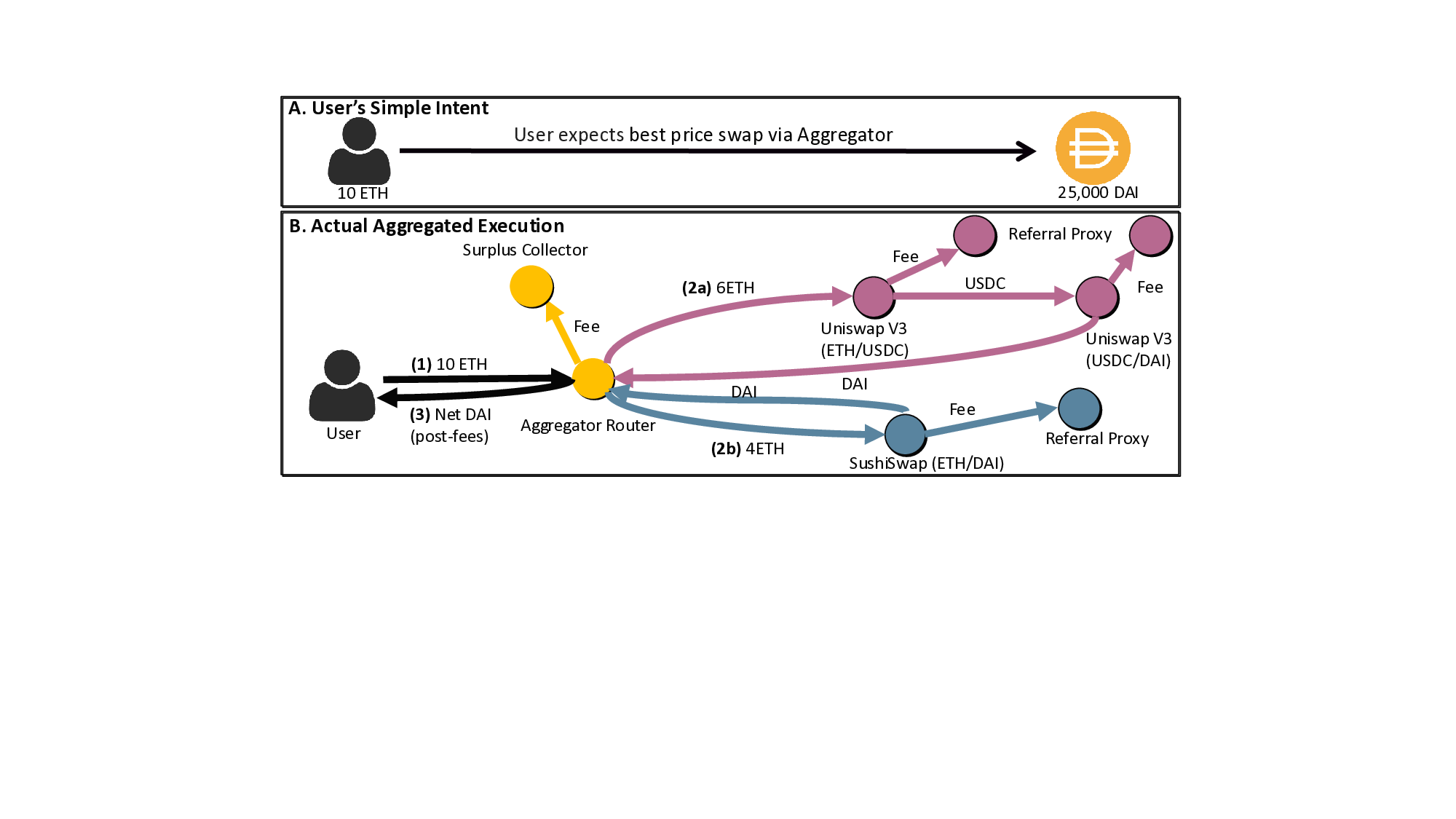
As Figure 1 shows, a user’s simple intent (e.g., “swap
ETH for DAI”) is often executed as a fragmented, multi-
contract transaction. Raw traces reveal what happened but not
why—leaving users unable to distinguish a routine swap from
a high-risk operation. This gap between user mental models
and on-chain reality motivates our research questions (RQs):
• RQ1: How do Web3 users understand transaction details
when signing?
• RQ2: What do users expect from transaction explanations
in terms of content and format?
• RQ3: How to design a framework and how the generated
explanations by it affect users’ comprehension and signing
behavior?
To address this gap, we first conduct a user study with 16
diverse Web3 participants to uncover how real users interpret
transactions and what explanatory elements they find most
valuable.
Guided by these findings, we propose TxSum: a new task
and schema for transaction understanding that operates at the
token-flow level. TxSum defines five semantic attributes (see
Section 3) that ground explanations in step-wise, verifiable
actions aligned with user mental models. We then construct a
high-quality dataset of 100 complex Ethereum transactions,
each annotated with (1) a 3–4 sentence natural-language sum-
mary and (2) fine-grained flow-level labels following our
pre-defined schema.
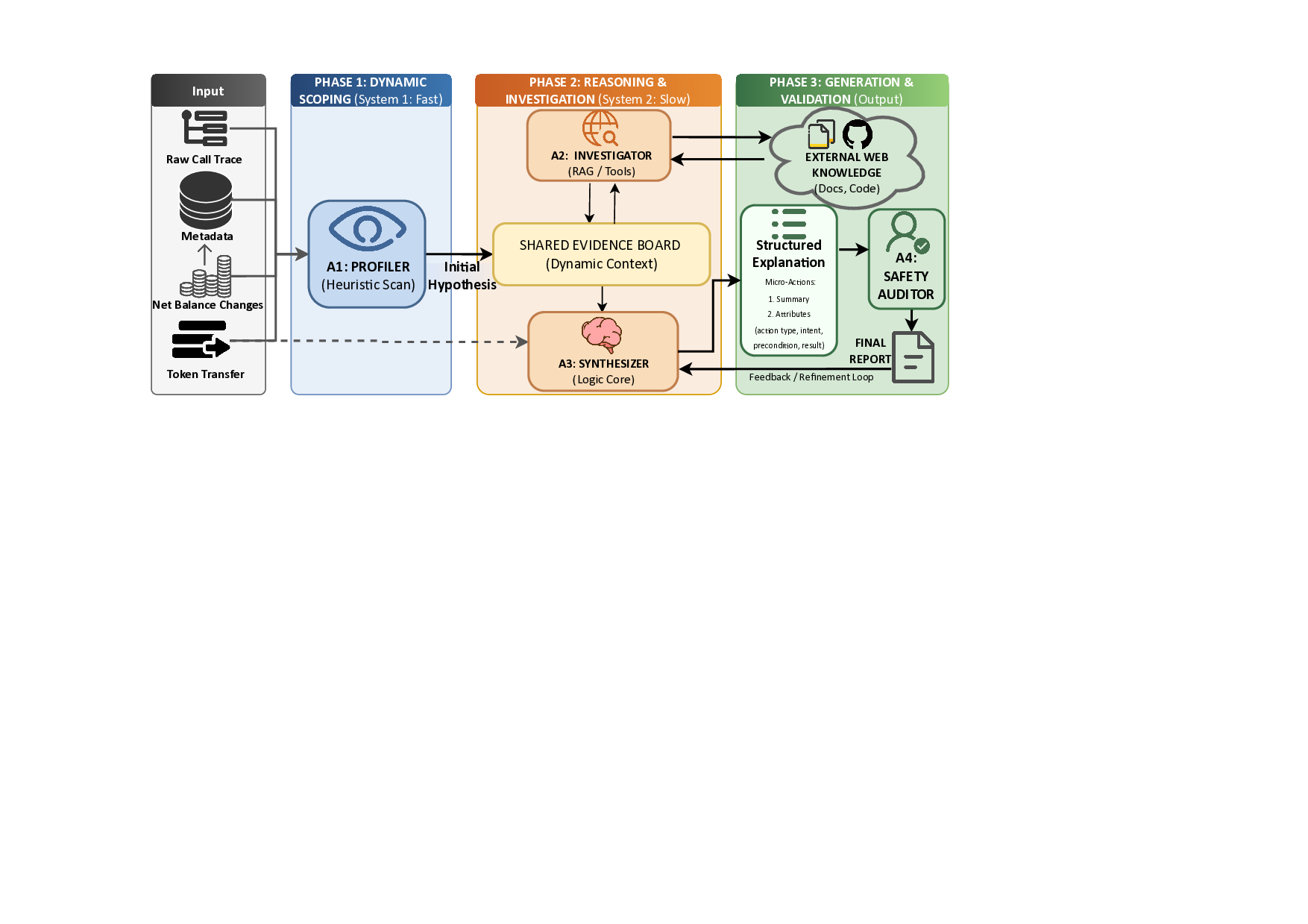
Finally, we introduce MATEX, a cognitive multi-agent
framework motivated by how human experts analyze trans-
actions: it implements a dual-process reasoning workflow [9,
10], where fast pattern recognition (System 1) flags uncer-
tainty and triggers slow, evidence-based investigation (Sys-
tem 2). The system decomposes traces, retrieves live protocol
context to resolve ambiguity, fuses evidence into attributed
narratives.
We evaluate MATEX through automatic and expert assess-
ment, a user study, and risk auditing on real transactions.
1
arXiv:2512.06933v2 [cs.CE] 5 Jan 2026
10 ETH
25,000 DAI
User expects best price swap via Aggregator
B. Actual Aggregated Execution
(1) 10 ETH
(2a) 6ETH
USDC
Uniswap V3
(ETH/USDC)
Uniswap V3
(USDC/DAI)
DAI
DAI
(2b) 4ETH
Aggregator Router
(3) Net DAI
(post-fees)
A. User’s Simple Intent
User
Fee
Fee
Fee
SushiSwap (ETH/DAI)
Referral Proxy
Referral Proxy
Fee
Surplus Collector
Figure 1: Mismatch between user intent and on-chain exec
…(Full text truncated)…
📸 Image Gallery
Reference
This content is AI-processed based on ArXiv data.