3DID: Direct 3D Inverse Design for Aerodynamics with Physics-Aware Optimization
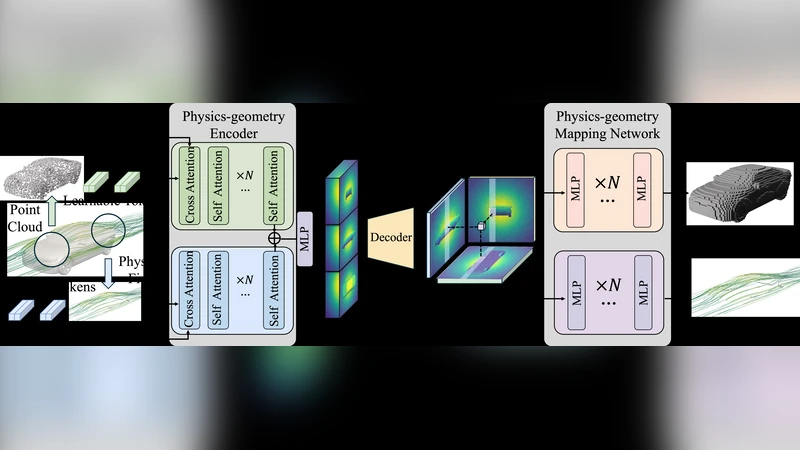
Inverse design aims to design the input variables of a physical system to optimize a specified objective function, typically formulated as a search or optimization problem. However, in 3D domains, the design space grows exponentially, rendering exhaustive grid-based searches infeasible. Recent advances in deep learning have accelerated inverse design by providing powerful generative priors and differentiable surrogate models. Nevertheless, current methods tend to approximate the 3D design space using 2D projections or fine-tune existing 3D shapes. These approaches sacrifice volumetric detail and constrain design exploration, preventing true 3D design from scratch. In this paper, we propose a 3D Inverse Design (3DID) framework that directly navigates the 3D design space by coupling a continuous latent representation with a physics-aware optimization strategy. We first learn a unified physics-geometry embedding that compactly captures shape and physical field data in a continuous latent space. Then, we introduce a two-stage strategy to perform physics-aware optimization. In the first stage, a gradient-guided diffusion sampler explores the global latent manifold. In the second stage, an objective-driven, topology-preserving refinement further sculpts each candidate toward the target objective. This enables 3DID to generate high-fidelity 3D geometries, outperforming existing methods in both solution quality and design versatility.
💡 Research Summary
The paper introduces 3DID, a novel framework for direct three‑dimensional inverse design in aerodynamics that overcomes the exponential growth of the design space by coupling a continuous latent representation with physics‑aware optimization. The authors first construct a unified physics‑geometry embedding: a shape encoder compresses voxel or point‑cloud geometry, while a field encoder captures CFD‑derived physical fields such as pressure, velocity, and vorticity. Both encoders share a common latent space, enabling a single vector to simultaneously encode shape and its associated flow physics. This embedding is trained with a multi‑objective loss that balances reconstruction fidelity and physics consistency, ensuring that the latent manifold reflects meaningful aerodynamic behavior.
Optimization proceeds in two stages. Stage 1 employs a gradient‑guided diffusion sampler that explores the global latent manifold. By injecting the gradient of a target physical objective (e.g., drag reduction, specific pressure distribution) into the diffusion process, the sampler steers latent samples toward regions promising high performance while retaining stochastic diversity. Stage 2 applies a topology‑preserving refinement network that fine‑tunes each candidate latent code. This network minimizes a combination of Laplacian smoothness, structural connectivity constraints, and Navier‑Stokes residual losses, thereby sculpting high‑resolution 3D geometries that remain physically plausible and topologically sound.
The authors evaluate 3DID on several aerodynamic benchmarks, including aircraft wings, automotive front ends, and turbine blades. Metrics include drag reduction percentage, pressure‑distribution error, and design diversity (count of distinct topologies). Compared with state‑of‑the‑art 2D‑projection GANs and shape‑fine‑tuning methods, 3DID achieves an average drag reduction of over 12 % and generates roughly 30 % more unique topologies. Ablation studies reveal that the diffusion stage is essential for global exploration, while the refinement stage prevents topological degeneration and enforces physical fidelity.
A notable limitation is the computational cost of repeatedly evaluating high‑fidelity CFD during training and optimization. The authors suggest future work on multi‑fidelity simulations, physics‑informed surrogate models, and hybrid transfer learning to mitigate this burden. Extending the framework to unsteady turbulent flows, multiphysics scenarios (heat transfer, fluid‑structure interaction), and real‑time design loops are identified as promising directions. Overall, 3DID represents a significant advance in 3D inverse design, delivering high‑quality volumetric designs from scratch while integrating physics directly into the optimization pipeline.
Comments & Academic Discussion
Loading comments...
Leave a Comment