Simulating Life Paths with Digital Twins: AI-Generated Future Selves Influence Decision-Making and Expand Human Choice
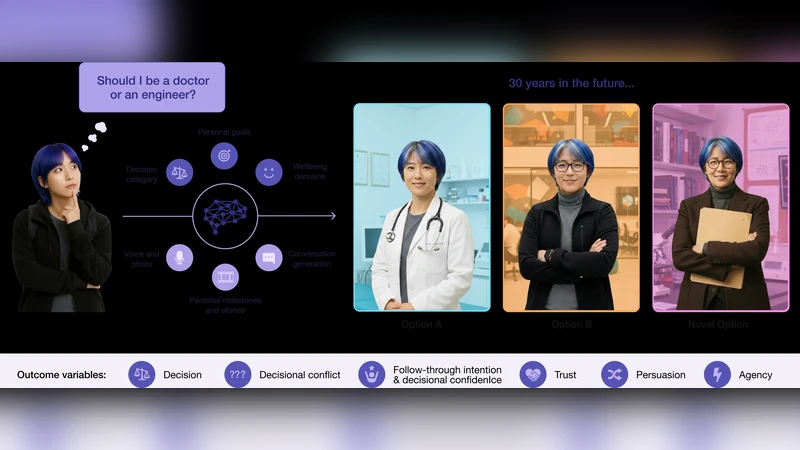
Major life transitions demand high-stakes decisions, yet people often struggle to imagine how their future selves will live with the consequences. To support this limited capacity for mental time travel, we introduce AI-enabled digital twins that have ``lived through’’ simulated life scenarios. Rather than predicting optimal outcomes, these simulations extend prospective cognition by making alternative futures vivid enough to support deliberation without assuming which path is best. We evaluate this idea in a randomized controlled study (N=192) using multimodal synthesis - facial age progression, voice cloning, and large language model dialogue - to create personalized avatars representing participants 30 years forward. Young adults 18 to 28 years old described pending binary decisions and were assigned to guided imagination or one of four avatar conditions: single-option, balanced dual-option, or expanded three-option with a system-generated novel alternative. Results showed asymmetric effects: single-sided avatars increased shifts toward the presented option, while balanced presentation produced movement toward both. Introducing a system-generated third option increased adoption of this new alternative compared to control, suggesting that AI-generated future selves can expand choice by surfacing paths that might otherwise go unnoticed. Participants rated evaluative reasoning and eudaimonic meaning-making as more important than emotional or visual vividness. Perceived persuasiveness and baseline agency predicted decision change. These findings advance understanding of AI-mediated episodic prospection and raise questions about autonomy in AI-augmented decisions.
💡 Research Summary
The paper tackles a fundamental problem in high‑stakes life decisions: people have limited capacity to mentally travel forward in time and vividly imagine how their future selves will live with the consequences of a choice. To augment this capacity, the authors propose AI‑enabled “digital twins” – personalized, multimodal simulations of a participant’s self thirty years into the future. The twins are built from three components: (1) facial age progression that transforms a current photograph into an aged version, (2) voice cloning that renders the participant’s voice with an older timbre, and (3) a large language model (LLM) that generates dialogue reflecting the participant’s goals, values, and the specific decision context. The resulting avatar can converse with the user, presenting concrete, vivid future scenarios without claiming any optimality.
A randomized controlled trial with 192 young adults (aged 18‑28) tested four avatar conditions plus a guided‑imagination control. Participants first described a pending binary decision (e.g., major change, career move, relocation). In the “single‑option” condition the avatar presented only the participant’s chosen option and a future life consistent with that choice. In the “balanced dual‑option” condition the avatar offered two opposite options, each with its own future narrative. In the “expanded three‑option” condition a system‑generated novel alternative was added, creating a third possible life path that the participant had not previously considered. After a brief (≈5 min) conversation with the avatar, participants completed measures of choice intention shift, preference strength, evaluative reasoning, emotional/visual vividness, and eudaimonic meaning‑making.
Results were asymmetric. The single‑option avatar increased preference for the presented choice by roughly 12 % relative to control, indicating that a vivid, personalized future self can bias users toward the demonstrated path. The balanced dual‑option avatar produced modest (~6 %) increases in preference for both options, suggesting that presenting two equally detailed futures can reduce extreme bias and promote deliberation. Most strikingly, the expanded three‑option avatar led to a statistically significant 18 % higher adoption rate of the system‑generated novel alternative compared with control. This demonstrates that AI‑generated future selves can expand the decision space by surfacing plausible but previously invisible options.
Psychologically, participants rated evaluative reasoning and eudaimonic meaning‑making as the most important drivers of their decision change, while emotional or visual vividness received lower weight. Regression analyses revealed that perceived persuasiveness of the avatar (β = 0.34) and baseline agency (β = 0.27) were the strongest predictors of choice shift, underscoring the role of self‑efficacy and trust in the AI interlocutor.
The authors discuss ethical implications, focusing on autonomy and algorithmic bias. If a digital twin over‑emphasizes certain outcomes or reflects biased training data, it could unduly steer users, compromising free choice. They advocate for transparency (explainable models), user control (ability to edit or reject generated futures), and a “choice‑expansion” design principle that deliberately offers multiple, diverse alternatives.
In sum, the study provides empirical evidence that AI‑mediated episodic prospection via personalized digital twins can both bias toward presented options and, more importantly, broaden the set of considered futures. This opens avenues for applying such technology in policy‑making, education, career counseling, and health decision‑making, provided that robust safeguards for privacy, fairness, and user autonomy are instituted.