Magnetic fields in galactic environments probed by Fast Radio Bursts
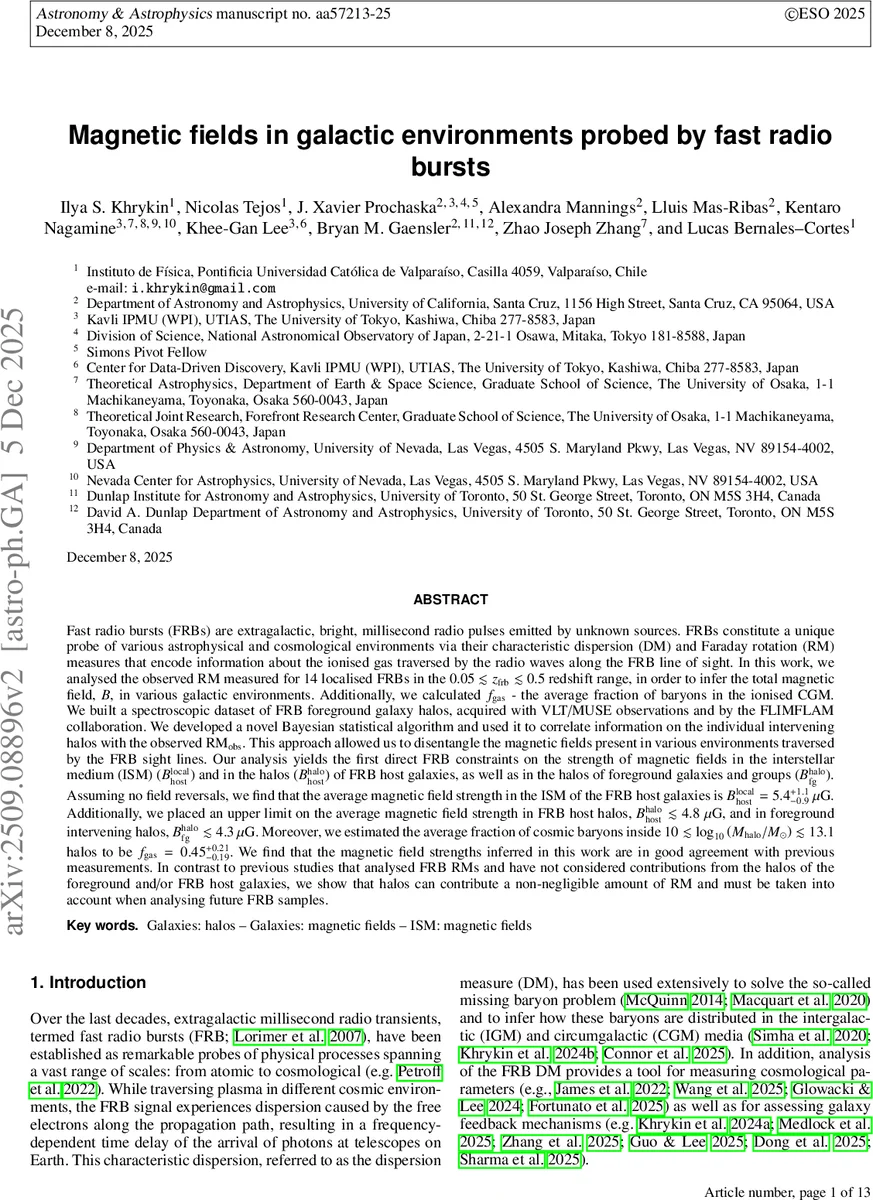
FRBs constitute a unique probe of various astrophysical and cosmological environments via their characteristic dispersion and rotation (RM) measures that encode information about the ionized gas traversed by the FRB sightlines. In this work, we analyse observed RM measured for 14 localized FRBs at $0.05 \lesssim z \lesssim 0.5$, to infer total magnetic fields in various galactic environments. Additionally, we calculate $f_{\rm gas}$ - the average fraction of halo baryons in the ionized CGM. We build a spectroscopic dataset of FRB foreground galaxy halos, acquired with VLT/MUSE and FLIMFLAM survey. We develop a novel Bayesian algorithm and use it to correlate the individual intervening halos with the observed RM. This approach allows us to disentangle the magnetic fields present in various environments traversed by the FRB. Our analysis yields the first direct FRB constraints on the strength of magnetic fields in the ISM and halos of the FRB host galaxies, as well as in halos of foreground galaxies. We find that the average magnetic field in the ISM of FRB hosts is $B_{\rm host}^{\rm local} = 5.44^{+1.13}{-0.87}μ{\rm G}$. Additionally, we place upper limits on average magnetic field in FRB host halos, $B{\rm host}^{\rm halo} < 4.81μ{\rm G}$, and in foreground intervening halos, $B_{\rm f/g}^{\rm halo} < 4.31μ{\rm G}$. Moreover, we estimate the average fraction of cosmic baryons inside $10 \lesssim \log_{10} \left( M_{\rm halo} / M_{\odot}\right) \lesssim 13.1$ halos $f_{\rm gas} = 0.45^{+0.21}_{-0.19}$. We find that the magnetic fields inferred in this work are in good agreement with previous measurements. In contrast to previous studies that analysed FRB RMs and have not considered contributions from the halos of the foreground and/or FRB host galaxies, we show that they can contribute a non-negligible amount of RM and must be taken into account when analysing future FRB samples.
💡 Research Summary
The authors present a comprehensive analysis of magnetic fields in galactic environments using rotation measures (RMs) from 14 well‑localized fast radio bursts (FRBs) spanning redshifts 0.05 ≲ z ≲ 0.5. By combining FRB dispersion measures (DMs) with high‑resolution spectroscopic observations of foreground galaxies obtained with VLT/MUSE and the FLIMFLAM survey, they construct a detailed model of the total observed RM for each burst. The model decomposes RM into contributions from the Milky Way (halo + disk), the intergalactic medium (IGM), the host galaxy’s interstellar medium (ISM) and halo, and any intervening foreground galaxy halos intersected by the line of sight.
A novel Bayesian Markov Chain Monte Carlo (MCMC) framework is developed to simultaneously infer the magnetic field strength in each component while accounting for observational uncertainties and the stochastic nature of magnetic field reversals. Stellar masses of foreground galaxies are derived via SED fitting (CIGALE) and converted to halo masses using the Moster et al. (2013) stellar‑to‑halo mass relation. Halos whose impact parameters are within their virial radii (r₍₂₀₀₎) are allowed to contribute to RM. The electron density profile in each halo is modeled with a β‑model, and the line‑of‑sight magnetic field is assumed to be uniform and non‑reversing for the purpose of deriving upper limits.
The Bayesian inference yields the following key results:
-
Host ISM magnetic field – The average line‑of‑sight magnetic field in the interstellar medium of FRB host galaxies is B_local_host = 5.44^{+1.13}_{-0.87} µG. This value is comparable to the Milky Way’s disk field and aligns with previous FRB‑based estimates.
-
Host halo magnetic field – An upper limit of B_halo_host < 4.81 µG is obtained for the circumgalactic medium (CGM) of the host galaxies.
-
Foreground halo magnetic field – Intervening foreground galaxy halos contribute at most B_halo_fg < 4.31 µG, demonstrating that foreground halos can provide a non‑negligible portion of the extragalactic RM.
-
Ionized CGM baryon fraction – By jointly fitting the RM and the known DM contributions, the average fraction of cosmic baryons residing in the ionized CGM of halos with 10 ≲ log₁₀(M_halo/M_⊙) ≲ 13.1 is f_gas = 0.45^{+0.21}_{-0.19}, consistent with independent measurements from quasar absorption line studies.
The authors also examine the correlation between extragalactic RM (RM_eg = RM_obs − RM_MW) and various DM components (total host DM, ISM host DM). Pearson correlation coefficients are low (r ≈ 0.10–0.19), indicating that RM and DM probe different physical aspects—magnetic field strength and orientation versus electron column density.
A discussion of systematic uncertainties highlights that assuming a non‑reversing magnetic field yields conservative upper limits; if field reversals are common, the true field strengths could be higher. The IGM contribution remains poorly constrained with the current sample but could be isolated with larger FRB datasets and improved Milky Way RM models.
Overall, this work demonstrates that FRB rotation measures, when combined with detailed foreground galaxy spectroscopy and a robust Bayesian framework, can disentangle magnetic field contributions from multiple galactic environments. It establishes a methodological baseline for future large‑scale FRB surveys (e.g., CHIME/FRB, ASKAP, DSA‑110) aiming to map magnetic fields across cosmic time and to refine the baryon census in the circumgalactic medium.
Comments & Academic Discussion
Loading comments...
Leave a Comment