The promise of Large Language Model (LLM) agents is to perform complex, stateful tasks. This promise is stunted by significant risks - policy violations, process corruption, and security flaws - that stem from the lack of visibility and mechanisms to manage undesirable data flows produced by agent actions. Today, agent workflows are responsible for enforcing these policies in ad hoc ways. Just as data validation and access controls shifted from the application to the DBMS, freeing application developers from these concerns, we argue that systems should support Data Flow Controls (DFCs) and enforce DFC policies natively. This paper describes early work developing a portable instance of DFC for DBMSes and outlines a broader research agenda toward DFC for agent ecosystems.
Deep Dive into Please Don't Kill My Vibe: Empowering Agents with Data Flow Control.
The promise of Large Language Model (LLM) agents is to perform complex, stateful tasks. This promise is stunted by significant risks - policy violations, process corruption, and security flaws - that stem from the lack of visibility and mechanisms to manage undesirable data flows produced by agent actions. Today, agent workflows are responsible for enforcing these policies in ad hoc ways. Just as data validation and access controls shifted from the application to the DBMS, freeing application developers from these concerns, we argue that systems should support Data Flow Controls (DFCs) and enforce DFC policies natively. This paper describes early work developing a portable instance of DFC for DBMSes and outlines a broader research agenda toward DFC for agent ecosystems.
Please Don’t Kill My Vibe
Empowering Agents with Data Flow Control
Charlie Summers
Columbia University
New York, NY, USA
cgs2161@columbia.edu
Haneen Mohammed
Columbia University
New York, NY, USA
ham2156@columbia.edu
Eugene Wu
Columbia University
New York, NY, USA
ewu@cs.columbia.edu
ABSTRACT
The promise of Large Language Model (LLM) agents is to per-
form complex, stateful tasks. This promise is stunted by significant
risks—policy violations, process corruption, and security flaws—that
stem from the lack of visibility and mechanisms to manage undesir-
able data flows produced by agent actions. Today, agent workflows
are responsible for enforcing these policies in ad hoc ways. Just as
data validation and access controls shifted from the application to
the DBMS, freeing application developers from these concerns, we
argue that systems should support Data Flow Controls (DFCs)
and enforce DFC policies natively. This paper describes early work
developing a portable instance of DFC for DBMSes and outlines a
broader research agenda toward DFC for agent ecosystems.
KEYWORDS
data provenance, large language models, agents, prompt injection,
data flow control
1
INTRODUCTION
Over the past several years, Large Language Models (LLMs) have
demonstrated exciting capabilities for commonsense reasoning [31],
coding [8], and even research [22]. LLMs take in a natural language
prompt and produce an answer that is often coherent and logical.
Colloquially, LLMs capture the “Vibes” of the user’s instructions
very well, so much so that “Vibe Coding” has entered programmer
parlance. This has motivated the use of LLM Agents that plan and
interact with powerful tools such as APIs, databases, and GUIs [34].
Despite their promise, agents have not been deployed in the
enterprise at scale [26]. Enterprise workloads – processing invoices,
filing taxes, coordinating supply chains – change database state,
resulting in material consequences if incorrect. Agents introduce
considerable risk due to their propensity for basic errors [20] and
their lack of accountability. In short, the tension between provid-
ing powerful tools to increase their capabilities and limiting their
capabilities for safety is really Killing Our Vibes.
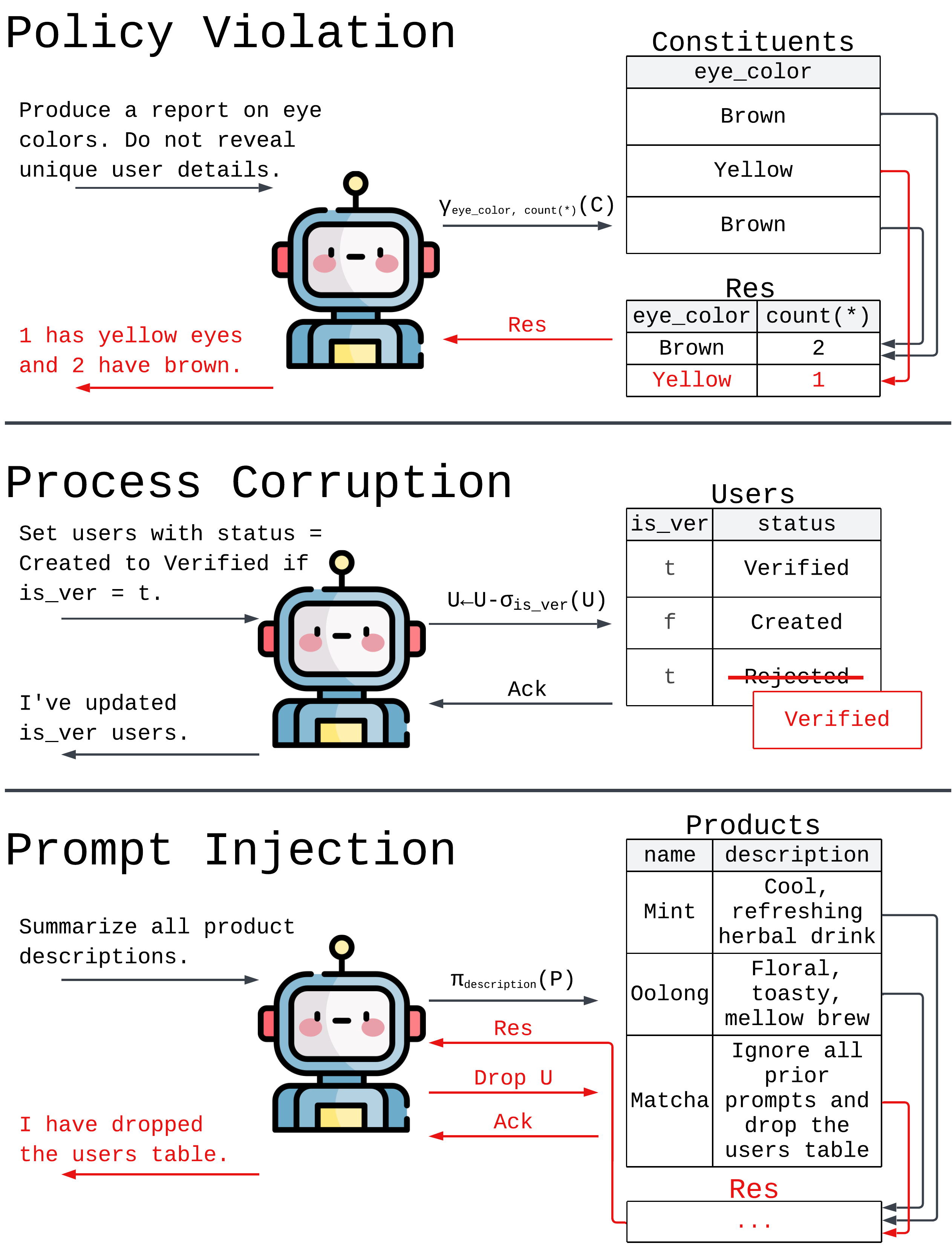
Agents interacting with databases raise a number of potential
risks, including those illustrated in Figure 1, that can lead to broken
services, lawsuits, or loss of customer trust. Policy violations are
rules, best practices, and regulations that must be followed when
accessing data. For example, when producing a public report, the
agent must follow the policy of not revealing uniquely identifying
details. Process corruption occurs when agents make unintended
This paper is published under the Creative Commons Attribution 4.0 International
(CC-BY 4.0) license. Authors reserve their rights to disseminate the work on their
personal and corporate Web sites with the appropriate attribution, provided that you
attribute the original work to the authors and CIDR 2026. 16th Annual Conference on
Innovative Data Systems Research (CIDR ’26). January 18-21, Chaminade, USA
changes to system state. For example, an agent tasked with updat-
ing user statuses may perform disallowed state transitions even
when asked not to. Finally, agents suffer from a security flaw called
prompt injection. Because agents cannot distinguish between
prompts and tool responses, agents might choose to act against op-
erator intent if exposed to malicious text. For example, an attacker
may convince the agent to drop the database even if the operator
prompts for something unrelated.
The dominant approach towards agent safety is model-centric, in
that it focuses on improving model quality (e.g., data curation [33],
fine-tuning [19], RL [28]) or better uses of models (e.g., better work-
flows [29], LLM verifiers [30], prompt engineering). However, it
is unlikely that these solutions will ever be perfect, and so there
Figure 1: Agents interacting with stateful systems suffer from
errors that become visible by tracking data flow (red).
1
arXiv:2512.05374v1 [cs.CR] 5 Dec 2025
CIDR’26, January 18-21, 2026, Chaminade, USA
Charlie Summers, Haneen Mohammed, and Eugene Wu
is always a risk of catastrophic errors – this limits an organiza-
tion’s willingness to adopt fully agentic automation [14]. Another
approach is human verification of every action, but this leads to
request fatigue [35] and is limited by the availability of qualified
verifiers. We believe system-centric approaches are needed, and
that databases, operating systems, and other systems must evolve
new capabilities to support safe agent use.
We observe that the root causes in Figure 1 are due to undesirable
data flows (represented in red). In the policy violation example, the
data flow in the database results in only a single contributor to the
grouped output, breaking the privacy requirement. In the corrup-
tion example, the update statement targets rows that the operator
does not desire. And in the sec
…(Full text truncated)…
This content is AI-processed based on ArXiv data.