Comparisons of Infinite Sets
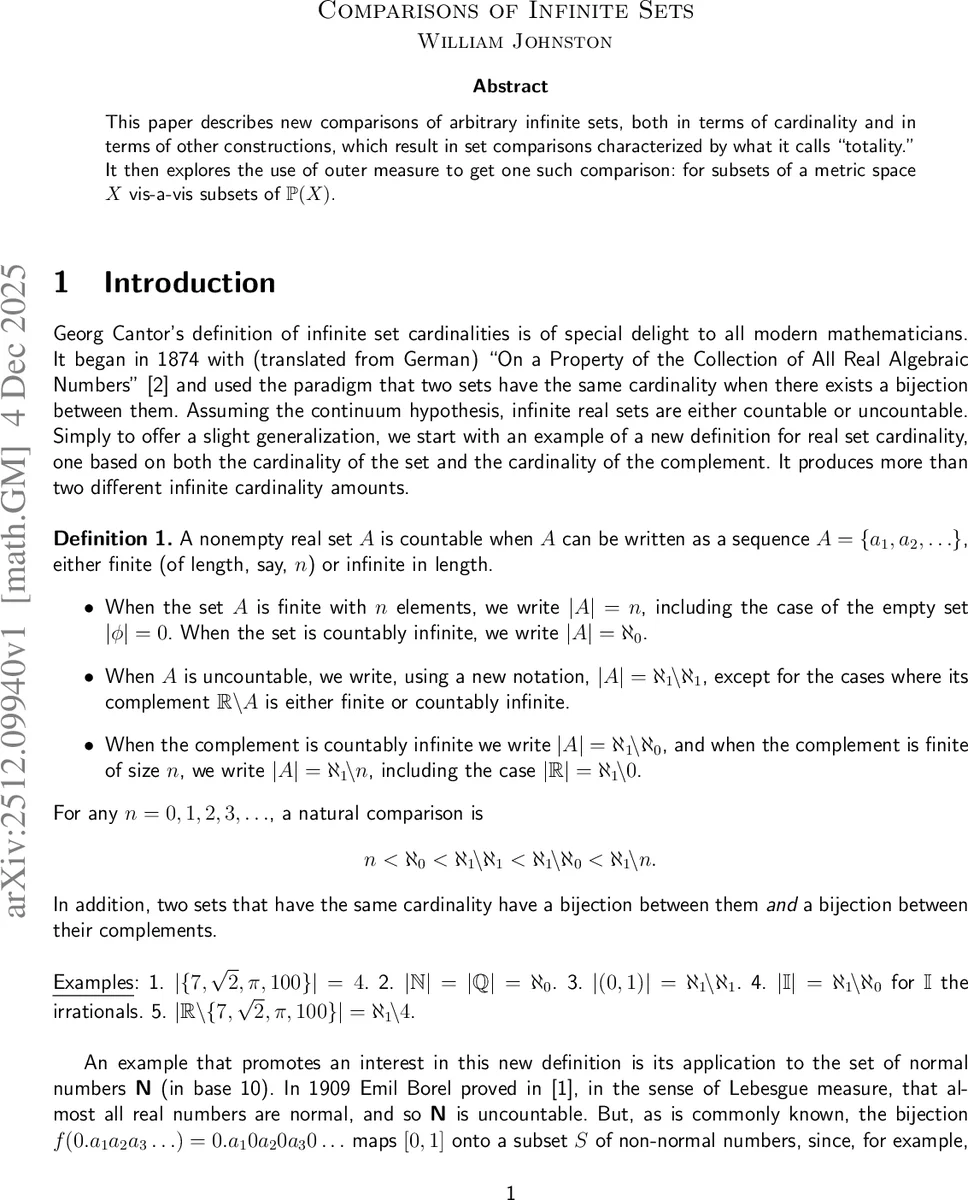
This paper describes new comparisons of arbitrary infinite sets, both in terms of cardinality and in terms of other constructions, which result in set comparisons characterized by what it calls ``totality.’’ It then explores the use of outer measure to get one such comparison: for subsets of a metric space X vis-a-vis subsets of its power set P(X).
💡 Research Summary
This paper proposes novel frameworks for comparing the sizes of infinite sets, moving beyond the traditional bijection-based cardinality established by Georg Cantor. It introduces two main conceptual innovations: a refined cardinality notation for subsets of the real numbers and a more general concept called “totality,” which is then used to compare sets of fundamentally different types, such as points in a metric space and collections of subsets.
The first part redefines cardinality for real sets by considering both the set and its complement. Under this scheme, an uncountable set A is assigned a cardinality of ℵ₁\ℵ₁ if its complement is also uncountable, ℵ₁\ℵ₀ if its complement is countable, and ℵ₁\n if its complement is finite with n elements. This creates a more granular hierarchy than the standard countable/uncountable dichotomy, intuitively distinguishing sets like the irrationals (ℵ₁\ℵ₀) from a generic uncountable set like (0,1) (ℵ₁\ℵ₁).
The paper then introduces “totality” as a broader comparative concept satisfying specific axioms: it must be uniquely defined for every subset, agree with finite cardinality for finite sets, and be monotonic. A step-by-step refinement process is exemplified, where sets are iteratively partitioned into more and more totality classes (denoted Ω_s, like Ω₀, Ω₁/₂, Ω₁/₃), effectively creating a finer-grained “size” spectrum than cardinality allows, even for sets between which a bijection exists.
The core technical contribution addresses the challenge of comparing subsets of a metric space (X, d) with subsets of its power set P(X). The goal is to establish a “strategic totality pair” that allows meaningful, formulaically determined comparisons between these different types of collections. The proposed method utilizes outer measure. The metric d is used to define a “metric outer measure” m on X. Then, using the Hausdorff metric induced by d on P(X), a corresponding outer measure μ is constructed on P(X). Theorem 1 proves that the totalities derived from these two outer measures (Ω_m for subsets of X and Ω_μ for subsets of P(X)) form a strategic totality pair. This provides a principled way to say, for instance, that an interval in R and a specific collection of subsets in P(R) have the “same size” in this totality sense, with the comparison rooted solely in the underlying metric topology.
In conclusion, the framework extends beyond comparing X and P(X) to comparisons between any two metric spaces via their respective metric outer measures. It offers a complementary perspective to Cantor’s theorem; while P(X) always has a greater cardinality than X, they can share the same infinite totality (Ω∞) under this constructed measure-based system. This approach opens avenues for analyzing the “size” of complex mathematical objects, such as function spaces and their power sets, based on their topological structure rather than mere bijections.
Comments & Academic Discussion
Loading comments...
Leave a Comment