📝 Original Info
- Title: Towards 6G Native-AI Edge Networks: A Semantic-Aware and Agentic Intelligence Paradigm
- ArXiv ID: 2512.04405
- Date: 2025-12-04
- Authors: Chenyuan Feng, Anbang Zhang, Geyong Min, Yongming Huang, Tony Q. S. Quek, Xiaohu You
📝 Abstract
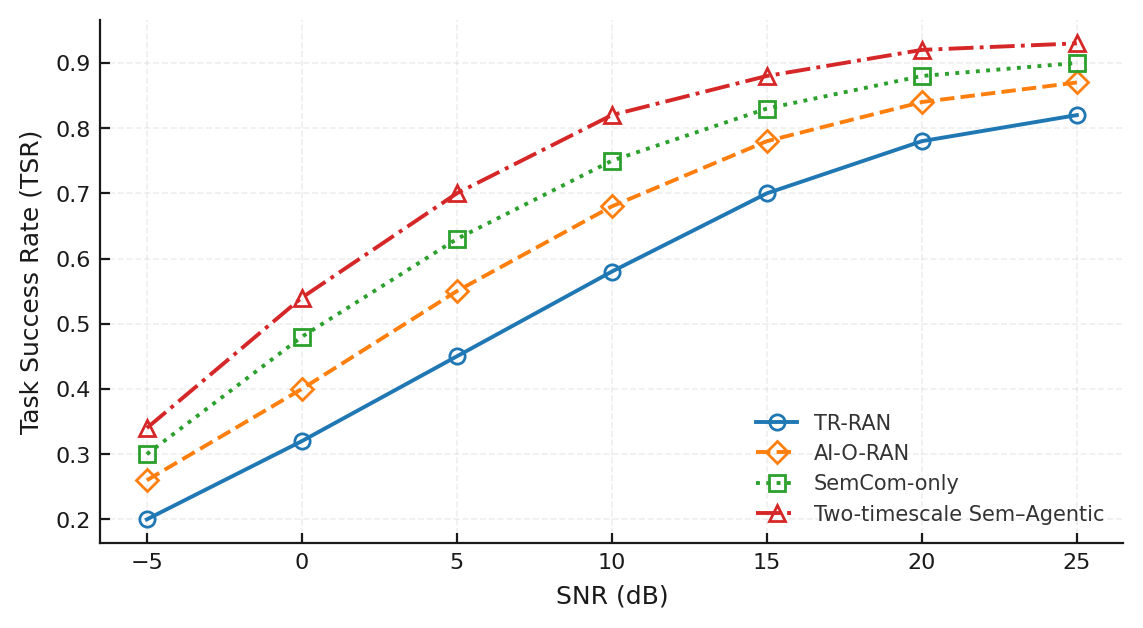
The evolution toward sixth-generation (6G) wireless systems positions intelligence as a native network capability, fundamentally transforming the design of radio access networks (RANs). Within this vision, Semantic-native communication (SemCom) and agentic intelligence are expected to play central roles. SemCom departs from bit-level fidelity and instead emphasizes task-oriented meaning exchange, enabling compact semantic representations and introducing new performance measures such as semantic fidelity and task success rate (TSR). Agentic intelligence endows distributed RAN entities with goal-driven autonomy, reasoning, planning, and multi-agent collaboration, increasingly supported by foundation models and knowledge graphs. In this work, we first introduce the conceptual foundations of SemCom and agentic networking, and discuss why existing AIdriven O-RAN solutions remain largely bit-centric and task-siloed. We then present a unified taxonomy that organizes recent research along three axes: i) semantic abstraction level (symbol/feature/intent/knowledge), ii) agent autonomy and coordination granularity (single-, multi-, and hierarchical-agent), and iii) RAN control placement across PHY/MAC, near-real-time RIC, and non-real-time RIC. Based on this taxonomy, we systematically introduce enabling technologies including task-oriented semantic encoders/decoders, multi-agent reinforcement learning, foundation-model-assisted RAN agents, and knowledge-graphbased reasoning for cross-layer awareness. Representative 6G use cases, such as immersive XR, vehicular V2X, and industrial digital twins, are analyzed to illustrate the semantic-agentic convergence in practice. Finally, we identify open challenges in semantic representation standardization, scalable trustworthy agent coordination, O-RAN interoperability, and energy-efficient AI deployment, and outline research directions toward operational semantic-agentic AI-RAN.
💡 Deep Analysis
Deep Dive into Towards 6G Native-AI Edge Networks: A Semantic-Aware and Agentic Intelligence Paradigm.
The evolution toward sixth-generation (6G) wireless systems positions intelligence as a native network capability, fundamentally transforming the design of radio access networks (RANs). Within this vision, Semantic-native communication (SemCom) and agentic intelligence are expected to play central roles. SemCom departs from bit-level fidelity and instead emphasizes task-oriented meaning exchange, enabling compact semantic representations and introducing new performance measures such as semantic fidelity and task success rate (TSR). Agentic intelligence endows distributed RAN entities with goal-driven autonomy, reasoning, planning, and multi-agent collaboration, increasingly supported by foundation models and knowledge graphs. In this work, we first introduce the conceptual foundations of SemCom and agentic networking, and discuss why existing AIdriven O-RAN solutions remain largely bit-centric and task-siloed. We then present a unified taxonomy that organizes recent research along thre
📄 Full Content
The sixth generation (6G) of wireless communication networks is expected to go beyond terabit-persecond data rates and sub-millisecond latency, and to serve as an intelligence-native, knowledge-driven infrastructure supporting emerging services such as holographic extended reality (XR), industrial digital twins, massive Internet-of-Things (IoT), and autonomous vehicular networks [1,2,3,4]. In contrast to previous generations where AI plays an auxiliary role, 6G envisions learning, reasoning, and decisionmaking embedded across the protocol stack, enabling a self-evolving radio access network (RAN) [5,6,7]. Despite this vision, current RAN operation and AIenabled O-RAN controllers remain largely rooted in a bit-centric Shannon abstraction, optimizing through-put, bit error rate (BER), or quality of service (QoS) without explicitly accounting for the meaning or task relevance of exchanged information [8,9]. This mismatch is particularly pronounced for task-oriented services, where achieving the correct intent or outcome is more important than exact symbol recovery. Semantic communication (SemCom) addresses this gap by transmitting compact, task-relevant semantic representations and by evaluating performance via semantic fidelity and task success rate (TSR), rather than solely bit-level metrics [10,11,12].
In parallel, the scale and heterogeneity anticipated in 6G RAN, including ultra-dense deployments, dynamic spectrum sharing, and tightly coupled crosslayer interactions, render purely centralized intelligence increasingly unsustainable. Network entities such as base stations, edge servers, and user devices thus need to evolve into autonomous, goal-driven agents capable of local perception, reasoning, planning, and multi-agent coordination. This agentic intelligence paradigm provides proactive and scalable control, complementing SemCom by determining what semantic information to exchange, when to exchange it, and at what abstraction level.
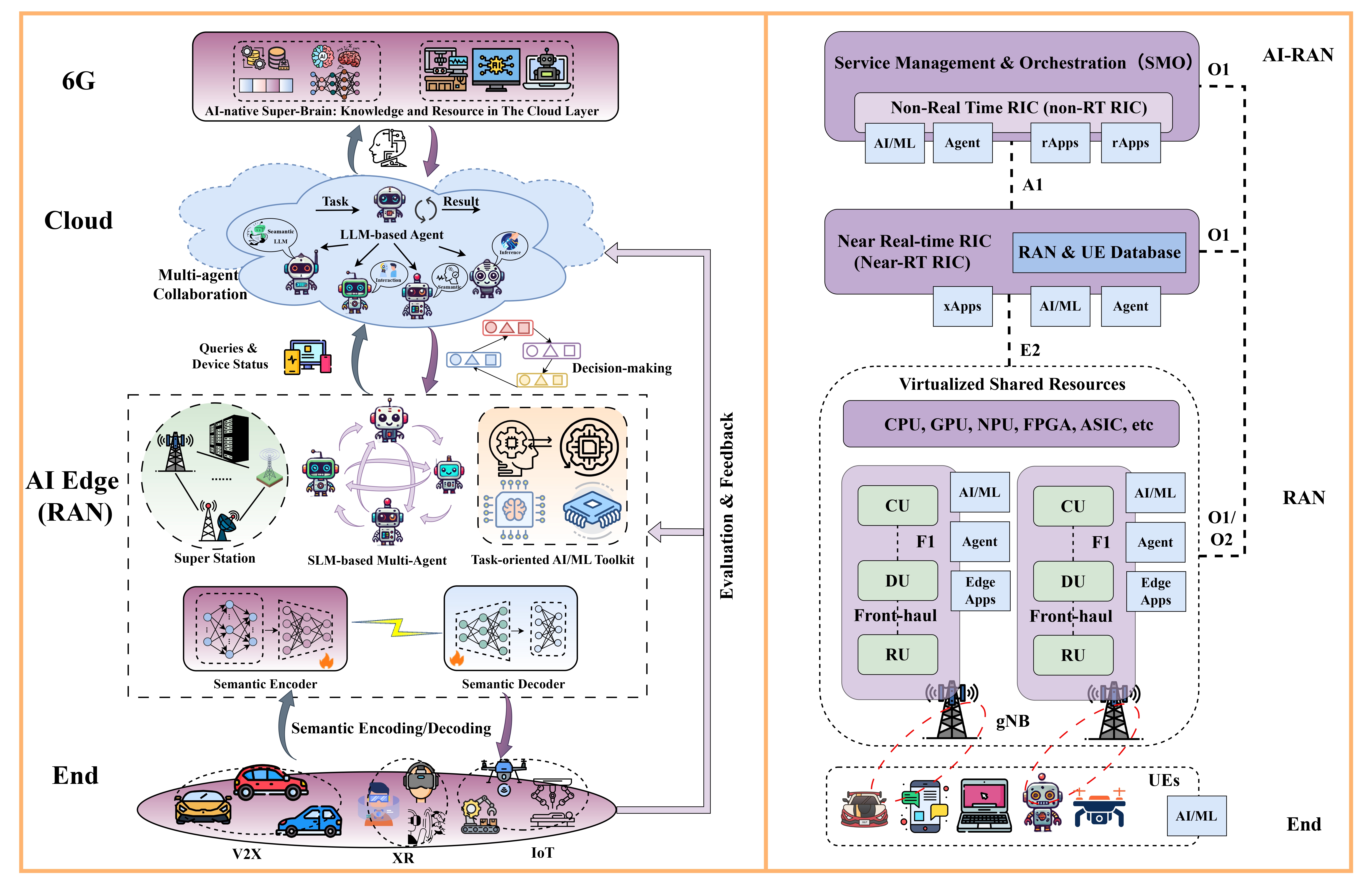
Recent advances have produced promising Sem-Com prototypes and distributed learning approaches for wireless networks, while AI-driven O-RAN has introduced open interfaces and hierarchical RAN Intelligent Controllers (near-RT and non-RT RICs) that facilitate xApp/rApp deployment [13]. However, several gaps hinder the realization of a task-effective, scalable 6G AI-RAN: (i) most SemCom designs are domain-specific, offering limited reusability across tasks and lacking standardized semantic representations or fidelity metrics; (ii) existing RIC-based AI solutions typically target narrow functions and face scalability challenges when coordinating many autonomous agents; (iii) trust, explainability, and security for distributed agent decisions remain underdeveloped; and (iv) energy-and latency-aware deployment of large semantic/agentic models is still challenging.
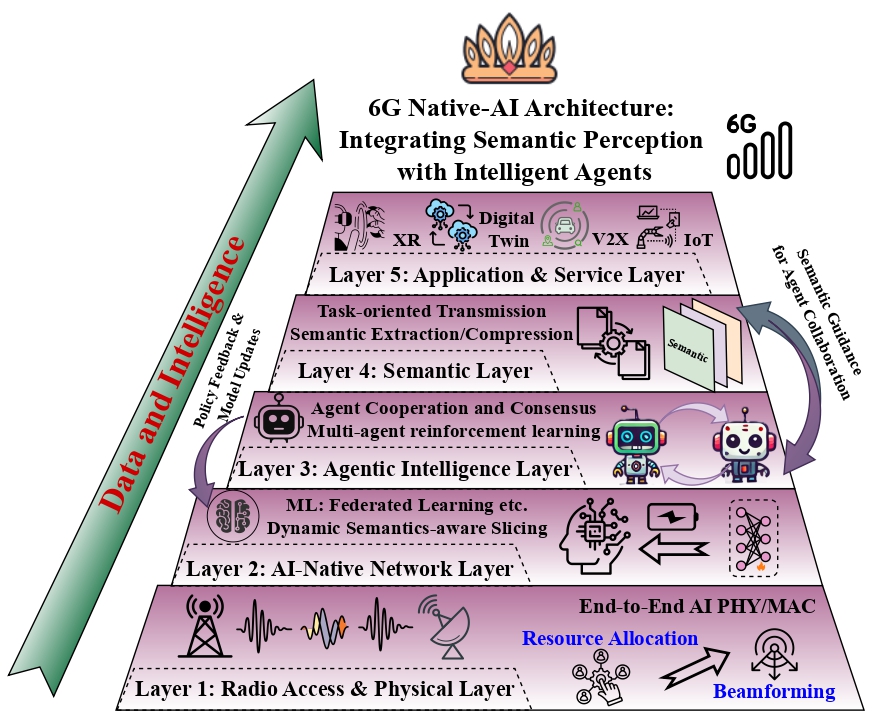
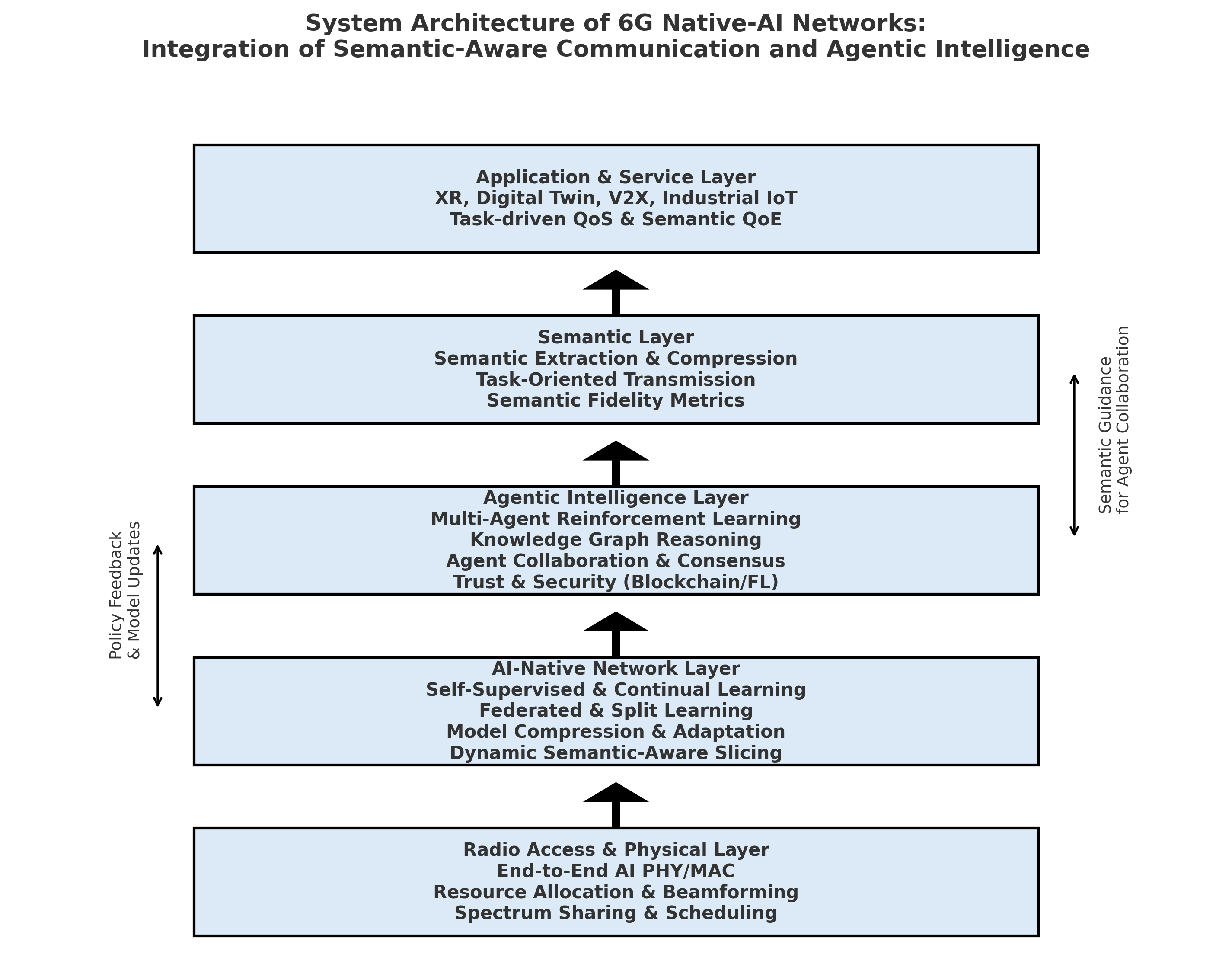
These gaps motivate an integrated view of semantic-aware and agentic AI-RAN for 6G. This work systematically reviews how SemCom and agentic intelligence can be jointly designed and deployed within the O-RAN architecture to enable a closedloop, self-evolving Native-AI RAN. The main contributions are summarized as follows. (i) Conceptual unification of semantic and agentic AI-RAN: We articulate a 6G Native-AI RAN paradigm where semantic representations and autonomous agents form a closed-loop self-evolving system, and clarify the roles of semantic fidelity and TSR as task-level KPIs. (ii) A three-axis taxonomy for semantic-agentic research: We propose a unified taxonomy along semantic abstraction level → agent autonomy/coordination granularity → RAN control placement (PHY/MAC, near-RT RIC, non-RT RIC), enabling systematic compar-ison of existing works. (iii) Summary of enabling technologies: We review key technical enablers including task-oriented semantic encoder/decoder design and metrics, scalable multi-agent learning and negotiation, foundation-model-augmented (planningoriented) agents, and knowledge-graph-based crosslayer reasoning and orchestration. (iv) Use cases and evaluation perspectives: We map semantic-agentic methods to representative 6G services (XR, V2X, digital twins, edge intelligence), and summarize datasets, benchmarks, and task-level KPIs beyond conventional BER and throughput. (v) Open challenges and standardization directions: We identify high-impact open issues in semantic representation/metric standardization, scalable and trustworthy multi-agent control, interoperability with O-RAN interfaces, and energyaware AI design, and outline potential evolution paths for future standardization.
Research toward 6G Native-AI RAN is converging along two historically separate threads: Sem-Com, which redefines the communication abstraction from bits to meaning, and agentic intelligence, which equips distributed RAN entities with goaldriven autonomy. Existing studies typically examine these threads in isolation-e.g., focusing on endto-end semantic encoders/decoders or on MARLbased RAN control-while practical d
…(Full text truncated)…
📸 Image Gallery
Reference
This content is AI-processed based on ArXiv data.