Statistical Analysis of weather variables of Antofagasta
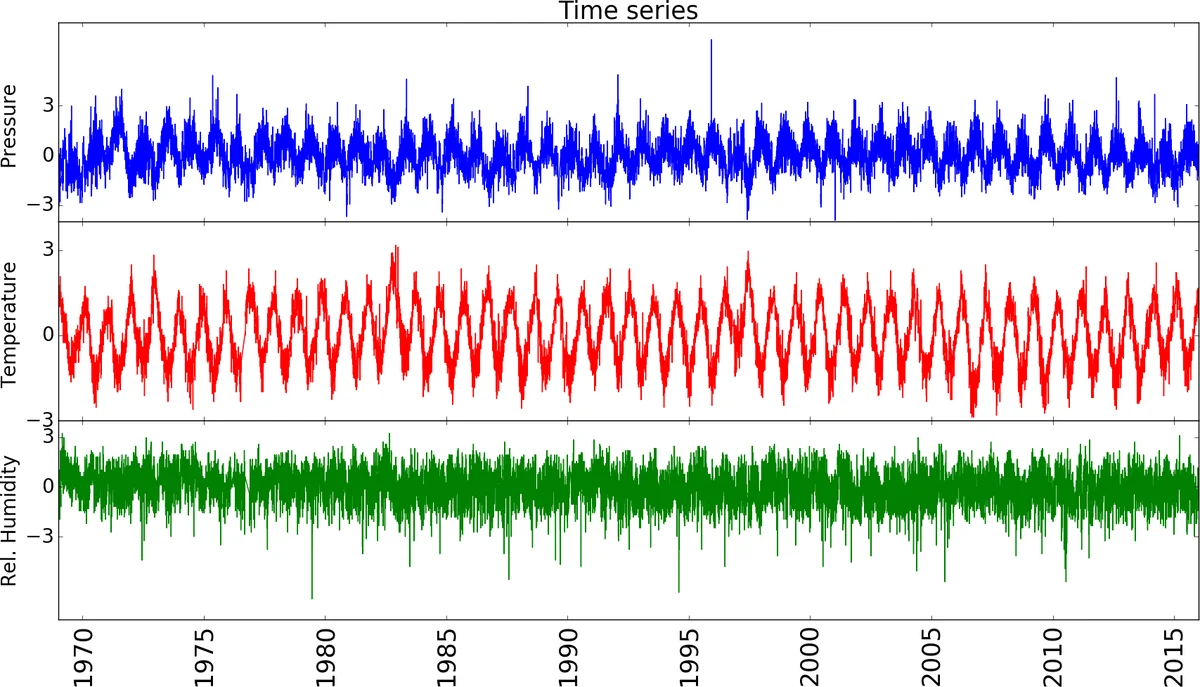
The statistical behavior of weather variables of Antofagasta is described, especially the daily data of air as temperature, pressure and relative humidity measured at 08:00, 14:00 and 20:00. In this article, we use a time series deseasonalization technique, Q-Q plot, skewness, kurtosis and the Pearson correlation coefficient. We found that the distributions of the records are symmetrical and have positive kurtosis, so they have heavy tails. In addition, the variables are highly autocorrelated, extending up to one year in the case of pressure and temperature.
💡 Research Summary
The paper presents a comprehensive statistical examination of three key atmospheric variables—air temperature, atmospheric pressure, and relative humidity—recorded at three daily times (08:00, 14:00, and 20:00) at the Universidad Católica del Norte meteorological station in Antofagasta, Chile, covering the period from 1969 to 2016. The authors first apply a classic deseasonalization procedure, calculating the mean for each calendar day across all years and subtracting this daily climatology from the original series to obtain residuals that are free of the dominant annual cycle. This step isolates the intrinsic variability of each variable, which is essential for subsequent distributional and correlation analyses.
The distributional properties of the residuals are investigated using histograms, normal probability Q‑Q plots, skewness (γ₁), and kurtosis (γ₂). The Q‑Q plots reveal that, for all three variables and all three observation times, the bulk of the data aligns closely with a theoretical normal distribution, indicating approximate Gaussian behavior. However, deviations appear in the tails, where the empirical quantiles diverge from the straight line. Skewness values are near zero (ranging from –0.39 to +0.44), confirming that the residuals are essentially symmetric about their means. In contrast, kurtosis values are consistently greater than the Gaussian benchmark of 3 (e.g., temperature at 14:00 shows γ₂ = 8.37, humidity at 08:00 γ₂ = 3.76). This leptokurtic character signals heavier tails than a normal distribution, implying a higher probability of extreme deviations and suggesting the presence of memory effects in the time series.
To quantify temporal dependence, the authors compute Pearson autocorrelation coefficients for each variable at each observation time, generating correlograms that extend up to several hundred days. Pressure exhibits a rapid decay of autocorrelation within roughly one month, followed by a gradual decline that approaches zero after about ten months. Temperature displays an even slower decay, retaining statistically significant positive autocorrelation for nearly a full year; the effect is most pronounced at 14:00, coinciding with the peak of solar radiation. Relative humidity shows a fast initial drop in autocorrelation over a few weeks, then a plateau that persists for several months at 08:00 and 20:00, while at 14:00 the correlation diminishes after about one month but remains weakly positive after a year. These differing decay patterns reflect the distinct physical drivers of each variable—pressure and temperature being governed by large‑scale atmospheric dynamics and radiative forcing, whereas humidity is more responsive to local moisture fluxes and diurnal cycles.
The discussion interprets the findings in the context of Antofagasta’s climatology. The strong annual cycle, driven by the persistent Southeast Pacific Subtropical Anticyclone, the proximity of the Andes, and the Humboldt Current, must be removed to reveal the underlying stochastic structure. The symmetric yet leptokurtic distributions, together with the long‑lasting autocorrelations for pressure and temperature, indicate that the atmospheric state retains memory over seasonal to interannual timescales. This has practical implications: climate models or statistical forecasting systems for the region should incorporate long‑range dependence for pressure and temperature, while humidity forecasts may rely more heavily on short‑term predictors. The heavy‑tailed nature also warns of a non‑negligible risk of extreme events (e.g., sudden temperature spikes or pressure drops), which could affect infrastructure and public safety.
In summary, the study demonstrates that relatively simple statistical tools—deseasonalization, Q‑Q analysis, skewness/kurtosis assessment, and Pearson autocorrelation—are sufficient to uncover important characteristics of Antofagasta’s atmospheric variables. The results highlight the need for models that capture both the heavy‑tailed distributional behavior and the prolonged temporal dependencies, especially for temperature and pressure. Future work could extend the analysis by employing nonlinear time‑series models, multivariate autoregressive frameworks, or incorporating external climate drivers such as ENSO and sea‑surface temperature anomalies to deepen the understanding of regional climate variability.
Comments & Academic Discussion
Loading comments...
Leave a Comment