📝 Original Info
- Title: DiscoverDCP: A Data-Driven Approach for Construction of Disciplined Convex Programs via Symbolic Regression
- ArXiv ID: 2512.15721
- Date: 2025-12-03
- Authors: - Sveinung Myhre (Department of Electrical Engineering and Computer Sciences, University of California, Berkeley, s.myhre@berkeley.edu)
📝 Abstract
We propose DiscoverDCP, a data-driven framework that integrates symbolic regression with the rule sets of Disciplined Convex Programming (DCP) to perform system identification. By enforcing that all discovered candidate model expressions adhere to DCP composition rules, we ensure that the output expressions are globally convex by construction, circumventing the computationally intractable process of post-hoc convexity verification. This approach allows for the discovery of convex surrogates that exhibit more relaxed and accurate functional forms than traditional fixed-parameter convex expressions (e.g., quadratic functions). The proposed method produces interpretable, verifiable, and flexible convex models suitable for safety-critical control and optimization tasks.
💡 Deep Analysis
Deep Dive into DiscoverDCP: A Data-Driven Approach for Construction of Disciplined Convex Programs via Symbolic Regression.
We propose DiscoverDCP, a data-driven framework that integrates symbolic regression with the rule sets of Disciplined Convex Programming (DCP) to perform system identification. By enforcing that all discovered candidate model expressions adhere to DCP composition rules, we ensure that the output expressions are globally convex by construction, circumventing the computationally intractable process of post-hoc convexity verification. This approach allows for the discovery of convex surrogates that exhibit more relaxed and accurate functional forms than traditional fixed-parameter convex expressions (e.g., quadratic functions). The proposed method produces interpretable, verifiable, and flexible convex models suitable for safety-critical control and optimization tasks.
📄 Full Content
DiscoverDCP: A Data-Driven Approach for
Construction of Disciplined Convex Programs via
Symbolic Regression
Sveinung Myhre
Department of Electrical Engineering and Computer Sciences
University of California, Berkeley
Berkeley, CA 94720
s.myhre@berkeley.edu
Abstract
We propose DiscoverDCP, a data-driven framework that integrates symbolic re-
gression with the rule sets of Disciplined Convex Programming (DCP) to perform
system identification. By enforcing that all discovered candidate model expres-
sions adhere to DCP composition rules, we ensure that the output expressions are
globally convex by construction, circumventing the computationally intractable
process of post-hoc convexity verification. This approach allows for the discovery
of convex surrogates that exhibit more relaxed and accurate functional forms than
traditional fixed-parameter convex expressions (e.g., quadratic functions). The
proposed method produces interpretable, verifiable, and flexible convex models
suitable for safety-critical control and optimization tasks.
1
Introduction
Convex optimization plays a central role in numerous applications including engineering, control
theory, statistics, and machine learning, largely due to its strong theoretical guarantees for tractability
and global optimality [1]. Ensuring that an optimization problem is convex relies on having a convex
objective and convex constraints on a convex domain. Traditionally, practitioners rely on models
known a priori to be convex, such as linear or quadratic functions with positive definite Hessians,
typically of the form:
f(x) = x⊤Ax + b⊤x + c.
(1)
However, restricting models to such simple families can severely limit expressiveness and the ability
to capture complex system dynamics.
The Disciplined Convex Programming (DCP) framework, introduced by Grant et al. [2], provides a
library of atoms and a set of compositional rules that guarantee convexity. If a function is constructed
according to these rules (e.g., sums of convex functions, compositions with non-decreasing convex
functions), the result is guaranteed to be convex. While the set of DCP-compliant functions is a
subset of all convex functions, determining if a function is DCP is algorithmically straightforward
[3], whereas verifying general convexity is NP-hard.
Despite the utility of DCP, discovering suitable convex expressions from raw data remains challenging.
Existing practice typically involves linearization or fitting parametric convex families. In parallel,
symbolic regression (SR) has emerged as a powerful technique for discovering interpretable analytic
expressions directly from data [4]. While standard SR does not ensure convexity, modern tools allow
for custom operator constraints.
This paper proposes DiscoverDCP, a framework that leverages symbolic regression under the
structural constraints imposed by DCP rules. By restricting the search space of symbolic regression
Preprint. Under review.
arXiv:2512.15721v1 [cs.LG] 3 Dec 2025
to operations and compositions that preserve convexity, we algorithmically learn convex models from
data. This approach yields interpretable mathematical expressions which are guaranteed to be convex
by construction.
Our Contributions.
To the best of our knowledge, this work represents the first direct integration
of symbolic regression with Disciplined Convex Programming rulesets. Our specific contributions
are:
• We propose DiscoverDCP, a method that restricts the symbolic regression search space to
DCP-compliant operations, guaranteeing global convexity of learned models by construction.
• We demonstrate that this approach eliminates the need for intractable post-hoc convexity
verification while offering greater interpretability than neural network-based approaches.
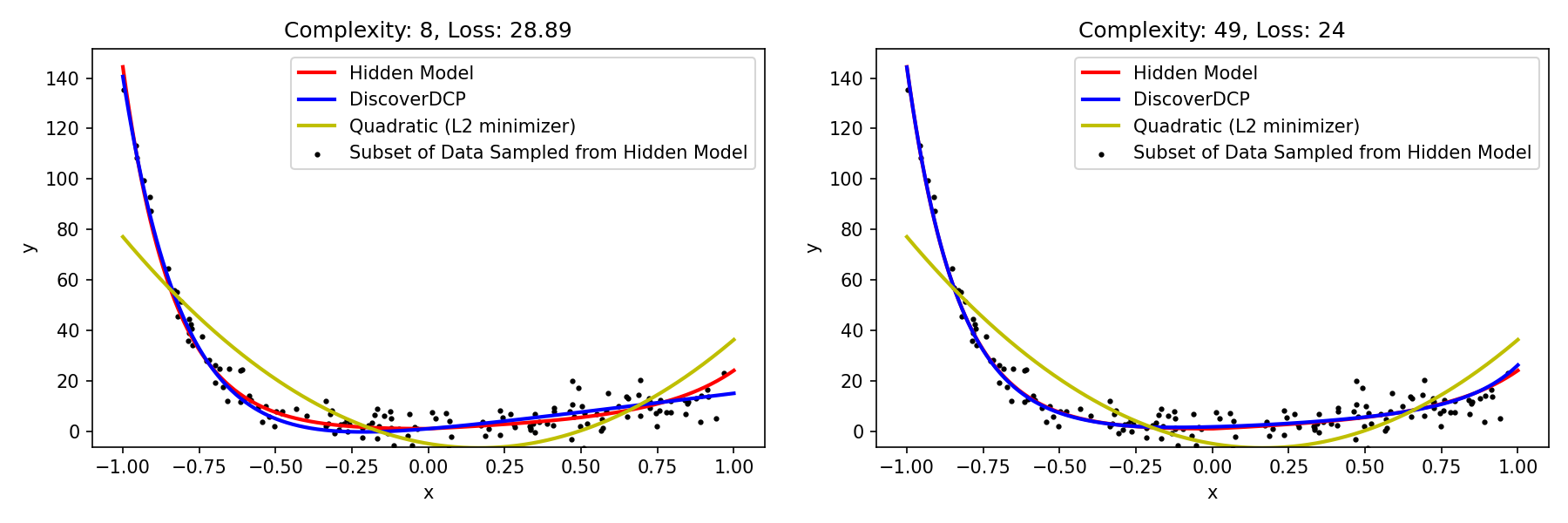
• We show via synthetic experiments that our method can better recover exact convex formu-
lations where traditional quadratic baselines fail.
2
Related Work
Classic references for convex optimization include Boyd and Vandenberghe [1]. The notion of DCP
[2] laid the groundwork for modern convex modeling toolboxes such as CVXPY [5], which automate
the verification and solving of convex programs.
Symbolic regression has seen recent developments with high-performance tools like PySR [4]. While
SR traditionally focuses on accuracy and parsimony, recent research has explored shape constraints,
such as ensuring positivity or monotonicity [6, 7].
In the realm of deep learning, Input Convex Neural Networks (ICNNs) [8] enforce convexity via
constraints on weights and activation functions. However, ICNNs remain "black box" models
that are difficult to interpret mathematically. In contrast, our proposed approach produces explicit,
interpretable algebraic expressions that can be directly inspected and utilized in DCP-compatible
solvers.
3
Method
The DiscoverDCP framework integrates symbolic regression with the rules of Disciplined Convex
Programming through two mechanisms:
1. Convexity-Preserving Operations.
DCP provid
…(Full text truncated)…
📸 Image Gallery
Reference
This content is AI-processed based on ArXiv data.