This paper investigates the determination of the Qibla direction using both astronomical and geometrical approaches. The study reviews historical and classical methods employed by Muslim scholars and astronomers including the use of instruments such as the astrolabe and compass. It further explores spherical trigonometry techniques to precisely calculate the Qibla azimuth from any given location on Earth. The research clarifies geometric constructions and presents a computational model implemented in C++ to facilitate accurate Qibla determination. This interdisciplinary analysis underscores the rich tradition of Islamic astronomy and geometry in solving practical religious requirements, providing both theoretical frameworks and practical algorithms for modern application.
Deep Dive into 천문·기하학적 접근을 통한 기블라 방향 결정 연구.
This paper investigates the determination of the Qibla direction using both astronomical and geometrical approaches. The study reviews historical and classical methods employed by Muslim scholars and astronomers including the use of instruments such as the astrolabe and compass. It further explores spherical trigonometry techniques to precisely calculate the Qibla azimuth from any given location on Earth. The research clarifies geometric constructions and presents a computational model implemented in C++ to facilitate accurate Qibla determination. This interdisciplinary analysis underscores the rich tradition of Islamic astronomy and geometry in solving practical religious requirements, providing both theoretical frameworks and practical algorithms for modern application.
Throughout history, islamic geographers and scholars have produced Qibla charts to guide worshippers in aligning themselves toward the Ka'ba [3]. Early approaches, often described as folk science, were based on traditional astronomical knowledge from pre-Islamic Arab civilizations. This knowledge, although lacking formal theoretical underpinning or precise calculations, contributed to the development of a sacred geographic worldview. In this worldview, the world was divided into regions radiating from the Ka'ba, with each region's Qibla direction determined by empirical methods rooted in folk astronomy. Subsequently, the introduction of mathematical science, largely influenced by Greek scholarship and characterized by theoretical and computational rigor, enabled the formulation of systematic procedures for determining the Qibla from any location. Despite the varied techniques employed by Muslims over the centuries to face the Ka'ba, it remains unequivocally true that the Qibla occupies a central and profound position in Islamic religious tradition and cultural identity [14].
The precise dating and original floor plans [8], including qibla orientations, of many ancient structures remain indeterminate. Scholarly discourse has emerged regarding the proficiency of Muslim architects during the initial two centuries of Islam in precisely determining true qiblas. A portion of the academic community contends that these architects possessed the requisite capability, whereas others dispute this claim. The issue may be nuanced, suggesting that certain architects demonstrated such accuracy while others did not, or that the precision of qibla determination varied temporally and geographically, particularly relative to the distance from qibla targets.
Prayer is an individual duty incumbent on every Muslim man and woman who has reached the age of puberty, is clean and undefiled, possesses a sound mind, has heard the message of the prophet, and is capable of performing it. A child is advised to perform the prayer at the age of seven and instructed to perform it at the age of ten [14]. As stated in the Holy Qur’an, the obligatory prayers should be performed at fixed times. Allah has prescribed that Muslims perform the prayer five times daily.
A recent publication by Nachef and Kadiar [9,10] posits that the qibla orientation for North America corresponds to the southeast direction. To substantiate this assertion, they cite various classical Islamic jurists. Additionally, their argument is reinforced by testimonials from multiple contemporary Muslim theologians and several scientists from Canada and the United States. The scientists consulted, predominantly geographers, advocate defining the qibla as the rhumb line toward Mecca, which, for the majority of North America, lies within the southeastern quadrant.
Mecca is considered the Qiblah for Muslims from all over the world, and prayer is not valid without facing the Qiblah itself. Due to the importance of determining the Qiblah direction in the lives of Muslims and linking this determination with the astronomical instruments that were developed, perhaps the most important of which are the astrolabe and the quadrant, it was necessary to study the astronomical instruments that contribute to determining the Qiblah direction through different methods in order to establish the direction of the Qiblah, which was formerly called the Qiblah azimuth.
Definition 1 (Qiblah Azimuth). It is the intersection point between the horizon circle and a great circle passing through the azimuths of our heads and the heads of the people of Mecca, according to what is mentioned in the books of astronomers.
There is no doubt that astronomy was known thousands of years before Christ. This is evidenced by what the Babylonians, the ancient Egyptians, and others have left in their records of certain astronomical phenomena, or which were built based on precise astronomical observations. The ancient Babylonians divided their agricultural year into three seasons and took the time when the star Sirius (Al-Shi’ra Al-Yamaniyah) was at a specific position in the eastern sky as the beginning of that year.
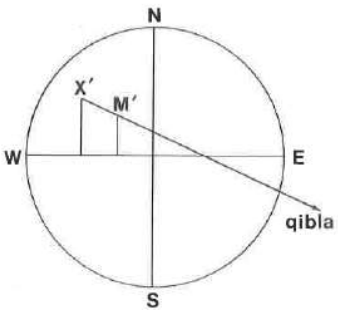
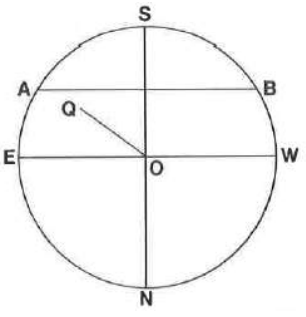
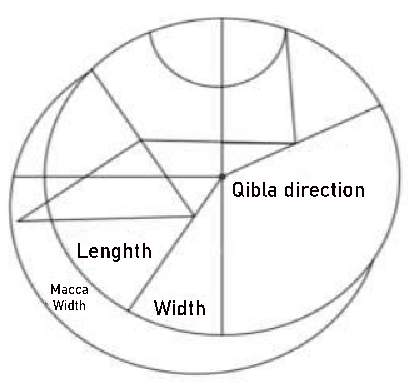
Determining the Qiblah means facing the House of Allah Al-Haram from any point on the surface of the Earth. As is known, the Qiblah of Muslims is Mecca. In this research, we will present methods of finding the Qiblah both astronomically and geometrically, through the study of the Qiblah azimuth and its clear determination. We will try to clarify a certain model to determine the azimuth using geometric laws which are indispensable for us. Then, we will present a mechanism for determining the Qiblah direction according to certain rules and steps, using astronomical instruments made for this purpose, along with other geometric and astronomical matters.
1.1. Research Objective. For over 1,400 years, the obligation to pray and to perform various ritual acts in a sacred direction toward the Ka’ba has been of
…(Full text truncated)…
This content is AI-processed based on ArXiv data.