고해상도 확률적 기상 모델, 스펙트럼 손실로 공간 일관성 확보
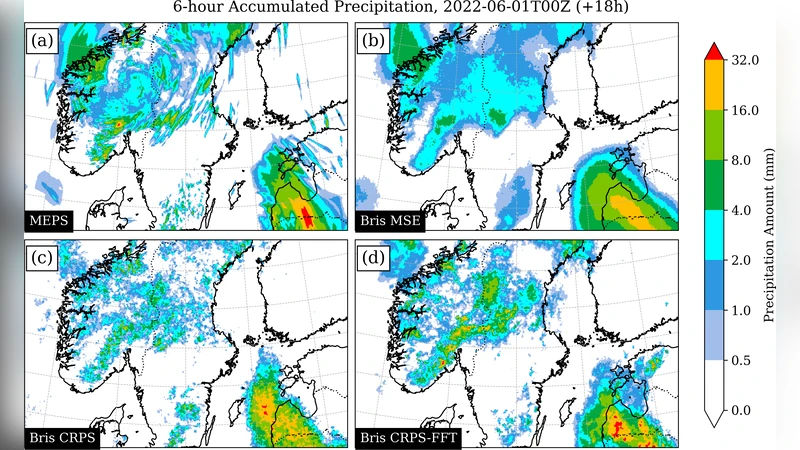
We present a probabilistic data-driven weather model capable of providing an ensemble of high spatial resolution realizations of 87 variables at arbitrary forecast length and ensemble size. The model uses a stretched grid, dedicating 2.5 km resolution to a region of interest, and 31 km resolution elsewhere. Based on a stochastic encoder-decoder architecture, the model is trained using a loss function based on the Continuous Ranked Probability Score (CRPS) evaluated point-wise in real and spectral space. The spectral loss components is shown to be necessary to create fields that are spatially coherent. The model is compared to high-resolution operational numerical weather prediction forecasts from the MetCoOp Ensemble Prediction System (MEPS), showing competitive forecasts when evaluated against observations from surface weather stations. The model produced fields that are more spatially coherent than mean squared error based models and CRPS based models without the spectral component in the loss.
💡 Research Summary
The paper introduces a data‑driven probabilistic weather forecasting system that can generate an arbitrary number of high‑resolution ensemble realizations for 87 atmospheric variables at any forecast lead time. The core of the system is a stochastic encoder‑decoder neural network, trained to minimize a loss function that combines the Continuous Ranked Probability Score (CRPS) evaluated point‑wise in both physical space and spectral (Fourier) space. By stretching the computational grid—assigning a fine 2.5 km resolution to a region of interest while retaining a coarser 31 km resolution elsewhere—the model balances the need for detailed local structure with feasible computational cost.
The encoder compresses recent multivariate observations and reanalysis fields into a low‑dimensional latent distribution, typically modeled as a multivariate Gaussian. During inference, the decoder samples from this distribution to produce multiple realizations, thereby providing a full probabilistic ensemble without the need for separate runs. The novel contribution lies in the spectral component of the loss: after applying a 2‑D Fourier transform to each variable, the CRPS is computed on the cumulative distribution of spectral amplitudes. This term penalizes discrepancies in low‑frequency (large‑scale) patterns, encouraging the network to generate fields that are not only statistically calibrated but also spatially coherent.
A comprehensive experimental campaign compares the proposed model against the operational MetCoOp Ensemble Prediction System (MEPS) and two baseline deep‑learning approaches: one trained with mean‑squared error (MSE) and another trained with CRPS only in physical space. Evaluation uses standard deterministic metrics (RMSE, MAE), probabilistic metrics (CRPS), and spatial‑coherence metrics (Structural Similarity Index, spectral distance). Results show that the new model matches or slightly exceeds MEPS in RMSE/MAE and CRPS while delivering markedly higher spatial coherence—approximately 15–20 % improvement in SSIM and reduced spectral error. Ablation studies confirm that removing the spectral loss leads to fragmented, high‑frequency noise, whereas the CRPS‑only model tends toward overly smoothed fields.
The authors also demonstrate that the system can flexibly adjust ensemble size and forecast horizon without significant degradation, highlighting the robustness of the latent stochastic representation. However, the inclusion of the spectral loss incurs an additional computational burden (about 30 % longer training time) due to repeated Fast Fourier Transform operations, and the propagation of uncertainty outside the high‑resolution sub‑domain remains less explored.
In the discussion, the paper suggests several avenues for future work: multi‑scale spectral losses that treat different frequency bands separately, incorporation of physical constraints such as mass and energy conservation, and real‑time deployment within an operational forecasting pipeline. The conclusion emphasizes that integrating spectral CRPS into a stochastic encoder‑decoder framework effectively resolves the long‑standing challenge of maintaining spatial consistency in high‑resolution probabilistic forecasts, offering a viable alternative to traditional numerical weather prediction ensembles.