📝 Original Info
- Title: 핀란드 고등학생의 AI 역량 인식이 위험 인식에 미치는 차이
- ArXiv ID: 2512.04115
- Date: 2025-12-01
- Authors: Researchers from original ArXiv paper
📝 Abstract
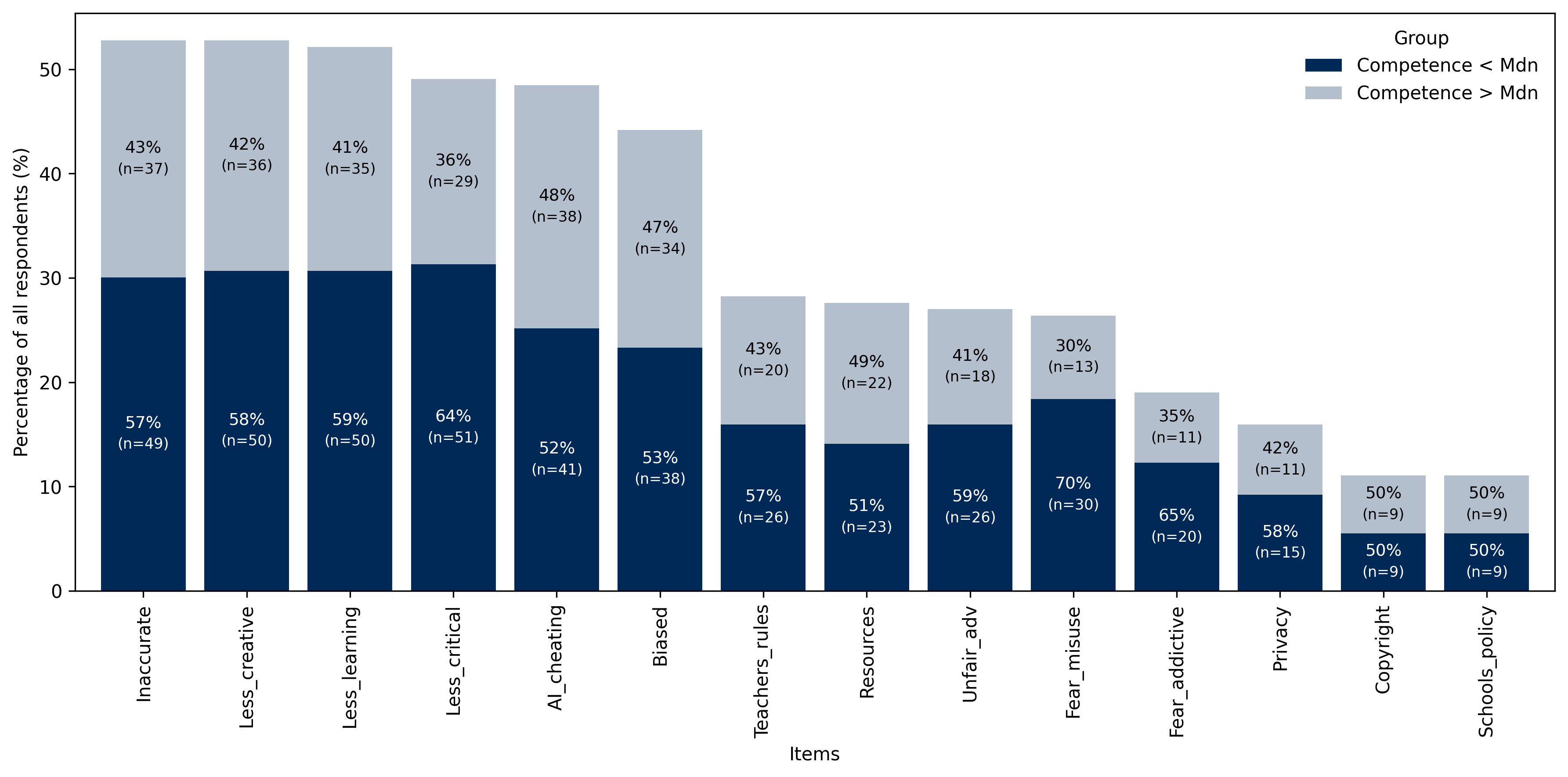
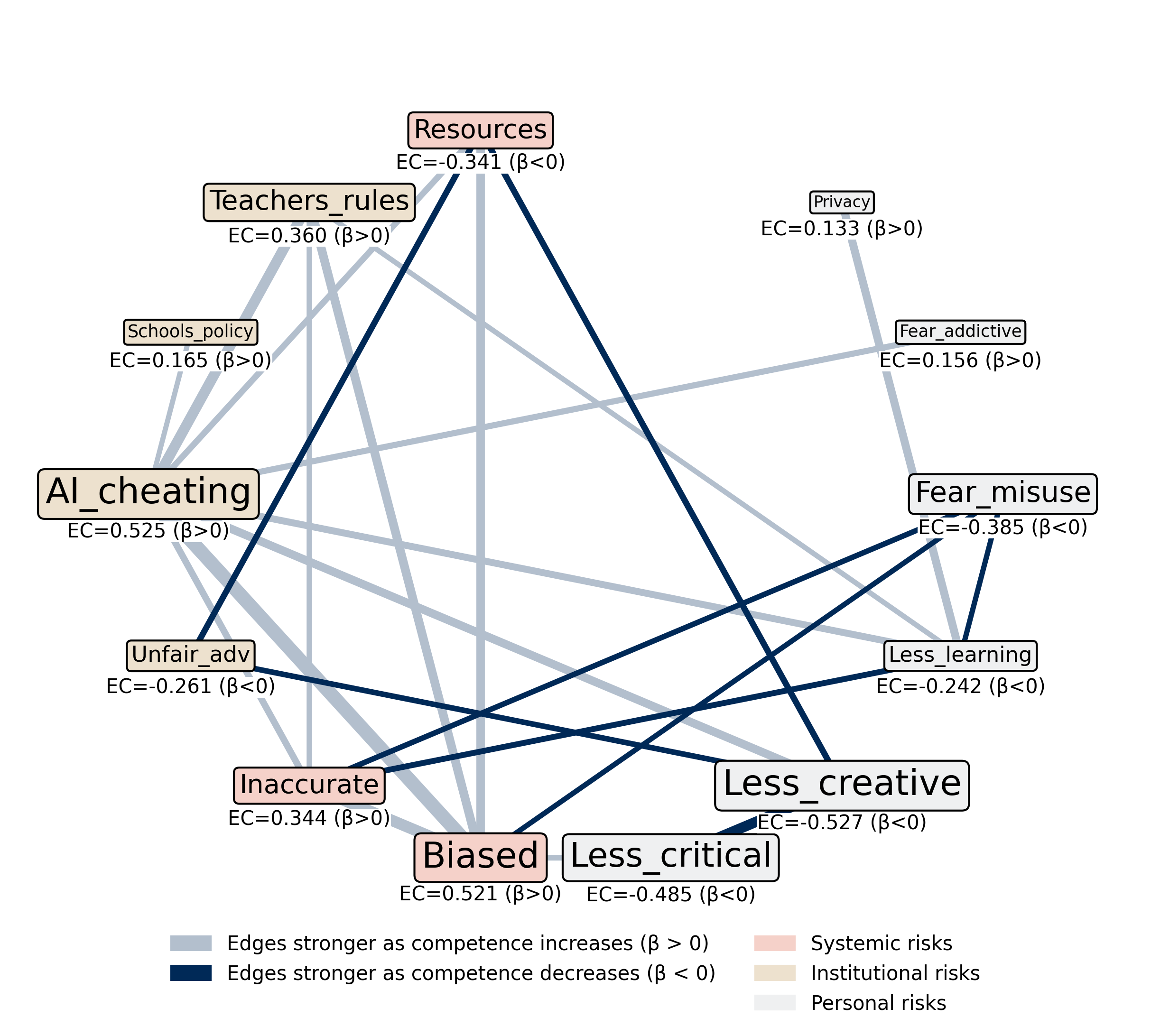
As artificial intelligence (AI) becomes increasingly integrated into education, understanding how students perceive its risks is essential for supporting responsible and effective adoption. This research aimed to examine the relationships between perceived AI competence and risks among Finnish K-12 upper secondary students (n = 163) by utilizing a co-occurrence analysis. Students reported their self-perceived AI competence and concerns related to AI across systemic, institutional, and personal domains. The findings showed that students with lower competence emphasized personal and learning-related risks, such as reduced creativity, lack of critical thinking, and misuse, whereas higher-competence students focused more on systemic and institutional risks, including bias, inaccuracy, and cheating. These differences suggest that students' self-reported AI competence is related to how they evaluate both the risks and opportunities associated with artificial intelligence in education (AIED). The results of this study highlight the need for educational institutions to incorporate AI literacy into their curricula, provide teacher guidance, and inform policy development to ensure personalized opportunities for utilization and equitable integration of AI into K-12 education.
CCS Concepts • Computing methodologies → Artificial intelligence; • Applied computing → Education; • Human-centered computing → Human computer interaction (HCI).
💡 Deep Analysis
Deep Dive into 핀란드 고등학생의 AI 역량 인식이 위험 인식에 미치는 차이.
As artificial intelligence (AI) becomes increasingly integrated into education, understanding how students perceive its risks is essential for supporting responsible and effective adoption. This research aimed to examine the relationships between perceived AI competence and risks among Finnish K-12 upper secondary students (n = 163) by utilizing a co-occurrence analysis. Students reported their self-perceived AI competence and concerns related to AI across systemic, institutional, and personal domains. The findings showed that students with lower competence emphasized personal and learning-related risks, such as reduced creativity, lack of critical thinking, and misuse, whereas higher-competence students focused more on systemic and institutional risks, including bias, inaccuracy, and cheating. These differences suggest that students’ self-reported AI competence is related to how they evaluate both the risks and opportunities associated with artificial intelligence in education (AIED).
📄 Full Content
Artificial Intelligence Competence of K-12 Students Shapes Their
AI Risk Perception: A Co-occurrence Network Analysis
Ville Heilala
University of Jyväskylä
Jyväskylä, Finland
Pieta Sikström
University of Jyväskylä
Jyväskylä, Finland
Mika Setälä
University of Jyväskylä
Jyväskylä, Finland
Tommi Kärkkäinen
University of Jyväskylä
Jyväskylä, Finland
Abstract
As artificial intelligence (AI) becomes increasingly integrated into
education, understanding how students perceive its risks is essen-
tial for supporting responsible and effective adoption. This research
aimed to examine the relationships between perceived AI compe-
tence and risks among Finnish K-12 upper secondary students (n =
163) by utilizing a co-occurrence analysis. Students reported their
self-perceived AI competence and concerns related to AI across
systemic, institutional, and personal domains. The findings showed
that students with lower competence emphasized personal and
learning-related risks, such as reduced creativity, lack of critical
thinking, and misuse, whereas higher-competence students focused
more on systemic and institutional risks, including bias, inaccuracy,
and cheating. These differences suggest that students’ self-reported
AI competence is related to how they evaluate both the risks and
opportunities associated with artificial intelligence in education
(AIED). The results of this study highlight the need for educational
institutions to incorporate AI literacy into their curricula, provide
teacher guidance, and inform policy development to ensure person-
alized opportunities for utilization and equitable integration of AI
into K-12 education.
CCS Concepts
• Computing methodologies →Artificial intelligence; • Ap-
plied computing →Education; • Human-centered computing
→Human computer interaction (HCI).
Keywords
Artificial Intelligence, Competence, K-12, Education, Risk Percep-
tion, Outcome Expectancy
ACM Reference Format:
Ville Heilala, Pieta Sikström, Mika Setälä, and Tommi Kärkkäinen. 2025.
Artificial Intelligence Competence of K-12 Students Shapes Their AI Risk
Perception: A Co-occurrence Network Analysis . In . ACM, New York, NY,
USA, 8 pages. https://doi.org/10.1145/nnnnnnn.nnnnnnn
Permission to make digital or hard copies of all or part of this work for personal or
classroom use is granted without fee provided that copies are not made or distributed
for profit or commercial advantage and that copies bear this notice and the full citation
on the first page. Copyrights for components of this work owned by others than the
author(s) must be honored. Abstracting with credit is permitted. To copy otherwise, or
republish, to post on servers or to redistribute to lists, requires prior specific permission
and/or a fee. Request permissions from permissions@acm.org.
Conference’17, Washington, DC, USA
© 2025 Copyright held by the owner/author(s). Publication rights licensed to ACM.
ACM ISBN 978-x-xxxx-xxxx-x/YYYY/MM
https://doi.org/10.1145/nnnnnnn.nnnnnnn
1
Introduction
With the rise of artificial intelligence (AI), especially generative
AI (GenAI), its influence on society and education is increasingly
recognized. However, the integration of artificial intelligence in
education (AIED) is not straightforward; on one hand, it has been
shown to improve educational outcomes [57], but, on the other
hand, there are also risks that can hinder the adoption [15, 21, 43, 58].
Despite the general view of AI technologies having a positive impact
on student learning, their effect particularly on students’ agency
and self-regulation is understudied [18]. This has raised concerns
about how the integration of AI tools affects students’ learning
experiences, as well as their impact on knowledge development
and skill acquisition [11, 59].
AI is not perceived solely as harmful or beneficial, but simultane-
ously as both a risk and an opportunity [50]. However, perceptions
and preferences regarding AI-related risks have received limited
scholarly attention [61]. Thereby, the relationship between risk
perceptions and individuals’ willingness to adopt AI-based applica-
tions is understudied [50]. Given that AI is affecting education and
how teaching will be organized [e.g., 27], it is crucial to explore
further the types of risks that might hinder the adoption of AI tools
in learning [53]. Research on risk perception [52], especially in
the context of AI, is essential for designing effective strategies that
support informed decision-making [36] and promote AI literacy
[11]. Because "risk is relative to the observer” [34, p. 12], individ-
ual characteristics shape which factors are perceived as risks [61].
Thus, this exploratory study aims to answer two research questions:
First, which of the factors do upper secondary K-12 students per-
ceive as risks? And second, how do K-12 students’ self-reported AI
competence shape their perceptions of potential AI-related risks?
Finland has been one of the early advocates for adopting digital
education solutions and p
…(Full text truncated)…
📸 Image Gallery
Reference
This content is AI-processed based on ArXiv data.