Joint Partitioning and Placement of Foundation Models for Real-Time Edge AI
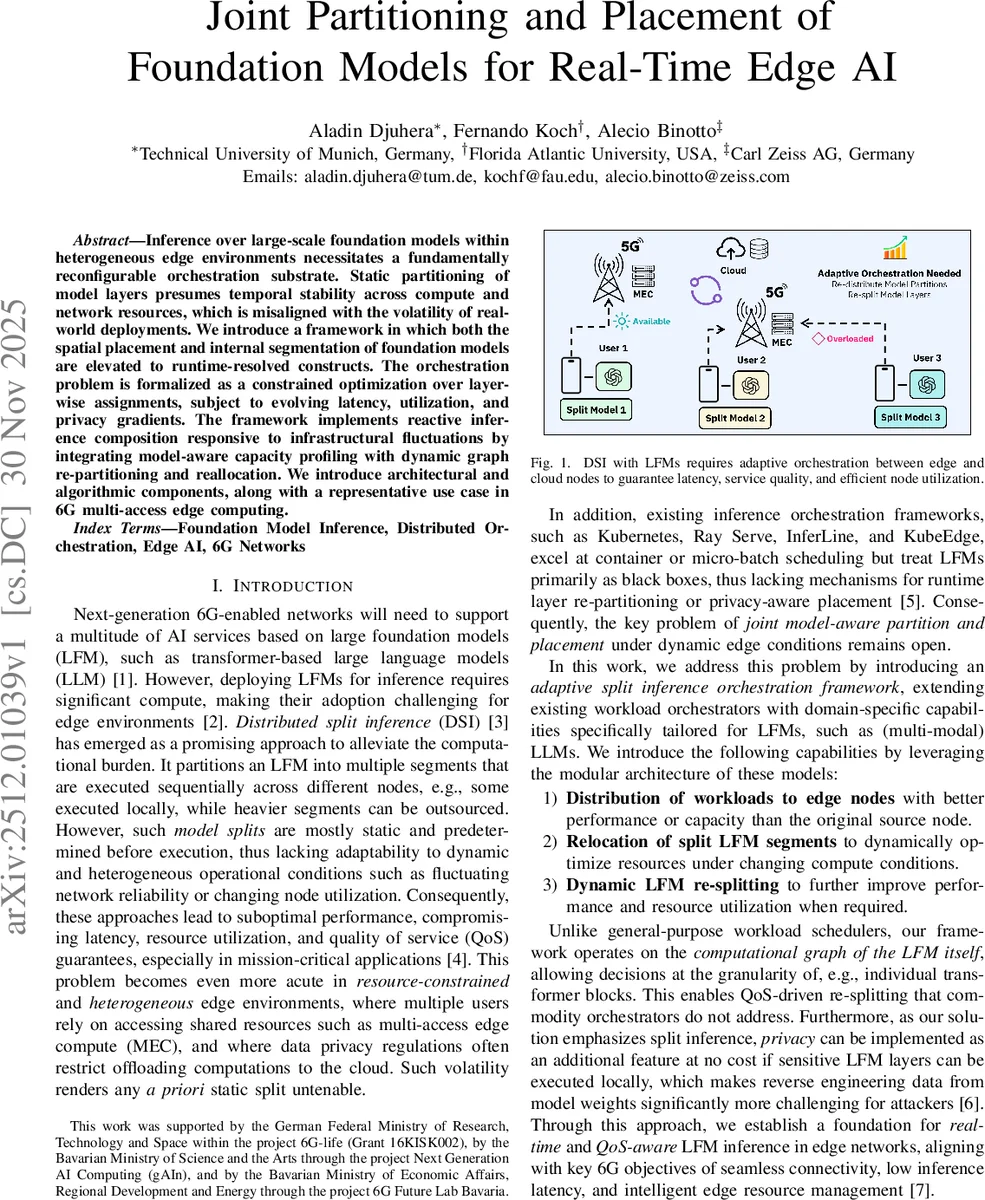
Inference over large-scale foundation models within heterogeneous edge environments necessitates a fundamentally reconfigurable orchestration substrate. Static partitioning of model layers presumes temporal stability across compute and network resources, which is misaligned with the volatility of real-world deployments. We introduce a framework in which both the spatial placement and internal segmentation of foundation models are elevated to runtime-resolved constructs. The orchestration problem is formalized as a constrained optimization over layer-wise assignments, subject to evolving latency, utilization, and privacy gradients. The framework implements reactive inference composition responsive to infrastructural fluctuations by integrating model-aware capacity profiling with dynamic graph re-partitioning and reallocation. We introduce architectural and algorithmic components, along with a representative use case in 6G multi-access edge computing.
💡 Research Summary
The paper addresses a critical gap in deploying large‑scale foundation models (LFMs) such as transformer‑based large language models on heterogeneous edge infrastructures, especially in the context of upcoming 6G‑enabled multi‑access edge computing (MEC). Existing distributed split inference (DSI) solutions rely on static, pre‑determined layer partitions and treat the model as an opaque binary, which makes them unable to react to real‑time fluctuations in network latency, node utilization, or privacy constraints. To overcome these limitations, the authors propose an adaptive split‑inference orchestration framework that jointly optimizes model partitioning (where to cut the computational graph) and placement (which node—edge or cloud—executes each partition) at runtime.
The framework consists of four core modules:
- Monitoring & Capacity Profiling (CP) continuously gathers CPU, GPU, memory, and bandwidth metrics from every edge node and the cloud, forming a time‑varying system state C(t).
- Adaptive Orchestrator (AO) evaluates a multi‑objective cost function Φ = α·L + β·U + γ·P, where L captures end‑to‑end inference latency (including data transfer), U measures resource‑usage imbalance or overload, and P penalizes privacy violations (e.g., placing sensitive layers on untrusted nodes). AO decides whether to keep the current split, migrate sub‑splits, or trigger a full re‑splitting.
- Split Revision (SR) explores the space Ω of all valid splitting schemes. It can employ heuristics, rule‑based logic, or reinforcement‑learning‑driven meta‑optimizers to generate new partition sets S* that better match the current resource landscape.
- Reconfiguration Broadcast (RB) disseminates the new placement matrix x* and/or new partition definitions to the affected nodes, ensuring a seamless, zero‑downtime transition.
Mathematically, the problem is formulated as a constrained binary optimization over a placement matrix x ∈ {0,1}^{|N|×k}, where k is the number of partitions and N ∪ {c} denotes the set of edge nodes plus the cloud. Constraints enforce (i) unique assignment of each partition, (ii) per‑node capacity limits, and (iii) privacy requirements that force certain early layers to remain on trusted edge devices. The objective Φ is minimized subject to these constraints, and the optimization may be solved iteratively as the system state evolves.
Algorithm 1 describes the runtime loop. At each monitoring interval Δt, the CP module updates the environment metrics E(t). A trigger function ShouldReconfigure evaluates whether any of the following thresholds are breached: EWMA latency > L_max (150 ms), maximum node utilization > U_max (85 %), or minimum inter‑edge bandwidth < B_min (50 Mbps). If a trigger fires and a cool‑down period T_cool (30 s) has elapsed, the AO enumerates feasible placement alternatives, optionally invoking SR to generate new partitions. The candidate with the lowest estimated cost C(d) is selected, and RB broadcasts the updated configuration. The system then resumes inference under the new mapping, closing the feedback loop.
Key contributions include:
- Formalizing dynamic, layer‑aware partitioning as a real‑time optimization problem that simultaneously accounts for latency, resource balance, and privacy.
- Extending traditional container‑orchestrators with model‑graph awareness, enabling decisions at the granularity of individual transformer blocks or convolutional layers.
- Introducing a modular architecture (CP, AO, SR, RB) that can be integrated with existing MEC platforms while remaining agnostic to the underlying hardware.
- Providing a concrete set of trigger metrics and a cool‑down mechanism to avoid oscillatory reconfigurations.
The paper also discusses limitations. No empirical evaluation with a truly large LLM (e.g., GPT‑3 scale) is presented, leaving open questions about the overhead of transferring partially updated model weights, the latency incurred during re‑splitting, and the convergence properties of learning‑based SR strategies. Future work is suggested to include real‑world 6G test‑bed experiments, quantitative analysis of synchronization costs, and compression techniques for weight migration.
In summary, the authors deliver a comprehensive, runtime‑adaptive orchestration framework that makes large foundation models feasible for real‑time edge AI by dynamically re‑partitioning and re‑placing model components in response to evolving network and compute conditions, while respecting privacy constraints. This approach bridges the gap between static split inference and the highly volatile environments expected in next‑generation 6G edge deployments.
Comments & Academic Discussion
Loading comments...
Leave a Comment