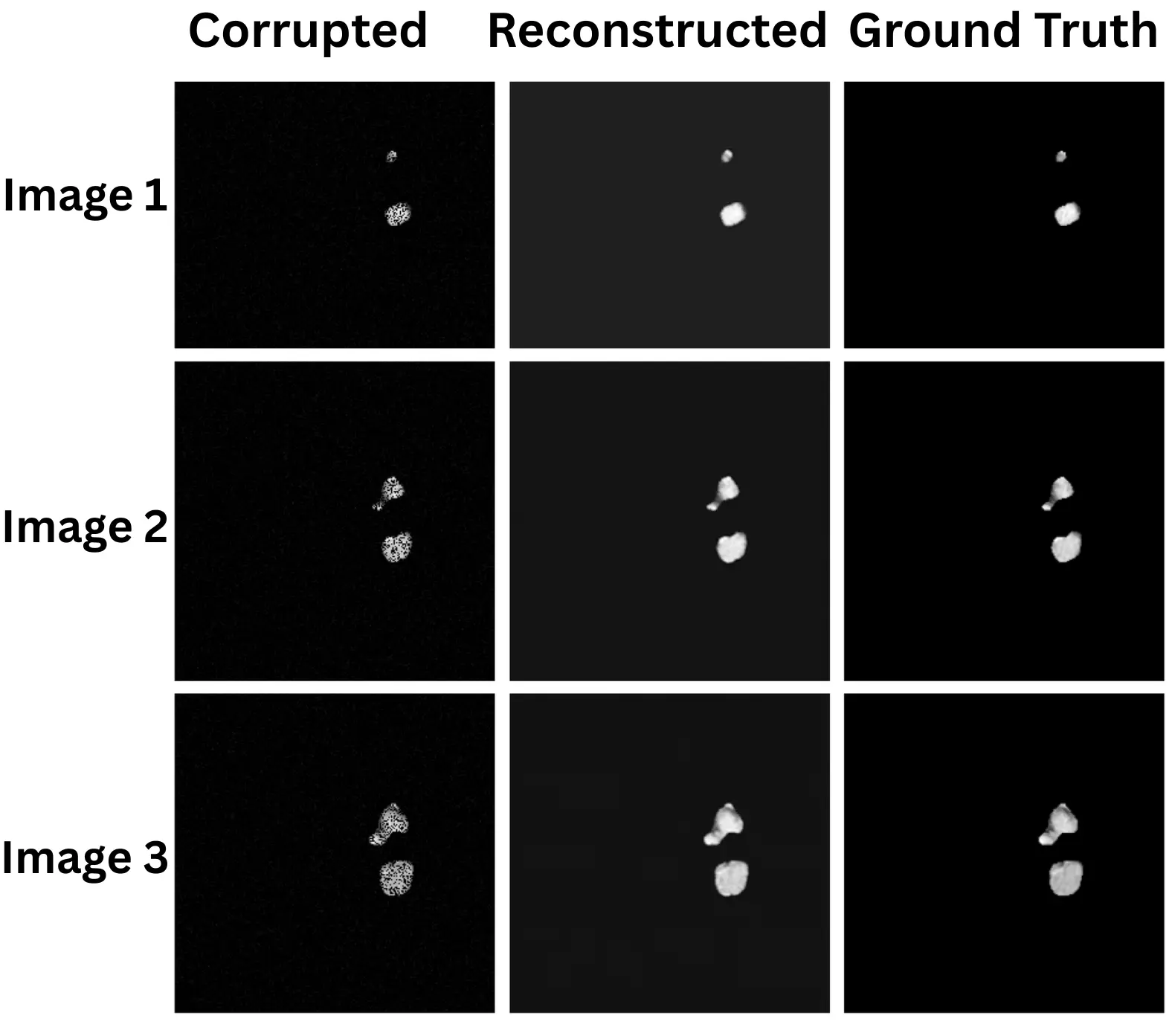
Medical imaging is essential for clinical diagnosis, yet realworld data frequently suffers from corruption, noise, and potential tampering, challenging the reliability of AI-assisted interpretation. Conventional reconstruction techniques prioritize pixel-level recovery and may produce visually plausible outputs while compromising anatomical fidelity, an issue that can directly impact clinical outcomes. We propose a semantic-aware medical image reconstruction framework that integrates high-level latent embeddings with a hybrid U-Net architecture to preserve clinically relevant structures during restoration. To ensure trust and accountability, we incorporate a lightweight blockchain-based provenance layer using scale-free graph design, enabling verifiable recording of each reconstruction event without imposing significant overhead. Extensive evaluation across multiple datasets and corruption types demonstrates improved structural consistency, restoration accuracy, and provenance integrity compared with existing approaches. By uniting semanticguided reconstruction with secure traceability, our solution advances dependable AI for medical imaging, enhancing both diagnostic confidence and regulatory compliance in healthcare environments.
Deep Dive into 의미인식 기반 의료 영상 복원과 블록체인 추적 통합 시스템.
Medical imaging is essential for clinical diagnosis, yet realworld data frequently suffers from corruption, noise, and potential tampering, challenging the reliability of AI-assisted interpretation. Conventional reconstruction techniques prioritize pixel-level recovery and may produce visually plausible outputs while compromising anatomical fidelity, an issue that can directly impact clinical outcomes. We propose a semantic-aware medical image reconstruction framework that integrates high-level latent embeddings with a hybrid U-Net architecture to preserve clinically relevant structures during restoration. To ensure trust and accountability, we incorporate a lightweight blockchain-based provenance layer using scale-free graph design, enabling verifiable recording of each reconstruction event without imposing significant overhead. Extensive evaluation across multiple datasets and corruption types demonstrates improved structural consistency, restoration accuracy, and provenance integrit
Medical imaging plays a central role in modern diagnostics, with modalities such as MRI, CT, and X-ray enabling detailed visualization of internal anatomy [29]. The quality and integrity of these images directly affect clinical decisions, yet real-world imaging data are frequently degraded by noise [26], acquisition and compression artifacts [13], or even intentional tampering [4,43,50] and device-level attacks [56], all of which can undermine diagnostic reliability. Standard reconstruction methods [4,13,31,43,50] focus primarily on pixel-level recovery, which can restore visually plausible content but fail to preserve critical anatom-ical structures. This gap presents a significant challenge for dependable AI systems that aim to assist or automate diagnosis.
Recent advances in deep generative models, including U-Net [17,34], GANs [20,60], and diffusion-based architectures [21], have improved inpainting and image restoration tasks. However, these methods remain largely agnostic to the underlying semantic content of medical images. In clinical scenarios, even small structural deviations can lead to incorrect interpretations [29], making semantic fidelity as important as visual similarity. For example, a GAN-based attack [39] changed a lung-cancer scan in seconds and escaped expert detection and a one-pixel perturbation [49] flipped diagnostic output. Furthermore, existing approaches [6,24,42,58] lack mechanisms to verify or track the provenance of reconstructed images, which is crucial for auditing, reproducibility, and clinical trust.
To address these limitations, we propose a semantic-aware reconstruction framework that operates directly on vector embeddings of medical images, rather than solely on pixels, and leverages high-level latent fingerprints to guide restoration of corrupted data. By conditioning the model on these embeddings extracted from verified image data, our approach ensures that reconstructed structures remain consistent with clinically relevant patterns. In addition, we integrate a lightweight blockchain-based provenance layer, which anchors each reconstruction event in a verifiable ledger. Such integration establishes tamper-evident traceability, decentralized trust, and verifiable data lineage across reconstruction pipelines, essential properties [28] for clinical imaging where authenticity and accountability are paramount. This combination allows not only accurate reconstruction but also traceable, auditable verification of every image modification, ensuring both reliability and trustworthiness. Despite blockchain’s promise for ensuring trust and reliability, its direct adoption in medical imaging introduces several practical challenges. First, conventional blockchain con-sensus mechanisms [3,33,59] such as PoW or BFT incur significant computational and latency overhead, incompatible with real-time or high-throughput image reconstruction tasks. Second, maintaining a complete ledger of reconstruction operations can impose excessive storage and bandwidth costs, especially when handling large-scale image datasets [52]. Third, the high latency of block confirmation [35,41] undermines the responsiveness needed for time-sensitive diagnostic scenarios. Finally, existing blockchain frameworks often assume persistent peer connectivity, whereas medical imaging workflows may span intermittently connected hospital systems or cloud-edge environments [1,5].
To address these challenges, we design and implement provenance-secured semantic image reconstruction for medical applications (PROSIMA), a system that integrates a U-Net-based reconstruction backbone augmented with semantic consistency guidance from pre-trained embeddings (e.g., Contrastive Language-Image Pretraining-CLIP or medical feature extractors). By conditioning reconstruction on latent fingerprints anchored in a lightweight, scale-free blockchain, PROSIMA ensures tamper-evident verification, traceability, and clinically faithful reconstruction. The system introduces innovations in consensus efficiency, adaptive sharding, distributed load balancing, and storage optimization tailored for vector data. Our framework is designed for robustness and generalization across multiple datasets and corruption types. By explicitly incorporating semantic guidance, perceptual quality metrics, and blockchain-anchored fingerprints, the proposed method bridges the gap between conventional pixel-focused reconstruction and the stringent requirements of dependable AI in medical imaging. Experiments demonstrate superior performance in structural fidelity, semantic consistency, and provenance verification compared to stateof-the-art baselines.
In summary, the paper makes the following core technical contributions:
(i) Semantic-aware Reconstruction Framework: A semantic-aware, provenance-verified image reconstruction pipeline based on a hybrid U-Net backbone, augmented with high-level embeddings and latent fingerprints anchored on a lightweight blockchain,
…(Full text truncated)…
This content is AI-processed based on ArXiv data.