📝 Original Info
- Title: Writing in Symbiosis: Mapping Human Creative Agency in the AI Era
- ArXiv ID: 2512.13697
- Date: 2025-11-28
- Authors: Researchers from original ArXiv paper
📝 Abstract
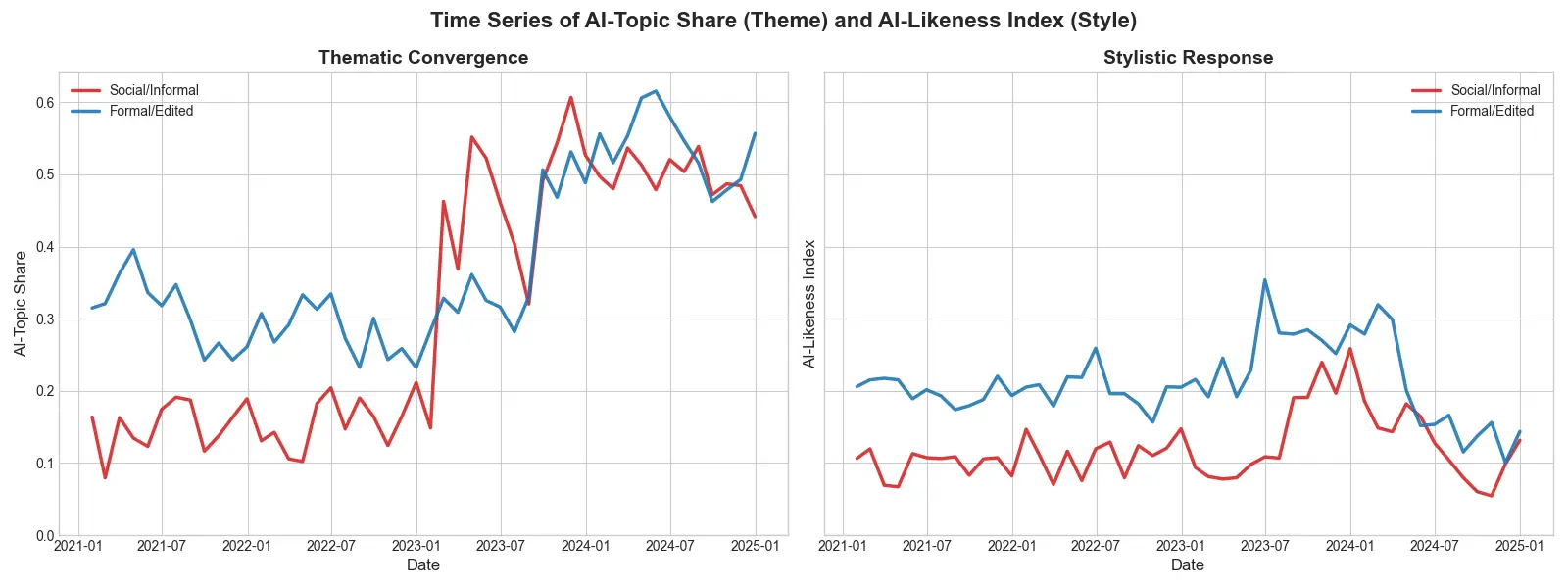
The proliferation of Large Language Models (LLMs) raises a critical question about what it means to be human when we share an increasingly symbiotic relationship with persuasive and creative machines. This paper examines patterns of human-AI coevolution in creative writing, investigating how human craft and agency are adapting alongside machine capabilities. We challenge the prevailing notion of stylistic homogenization by examining diverse patterns in longitudinal writing data. Using a large-scale corpus spanning the pre-and post-LLM era, we observe patterns suggestive of a "Dual-Track Evolution": thematic convergence around AI-related topics, coupled with structured stylistic differentiation. Our analysis reveals three emergent adaptation patterns: authors showing increased similarity to AI style, those exhibiting decreased similarity, and those maintaining stylistic stability while engaging with AI-related themes. This Creative Archetype Map illuminates how authorship is coevolving with AI, contributing to discussions about human-AI collaboration, detection challenges, and the preservation of creative diversity.
💡 Deep Analysis
Deep Dive into Writing in Symbiosis: Mapping Human Creative Agency in the AI Era.
The proliferation of Large Language Models (LLMs) raises a critical question about what it means to be human when we share an increasingly symbiotic relationship with persuasive and creative machines. This paper examines patterns of human-AI coevolution in creative writing, investigating how human craft and agency are adapting alongside machine capabilities. We challenge the prevailing notion of stylistic homogenization by examining diverse patterns in longitudinal writing data. Using a large-scale corpus spanning the pre-and post-LLM era, we observe patterns suggestive of a “Dual-Track Evolution”: thematic convergence around AI-related topics, coupled with structured stylistic differentiation. Our analysis reveals three emergent adaptation patterns: authors showing increased similarity to AI style, those exhibiting decreased similarity, and those maintaining stylistic stability while engaging with AI-related themes. This Creative Archetype Map illuminates how authorship is coevolving
📄 Full Content
Writing in Symbiosis: Mapping Human Creative
Agency in the AI Era
Vivan Doshi
Independent Researcher
San Jose, CA 95148
vivandoshi24@gmail.com
Mengyuan Li
Department of Computer Science
University of Southern California
Los Angeles, CA 90089
mli49061@usc.edu
Abstract
The proliferation of Large Language Models (LLMs) raises a critical question about
what it means to be human when we share an increasingly symbiotic relationship
with persuasive and creative machines. This paper examines patterns of human-AI
coevolution in creative writing, investigating how human craft and agency are
adapting alongside machine capabilities. We challenge the prevailing notion of
stylistic homogenization by examining diverse patterns in longitudinal writing
data. Using a large-scale corpus spanning the pre- and post-LLM era, we observe
patterns suggestive of a "Dual-Track Evolution": thematic convergence around
AI-related topics, coupled with structured stylistic differentiation. Our analysis
reveals three emergent adaptation patterns: authors showing increased similarity
to AI style, those exhibiting decreased similarity, and those maintaining stylistic
stability while engaging with AI-related themes. This Creative Archetype Map
illuminates how authorship is coevolving with AI, contributing to discussions about
human-AI collaboration, detection challenges, and the preservation of creative
diversity.
1
Introduction
We are at a pivotal moment in the symbiotic relationship between humans and machines. Large
Language Models (LLMs) have evolved from assistive tools into active collaborators, capable of
imitating, creating, and persuading on a massive scale. This new reality prompts a fundamental
question posed by the creative community: what does it mean to be human when authorship becomes
a collaborative act between human intuition and machine capability, and does it fundamentally
reshape how we value and recognize authentic human expression?
Initial research into this question has largely focused on the homogenizing effects of this partnership.
A growing body of work has documented the spread of a recognizable "AI style" across the internet
and academia [2, 19], characterized by linguistic patterns that suggest reduced creative diversity
[1]. This stylistic convergence has raised concerns about linguistic diversity erosion and cultural
marginalization [7, 14]. In parallel, AI detection has rapidly advanced with stylometric and deep
learning approaches [20, 24, 28], though detector robustness remains challenging.
While this prior work is crucial, it often frames the relationship as unidirectional influence rather
than dynamic coevolution. This overlooks the crucial element of human agency which is the
adaptive choices individuals make as they navigate this new landscape. Recent work suggests
human-AI coevolution with mutual influence [11, 13]. However, existing studies largely conflate
topical and stylistic changes, lack author-level longitudinal controls, or do not account for recent
adaptive behaviors following AI detection awareness. We hypothesize that the human creative
response to AI availability is not a monolithic trend but may instead exhibit structured patterns of
39th Conference on Neural Information Processing Systems (NeurIPS 2025) Creative AI Track.
arXiv:2512.13697v1 [cs.CY] 28 Nov 2025
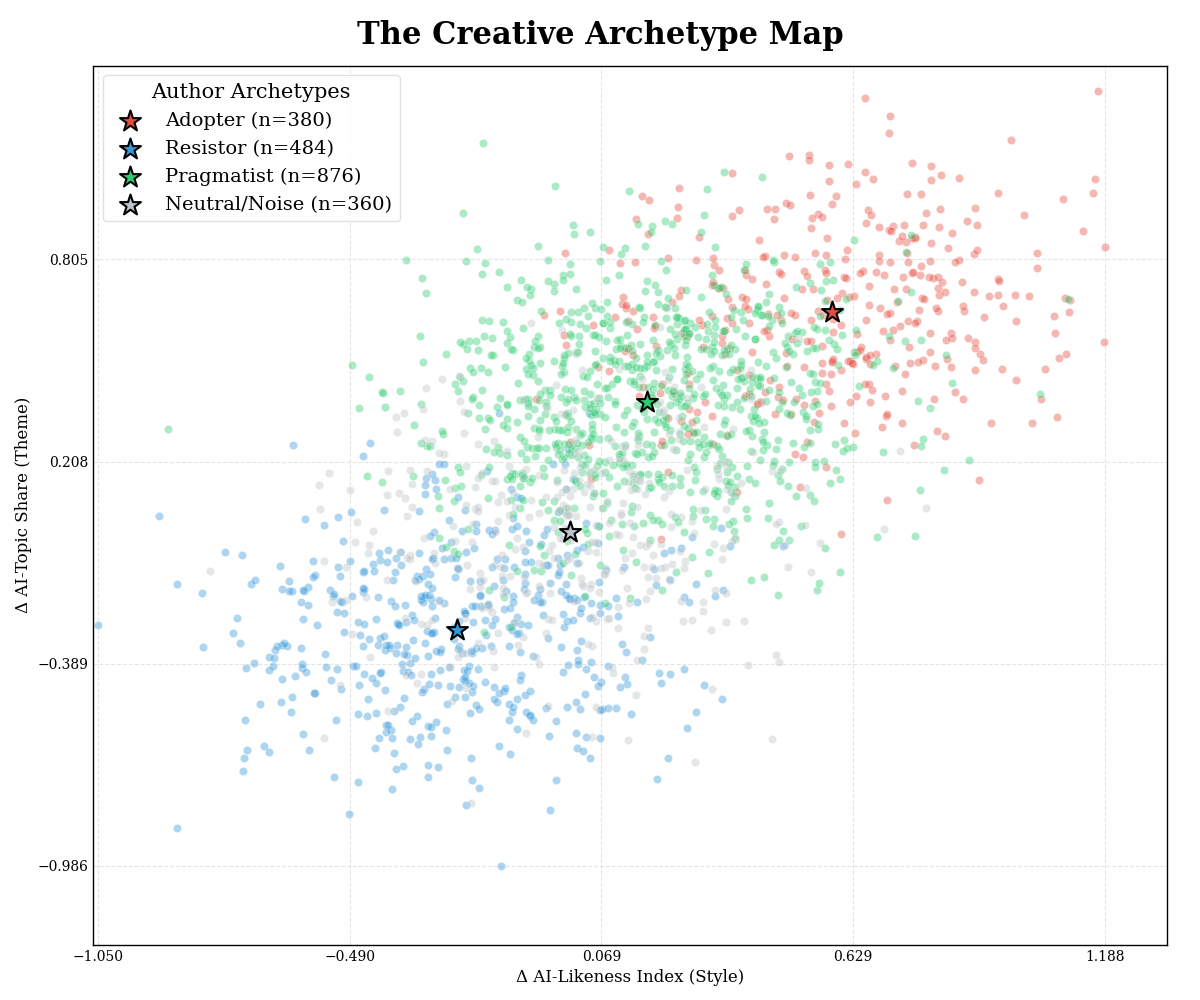
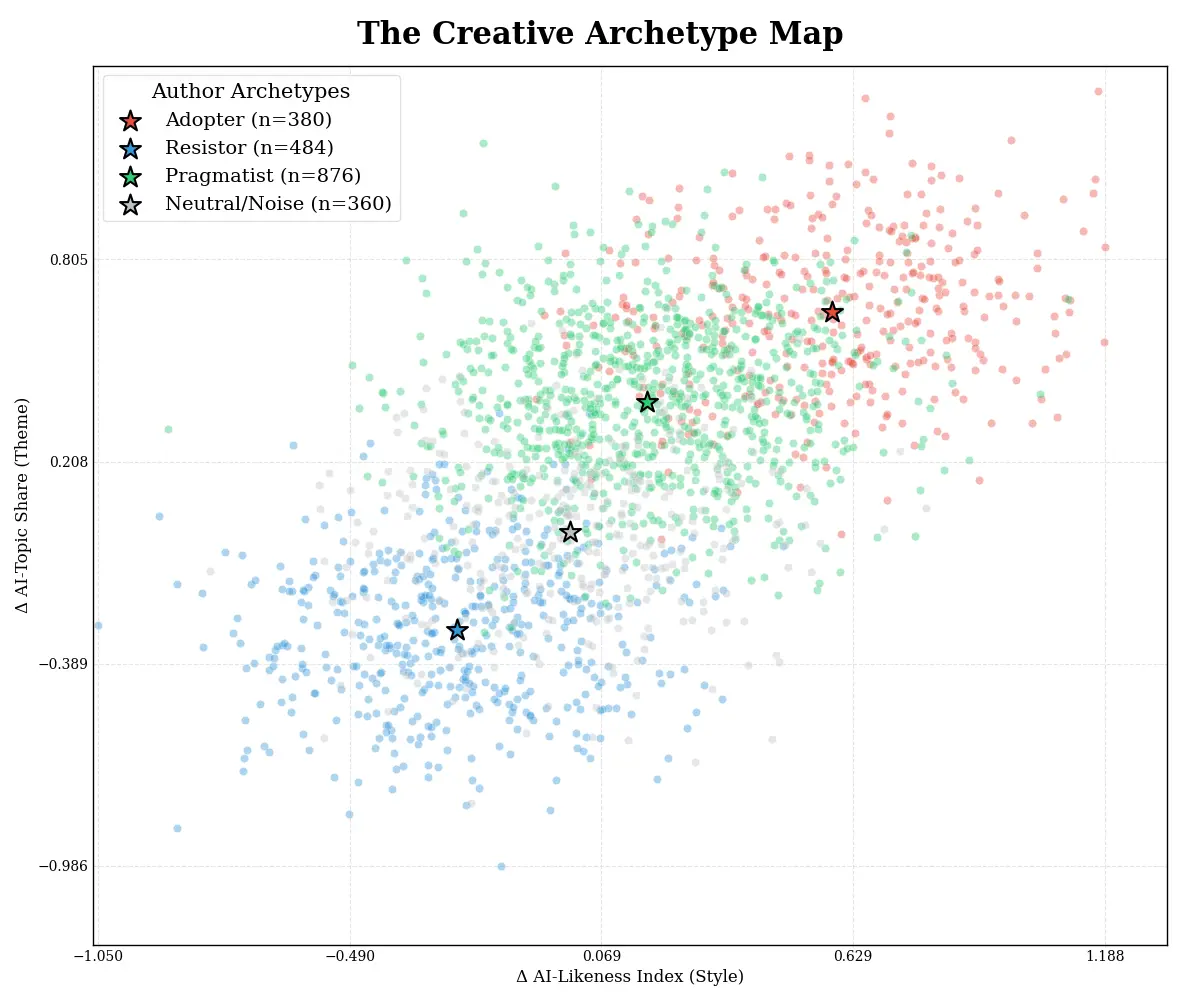
Figure 1: Author archetype map showing stylistic and thematic change vectors (n=2,100). Three
archetypes emerge from HDBSCAN clustering (silhouette computed on inlier points only): Adopters
(red), Resistors (blue), and Pragmatists (green). Stars denote cluster centroids. Cluster quality:
silhouette 0.426 (95% CI: 0.419-0.433), robustness ARI 0.891 (95% CI: 0.884-0.898).
change. To investigate this, we shift focus from binary classification to coevolution patterns. We
propose examining a "Dual-Track Evolution" hypothesis: thematic convergence on AI-related
topics while conversely exhibiting stylistic differentiation. This work presents, to our knowledge, the
first systematic quantification of dual-track human-AI coevolution at author resolution across social
and formal discourse genres, introducing an archetype framework that maps individual adaptation
strategies with rigorous pre/post controls.
As visualized in Figure 1, we observe three distinct patterns in stylistic change vectors: authors
whose writing shows increased similarity to AI-generated text patterns, those whose writing exhibits
decreased similarity, and those who maintain stylistic stability while engaging more with AI-related
themes. These patterns emerge from unsupervised clustering rather than predetermined categories,
suggesting systematic adaptation strategies that challenge binary detection frameworks and illuminate
the complexity of attribution in this rapidly evolving landscape.
2
Methodology
To empirically chart the evolution of human writing, we designed a comprehensive methodology
structured in three sequential phases: rigorous corpus curation, nuanced featur
…(Full text truncated)…
📸 Image Gallery
Reference
This content is AI-processed based on ArXiv data.