📝 Original Info
- Title: FlockVote: LLM-Empowered Agent-Based Modeling for Simulating U.S. Presidential Elections
- ArXiv ID: 2512.05982
- Date: 2025-11-27
- Authors: Researchers from original ArXiv paper
📝 Abstract
Modeling complex human behavior, such as voter decisions in national elections, is a long-standing challenge for computational social science. Traditional agent-based models (ABMs) are limited by oversimplified rules, while large-scale statistical models often lack interpretability. We introduce FlockVote, a novel framework that uses Large Language Models (LLMs) to build a "computational laboratory" of LLM agents for political simulation. Each agent is instantiated with a high-fidelity demographic profile and dynamic contextual information (e.g. candidate policies), enabling it to perform nuanced, generative reasoning to simulate a voting decision. We deploy this framework as a testbed on the 2024 U.S. Presidential Election, focusing on seven key swing states. Our simulation's macro-level results successfully replicate the real-world outcome, demonstrating the high fidelity of our "virtual society". The primary contribution is not only the prediction, but also the framework's utility as an interpretable research tool. FlockVote moves beyond black-box outputs, allowing researchers to probe agent-level rationale and analyze the stability and sensitivity of LLM-driven social simulations.
💡 Deep Analysis
Deep Dive into FlockVote: LLM-Empowered Agent-Based Modeling for Simulating U.S. Presidential Elections.
Modeling complex human behavior, such as voter decisions in national elections, is a long-standing challenge for computational social science. Traditional agent-based models (ABMs) are limited by oversimplified rules, while large-scale statistical models often lack interpretability. We introduce FlockVote, a novel framework that uses Large Language Models (LLMs) to build a “computational laboratory” of LLM agents for political simulation. Each agent is instantiated with a high-fidelity demographic profile and dynamic contextual information (e.g. candidate policies), enabling it to perform nuanced, generative reasoning to simulate a voting decision. We deploy this framework as a testbed on the 2024 U.S. Presidential Election, focusing on seven key swing states. Our simulation’s macro-level results successfully replicate the real-world outcome, demonstrating the high fidelity of our “virtual society”. The primary contribution is not only the prediction, but also the framework’s utility a
📄 Full Content
Published as a conference paper at ICAIS 2025
FLOCKVOTE:
LLM-EMPOWERED
AGENT-BASED
MODELING
FOR SIMULATING U.S. PRESIDENTIAL
ELECTIONS
Lingfeng Zhou1, Yi Xu4, Zhenyu Wang3, Dequan Wang1,2∗
1Shanghai Jiao Tong University
2Shanghai Innovation Institute
3Shanghai Academy of Social Sciences
4Nanjing University
ABSTRACT
Modeling complex human behavior, such as voter decisions in national elections,
is a long-standing challenge for computational social science. Traditional agent-
based models (ABMs) are limited by oversimplified rules, while large-scale statis-
tical models often lack interpretability. We introduce FlockVote1, a novel frame-
work that uses Large Language Models (LLMs) to build a “computational labo-
ratory” of LLM agents for political simulation. Each agent is instantiated with a
high-fidelity demographic profile and dynamic contextual information (e.g. can-
didate policies), enabling it to perform nuanced, generative reasoning to simulate
a voting decision. We deploy this framework as a testbed on the 2024 U.S. Presi-
dential Election, focusing on seven key swing states. Our simulation’s macro-level
results successfully replicate the real-world outcome, demonstrating the high fi-
delity of our “virtual society”. The primary contribution is not only the prediction,
but also the framework’s utility as an interpretable research tool. FlockVote moves
beyond black-box outputs, allowing researchers to probe agent-level rationale and
analyze the stability and sensitivity of LLM-driven social simulations.
1
INTRODUCTION
Understanding and modeling complex social phenomena, such as election outcomes, is a crucial
endeavor in political and computational social science. Traditionally, research in this domain has
relied on statistical models built from polling data (Brito et al., 2021; Coletto et al., 2015; Chauhan
et al., 2021) or conventional agent-based modeling (ABM) approaches (Gao et al., 2022; De Marchi
& Page, 2014; Qiu & Phang, 2020; Fowler & Smirnov, 2005). However, these methods often face
limitations: statistical models struggle with dynamic, real-time contexts, while traditional ABMs
tend to oversimplify complex human decision-making into predefined rules or heuristic functions.
This simplification hinders their ability to capture the full complexity and heterogeneity of real-
world voter populations, limiting their utility as true “computational laboratories” for social science.
The emergence of Large Language Models (LLMs) presents a new paradigm, offering unprece-
dented capabilities to model human behavior with greater nuance and realism (Argyle et al., 2023;
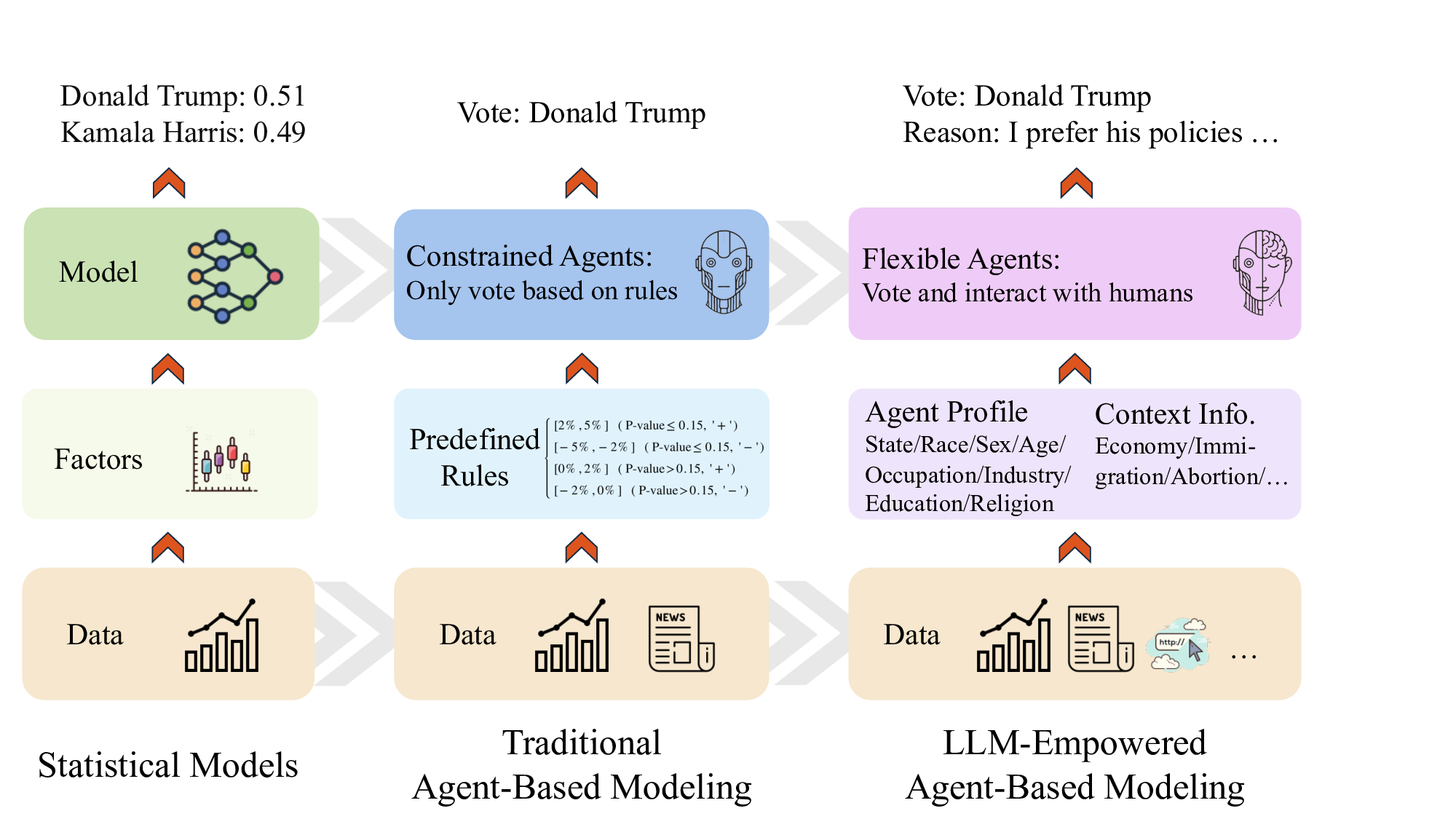
Zhang et al., 2024; Yu et al., 2024b; Grossmann et al., 2023; Gujral et al., 2024) (Figure 1). This
work leverages this potential to propose FlockVote, an agent-based simulation framework designed
as a computational laboratory for social science research. Instead of merely forecasting, FlockVote
uses LLM agents to construct a high-fidelity “virtual society” for in silico experimentation.
Each agent in the FlockVote framework is instantiated with a detailed voter profile, mirroring the
demographic composition of U.S. states based on data from the 2023 American Community Sur-
vey (ACS)2 and the 2020 U.S. Religion Census by the Association of Statisticians of American
Religious Bodies (ASARB)3. These profiles include key attributes such as state, race, sex, age, oc-
cupation, industry, education level, and religion. Crucially, agents are not static; they are provided
∗Corresponding author: dequanwang@sjtu.edu.cn
1https://github.com/maple-zhou/FlockVote
2https://www.census.gov/programs-surveys/acs
3https://usreligioncensus.org/
1
arXiv:2512.05982v1 [physics.soc-ph] 27 Nov 2025
Published as a conference paper at ICAIS 2025
Statistical Models
Data
Factors
Traditional
Agent-Based Modeling
Predefined
Rules
Constrained Agents:
Only vote based on rules
Flexible Agents:
Vote and interact with humans
Agent Profile
State/Race/Sex/Age/
Occupation/Industry/
Education/Religion
LLM-Empowered
Agent-Based Modeling
Model
Data
Data
Donald Trump: 0.51
Kamala Harris: 0.49
…
Context Info.
Economy/Immi-
gration/Abortion/…
Vote: Donald Trump
Vote: Donald Trump
Reason: I prefer his policies …
Figure 1: Comparison of Social Simulation Methodologies. (Left) Conventional statistical models
are often “black boxes” that correlate data-driven factors with outcomes but lack causal or behav-
ioral interpretability. (Center) Traditional agent-based modeling (ABM) relies on agents that follow
predefined, heuristic rules. This limits their behavioral realism and ability to adapt to new contex-
tual information. (Right) LLM-powered agent-based modeling, the approach used in our FlockVote
framework, serves as a “computational laboratory”. It empowers autonomous agents with demo-
graphic profiles and dynamic context, enabling them to simulate complex, human-like reasoning.
This provides a flexible, nuanced, and interpretable simulation essential for social science inquiry.
w
…(Full text truncated)…
📸 Image Gallery
Reference
This content is AI-processed based on ArXiv data.