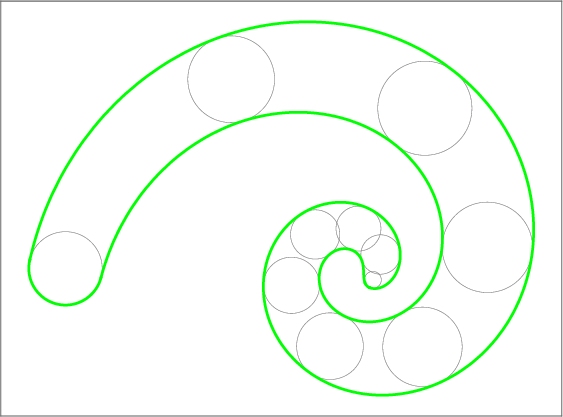
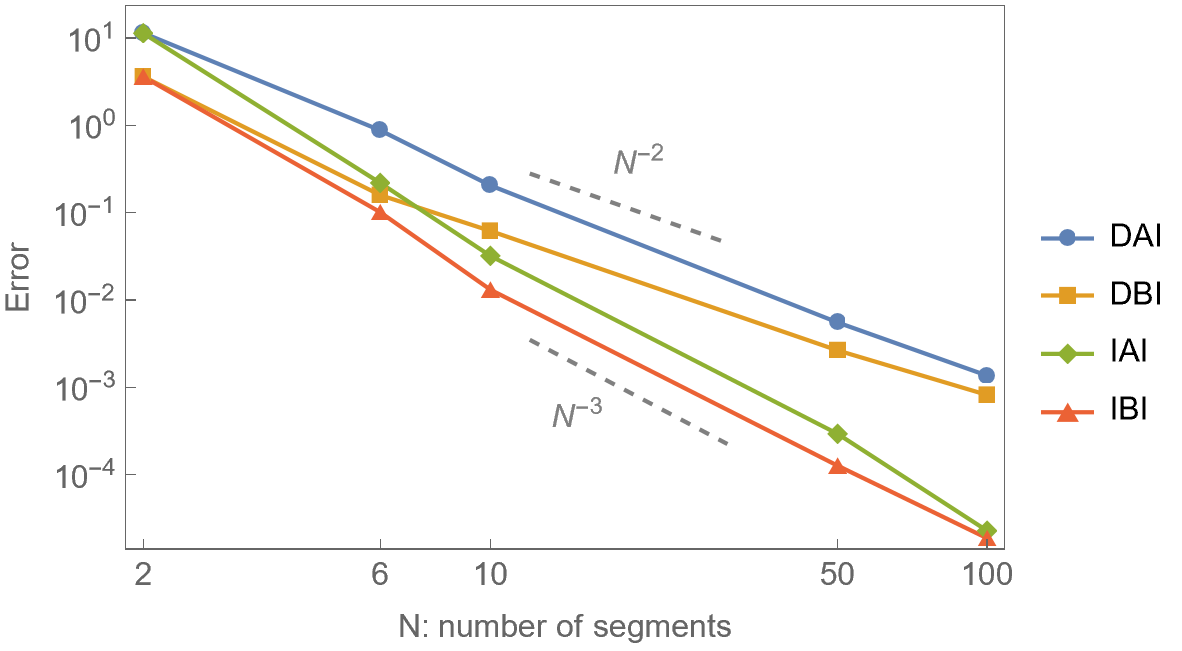
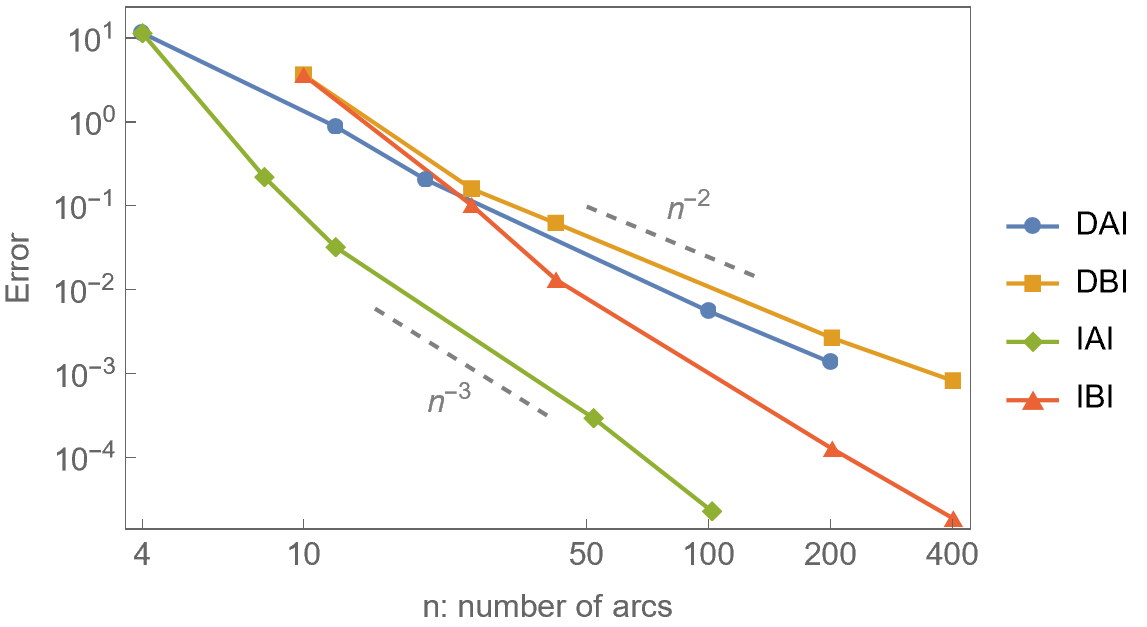
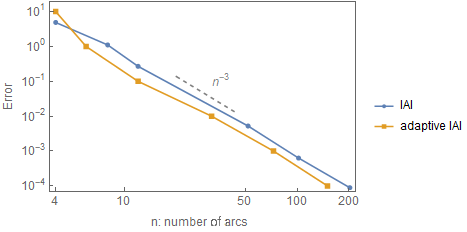
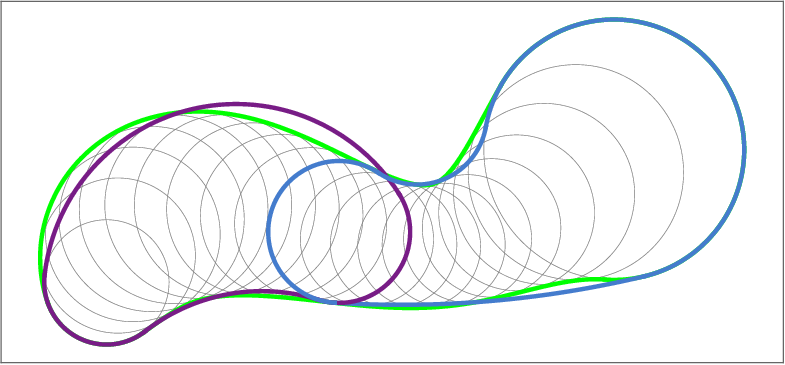
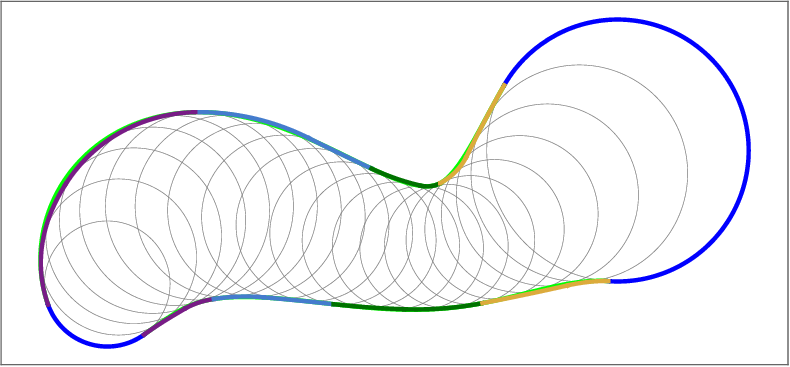
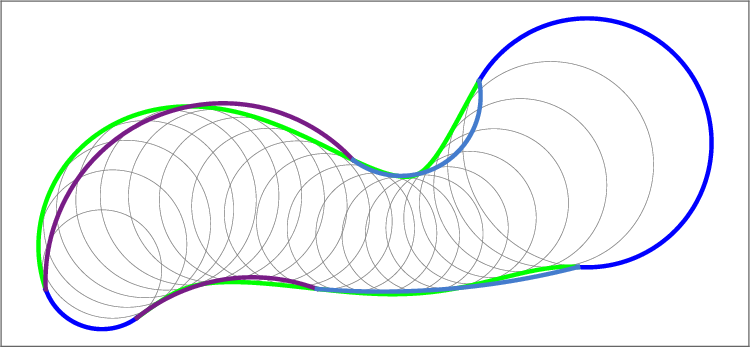
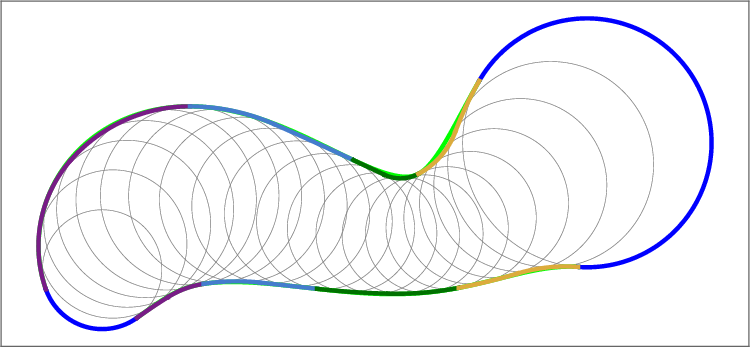
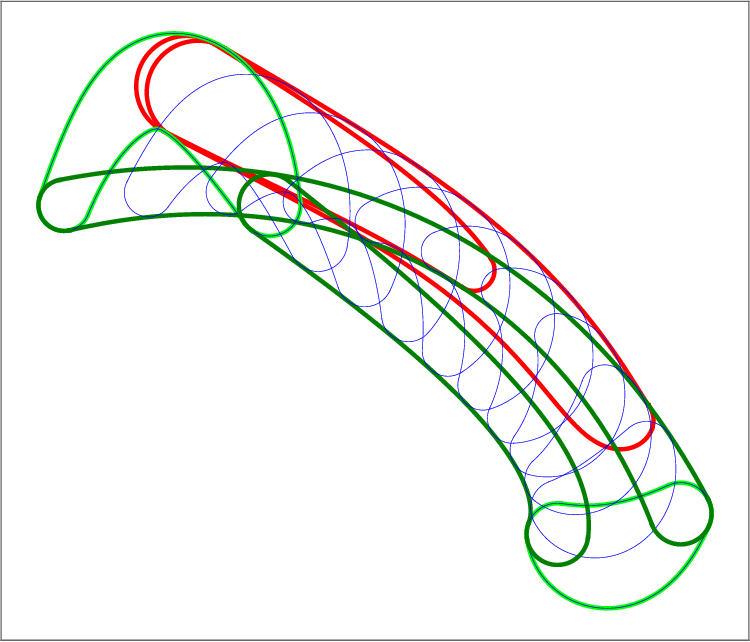
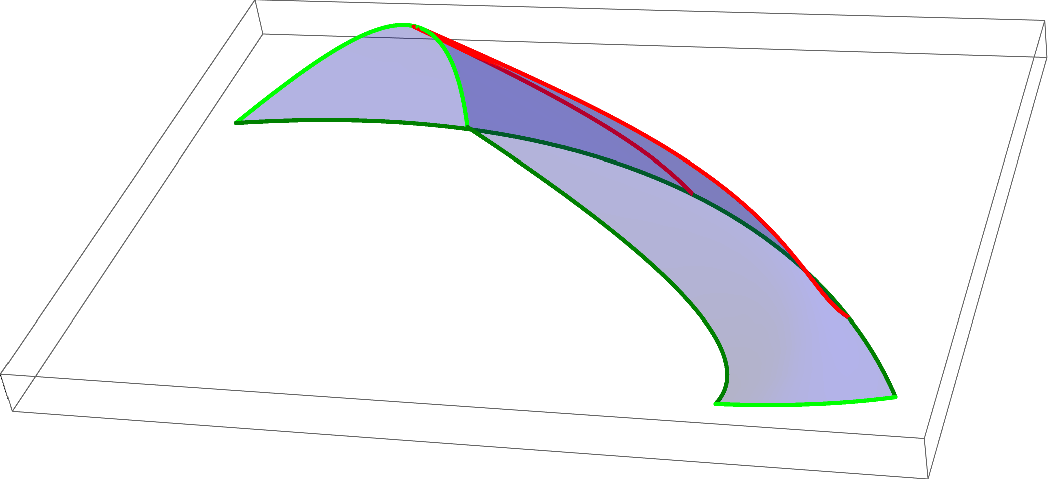
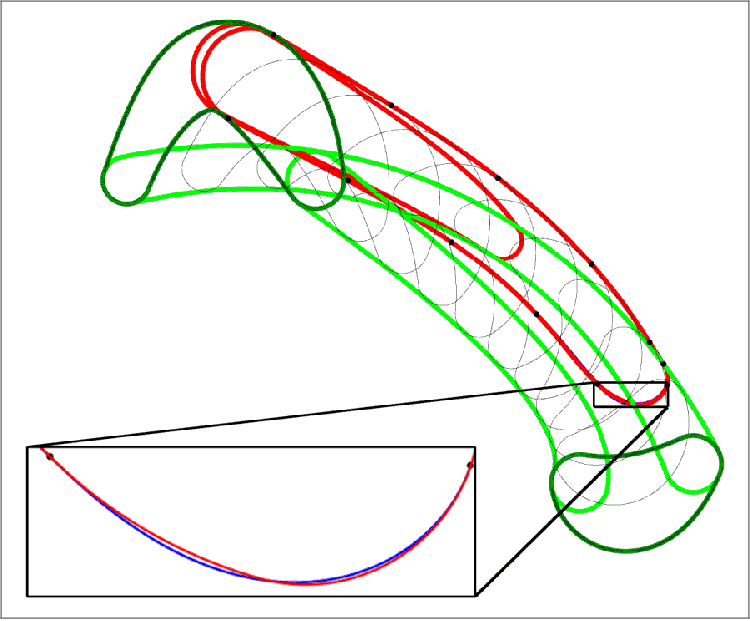
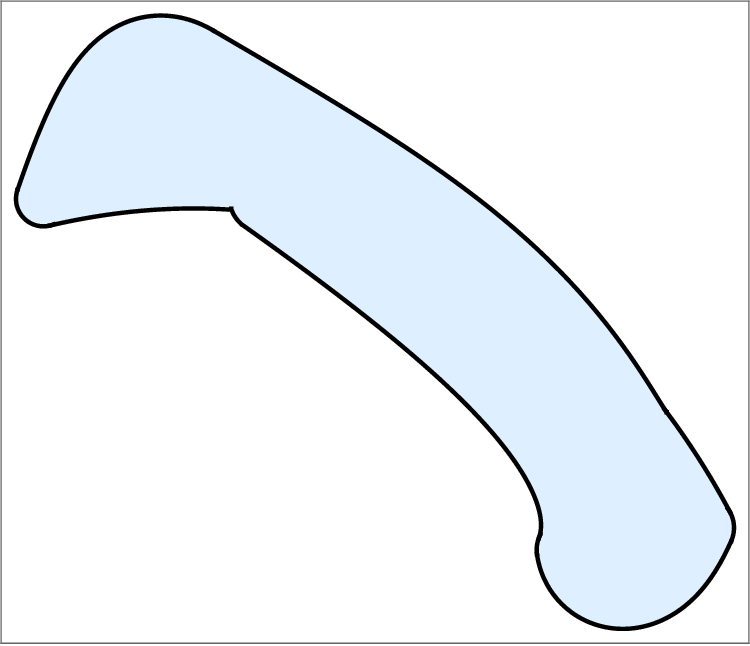
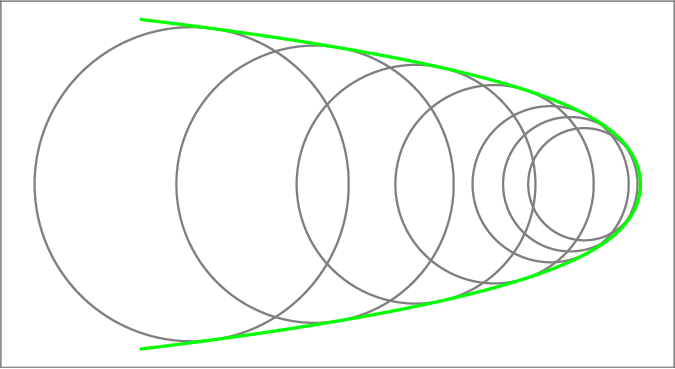
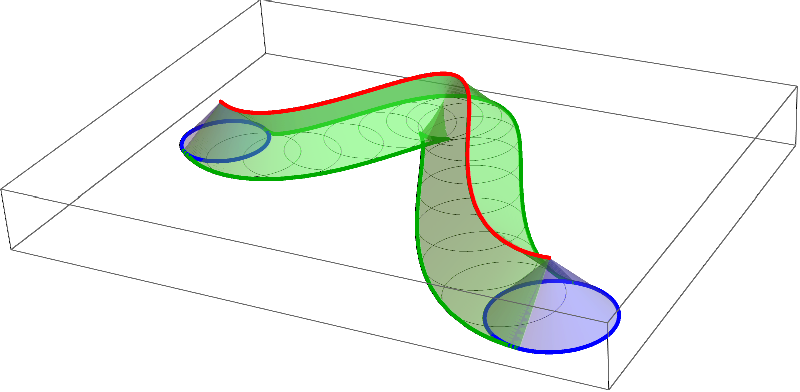
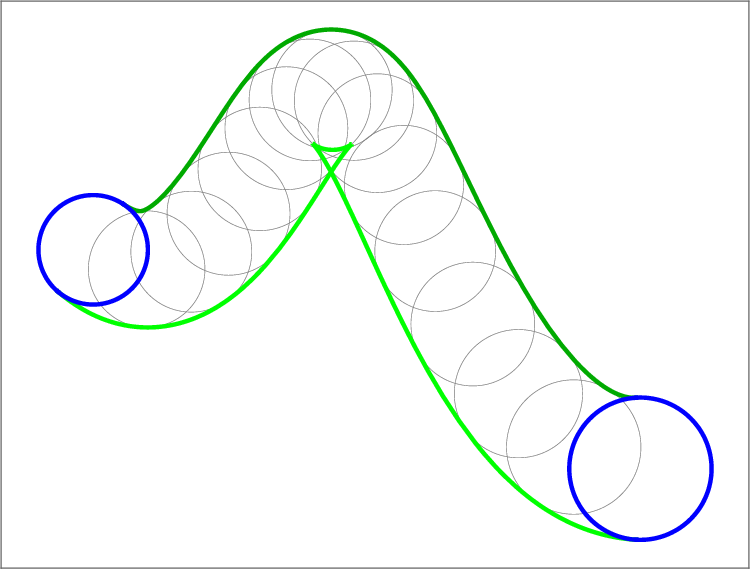
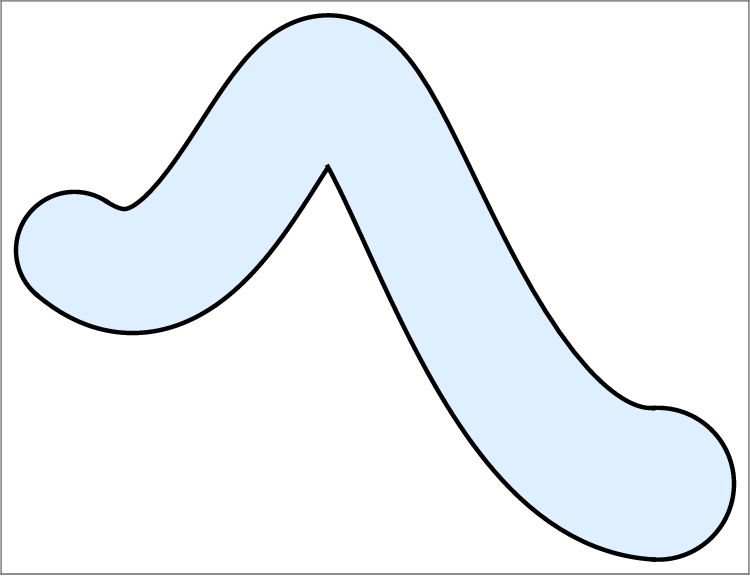
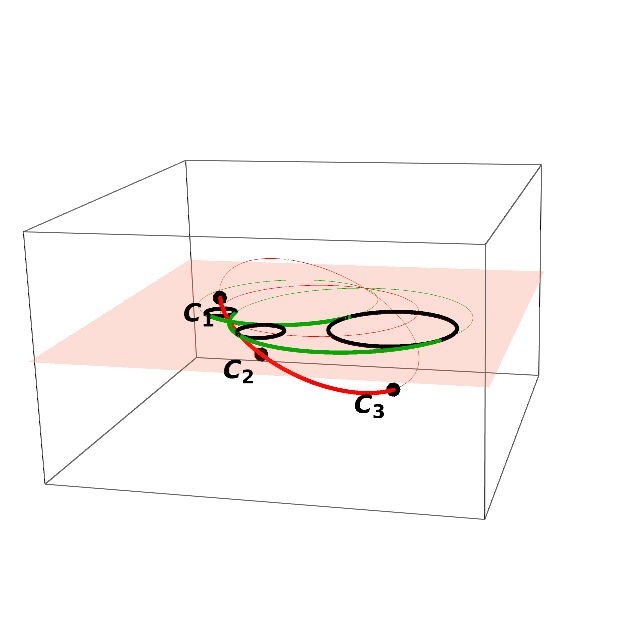
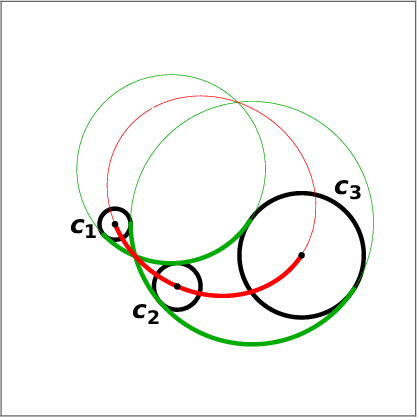
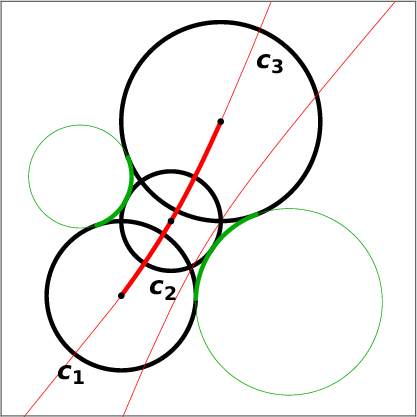
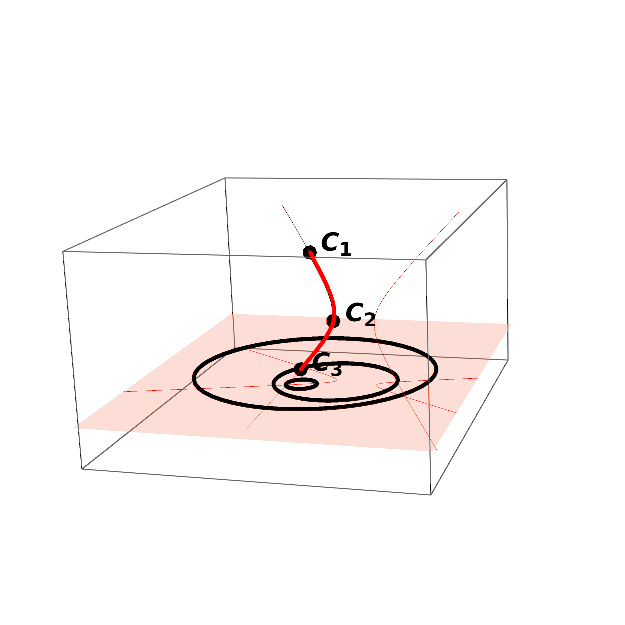
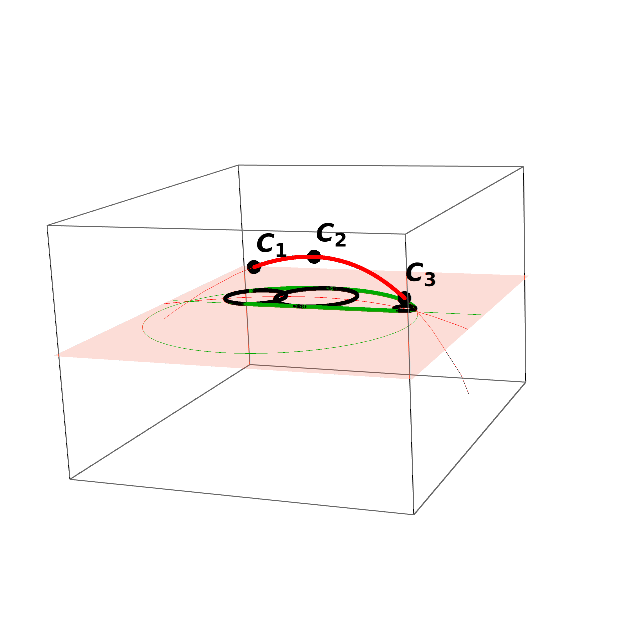
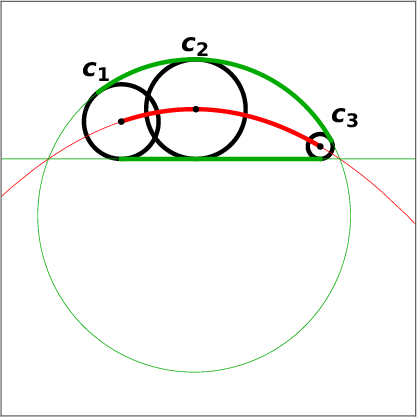
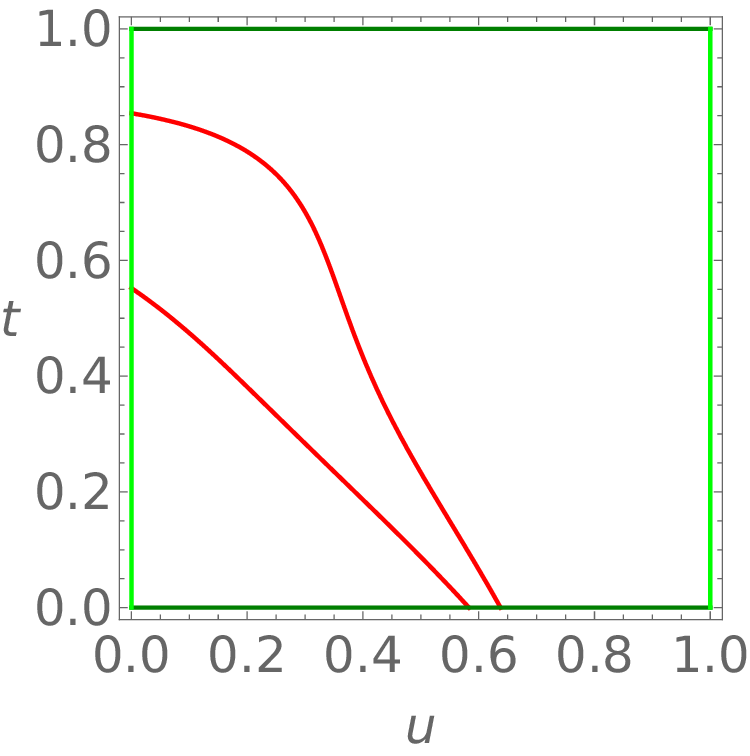
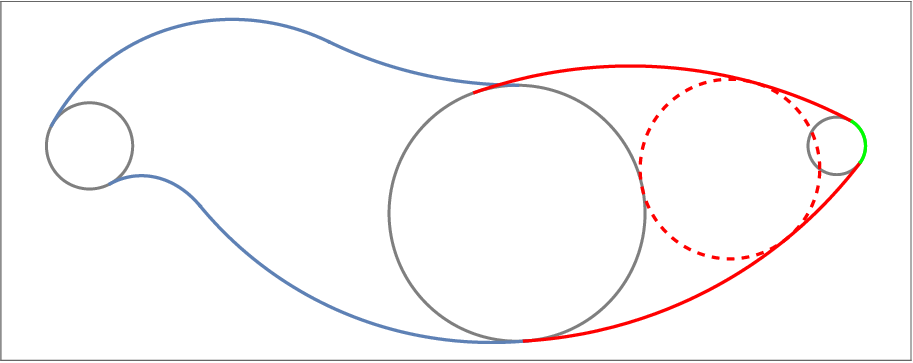
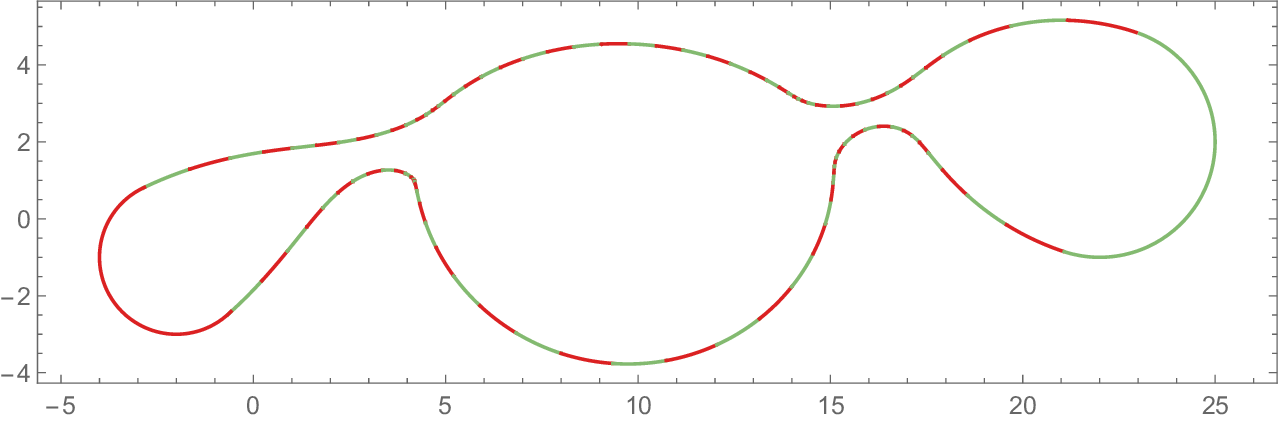
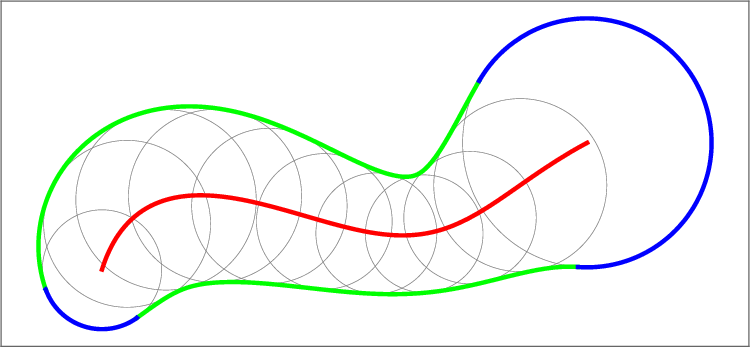
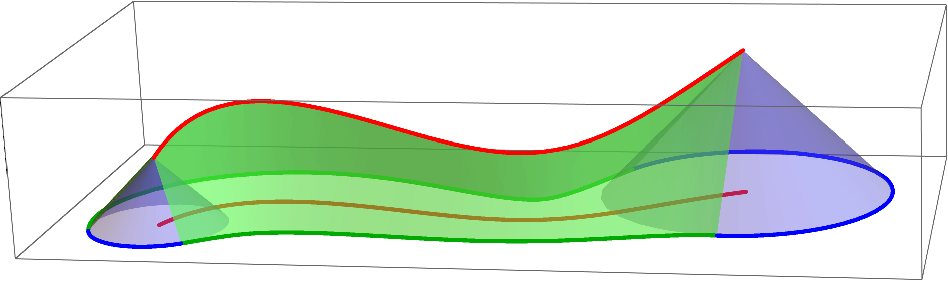
Computing the envelope of deforming planar domains is a significant and challenging problem with a wide range of potential applications. We approximate the envelope using circular arc splines, curves that balance geometric flexibility and computational simplicity. Our approach combines two concepts to achieve these benefits. First, we represent a planar domain by its medial axis transform (MAT), which is a geometric graph in Minkowski space R 2,1 (possibly with degenerate branches). We observe that circular arcs in the Minkowski space correspond to MATs of arc spline domains. Furthermore, as a planar domain evolves over time, each branch of its MAT evolves and forms a surface in the Minkowski space. This allows us to reformulate the problem of envelope computation as a problem of computing cyclographic images of finite sets of curves on these surfaces. We propose and compare two pairs of methods for approximating the curves and boundaries of their cyclographic images. All of these methods result in an arc spline approximation of the envelope of the evolving domain. Second, we exploit the geometric flexibility of circular arcs in both the plane and Minkowski space to achieve a high approximation rate. The computational simplicity ensures the efficient trimming of redundant branches of the generated envelope using a sweep line algorithm with optimal computational complexity.
Deep Dive into Arc Spline Approximation of Envelopes of Evolving Planar Domains.
Computing the envelope of deforming planar domains is a significant and challenging problem with a wide range of potential applications. We approximate the envelope using circular arc splines, curves that balance geometric flexibility and computational simplicity. Our approach combines two concepts to achieve these benefits. First, we represent a planar domain by its medial axis transform (MAT), which is a geometric graph in Minkowski space R 2,1 (possibly with degenerate branches). We observe that circular arcs in the Minkowski space correspond to MATs of arc spline domains. Furthermore, as a planar domain evolves over time, each branch of its MAT evolves and forms a surface in the Minkowski space. This allows us to reformulate the problem of envelope computation as a problem of computing cyclographic images of finite sets of curves on these surfaces. We propose and compare two pairs of methods for approximating the curves and boundaries of their cyclographic images. All of these meth
Sweeping a planar domain along a predefined trajectory is a powerful tool for e.g. constructing more complex domains and the main challenge is to approximate the envelope of the resulting volume or area. The case where the domain moves under a rigid body motion has been well studied, see e.g. [35] and the references therein.
Swept volumes can be generalized if we allow the domain to change its size or shape as it moves. We call such domains evolving domains. In the literature, the process is sometimes called general sweep.
Some of the existing methods build upon the techniques for computation of the envelope of a domain undergoing a rigid body motion. For example, Sweep Differential Equation (SDE) and Sweep Envelope Differential Equation (SEDE) were proposed [12,13]. They identify the sweeps with first-order linear ordinary equations. The methods were later generalized to general sweeps [11,46].
Other methods develop the theory for evolving domains separately. Kim and Elber formulate the problem as a polynomial equation in three variables [26]. Despite considering exact geometries, the technique generates a polyhedral approximation of the surface of the evolving domain.
In the case of planar evolving domains, a method for obtaining the exact envelope was proposed in [25] for domains that move along a parametric curve trajectory while they evolve, i.e., change their shape parametrically. The algorithm generates curve segments from which the envelope is extracted by a plane sweep algorithm. The plane sweep algorithm proposed by Bentley and Ottmann [8] was designed to compute and report intersections in a set of line segments and can be generalized to other primitives. However, for segments of algebraic curves of high degree, the plane sweep algorithm is highly inefficient.
To overcome the time difficulties, a polygonal approximation of the envelope of an evolving domain was proposed [1]. The envelope is again extracted by the plane sweep algorithm from a set of lines generated by the method. The polygonal boundaries are then fitted by cubic splines.
An incremental algorithm was proposed by [33]. At each instance of the time parameter, the domain is approximated by a polygonal boundary and the envelope is generated using boolean operations on simple polygons, which can be implemented robustly. The incremental nature of the algorithm produces the envelope at each step, such that no additional removal of redundant parts is necessary, making it useful for interactive shape design.
Our method is based on the interpolation of the medial axis transform. Medial axis (MA) was introduced by Blum [15] as a tool for shape recognition. It describes a planar domain by the centres of medial disks, i.e., maximum disks that are inscribed in the domain and are tangent to its boundary at at least two points. The medial axis transform (MAT) is defined by the medial axis and the radius function of the medial disks. Besides shape recognition, the medial axis transform has a wide range of applications, for example in domain decomposition, where it can be then used for G 1 -smooth parameterization of complex domains [40].
The medial axis transform can be computed exactly for domains with piecewise linear or piecewise circular boundaries [4,18,22,32]. For free-form shapes, the MAT can be approximated using a variety of techniques, including tracing methods [16,21,43], divide-and-conquer methods [3,20], and computing the Voronoi diagrams of sampled points [6,23,49].
In [48] it is shown that the medial axis of a compact set Ω with a piecewise C 2 smooth boundary δΩ is path-connected. If δΩ consists of finitely many real analytic curves, in [19] it is shown that MA(Ω) and MAT(Ω) are connected geometric graphs with finitely many branches (edges) and vertices.
The branches of the medial axis transform can be seen as curves in Minkowski space R 2,1 [21,41]. Minkowski space is a model of Laguerre geometry, the Euclidean geometry of oriented spheres and hyperplanes. Laguerre geometry was first introduced by Blaschke [14] and reexamined in a modern manner by Cecil [17]. Minkowski space (also called the cyclographic model) of Laguerre geometry was described in [41]. The model estabilishes a one-to-one correspondence between oriented spheres and points in Minkowski space. The mapping that assigns an oriented circle to a point in Minkowski space is called the cyclographic mapping. A cyclographic image of a point of the MAT of a planar domain is a medial disc and the domain can be recreated as the envelope of the medial discs.
The particular class of Minkowski Pythagorean-hodograph (MPH) curves [39], which are rationally parameterized curves that represent branches of the MAT, corresponds to domains that possess rationally parameterizable domain boundaries. It has been generalized to the broader class of RE curves [10], which share the rational envelope property with MPH curves.
Our results are also related to earlier work on methods
…(Full text truncated)…
This content is AI-processed based on ArXiv data.