Resolution and calibration effects in high contrast polarimetric imaging of circumstellar scattering regions
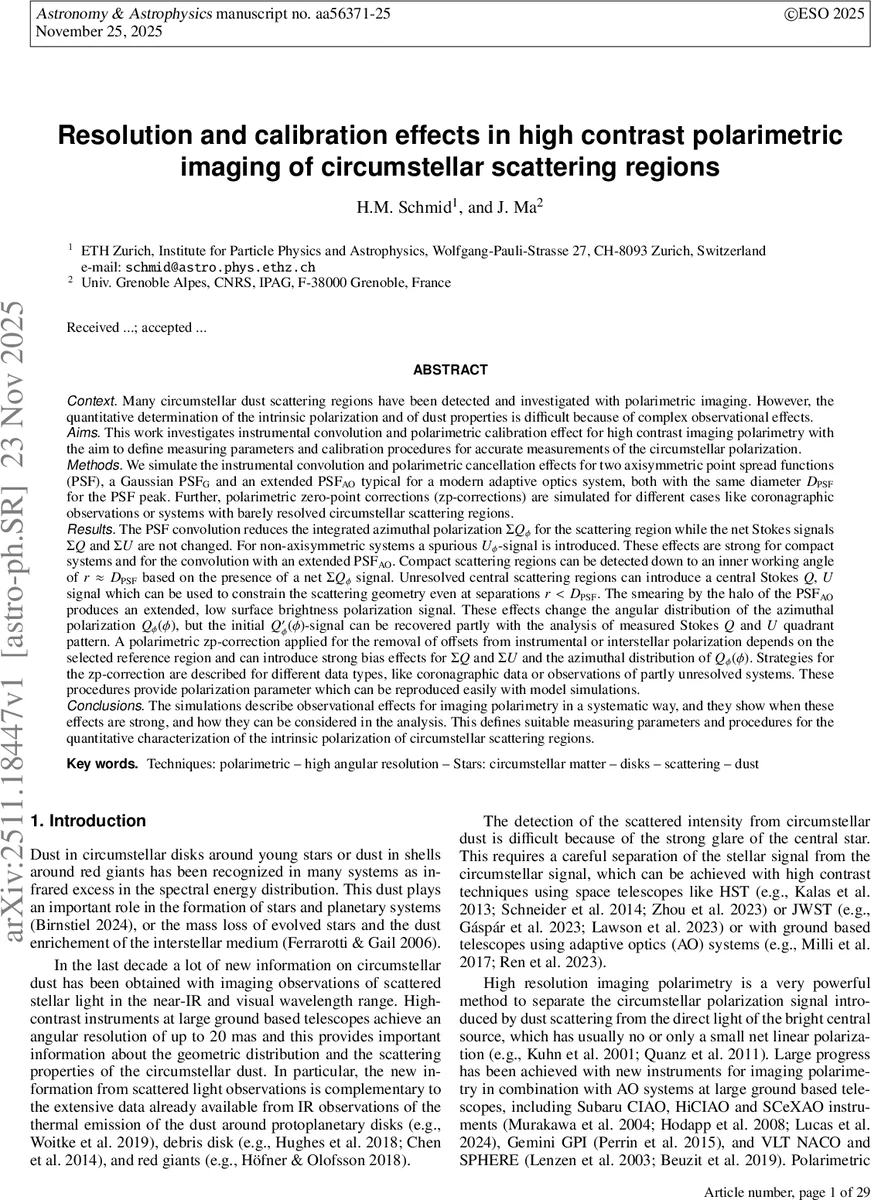
Many circumstellar dust scattering regions have been detected and investigated with polarimetric imaging. However, the quantitative determination of the intrinsic polarization and of dust properties is difficult because of complex observational effects. This work investigates instrumental convolution and polarimetric calibration effect for high contrast imaging polarimetry with the aim to define procedures for accurate measurements of the circumstellar polarization. For this we simulate the instrumental convolution and polarimetric cancellation effects for a Gaussian PSF and an extended PSF_{AO} typical for a modern adaptive optics system. Further, polarimetric zero-point corrections (zp-corrections) are simulated for different cases like coronagraphic observations or systems with barely resolved circumstellar scattering regions. We find that the PSF convolution reduces the integrated azimuthal polarization Q_phi for the scattering region while the net Stokes signals Q and U are not changed. For non-axisymmetric systems a spurious U_phi-signal is introduced. These effects are strong for compact systems but scattering regions can still be detected down to small separations while unresolved scattering regions can be constrained by the central Stokes Q,U signal. The smearing by PSF_{AO} produces an extended, low surface brightness polarization signal changing the angular distribution of the polarization, but the initial signal can be recovered partly from the Stokes Q and U quadrant pattern. A polarimetric zp-correction applied for the removal of offsets from instrumental or interstellar polarization depends on the selected reference region and can also introduce strong bias effects for the azimuthal distribution of the polarization signal. Strategies for the zp-correction are described for coronagraphic data or observations of partly unresolved systems.
💡 Research Summary
The paper presents a comprehensive simulation study of the two dominant systematic effects that limit quantitative polarimetric imaging of circumstellar scattering regions with high‑contrast adaptive‑optics (AO) instruments: (1) PSF convolution (including the extended halo typical of AO‑corrected point spread functions) and (2) polarimetric zero‑point corrections (zp‑corrections) used to remove instrumental, interstellar, or intrinsic stellar polarization offsets.
The authors construct a set of idealised 2‑D Stokes models for a central point‑like star and an extended dust scattering component. The scattering component is represented by four families of geometries: (i) axisymmetric rings (Ring0) with a Gaussian radial profile, (ii) axisymmetric disks (Disk0) with inner and outer radii and surface‑brightness power‑law indices α = 0, −1, −2, and (iii) the same structures inclined by 60° (RingI60, DiskI60) to introduce azimuthal dependence of the scattering angle. The intrinsic fractional polarization is set to p_max = 0.25 and the scattering phase function follows a Henyey‑Greenstein law with g = 0.6, reproducing the forward‑scattering brightness asymmetry observed in many disks.
Two PSFs are convolved with the intrinsic Stokes maps: a simple Gaussian PSF (G) and a realistic AO PSF (PSF_AO) that shares the same core width (D_PSF) but possesses a broad low‑level halo. After convolution, the azimuthal Stokes parameters Q_φ = Q cos 2ϕ + U sin 2ϕ and its orthogonal counterpart U_φ are derived. The simulations reveal several key behaviours:
-
Integrated azimuthal polarization loss – The total Q_φ signal (ΣQ_φ) is reduced by up to a factor of several depending on the compactness of the source, while the net Stokes integrals ΣQ and ΣU remain unchanged. This reflects the vector nature of polarization: convolution redistributes Q and U but does not alter their vector sum.
-
Spurious U_φ in non‑axisymmetric cases – For inclined disks the convolution mixes Q and U in a way that generates a non‑zero U_φ even though the intrinsic U_φ is zero. The effect is strongest for compact sources and for the AO halo, potentially mimicking physical asymmetries.
-
Halo‑induced low‑surface‑brightness polarization – PSF_AO’s extended halo spreads a faint polarized signal over a large area, altering the azimuthal dependence of Q_φ(ϕ). Nevertheless, the characteristic quadrant pattern in the Q‑U plane survives; by analysing this pattern one can partially recover the original Q_φ distribution.
-
Detectability at small separations – Even when the scattering region lies within the inner working angle (r ≈ D_PSF), a residual ΣQ_φ can be measured, allowing detection of very compact dust structures. If the central star is unpolarized, any net Q or U measured at r < D_PSF directly constrains the geometry of unresolved scattering.
The second part of the study addresses polarimetric zero‑point corrections. The observed Stokes vectors are modeled as Q = Q′ + q I and U = U′ + u I, where (q, u) represent fractional interstellar or instrumental offsets. The zp‑correction subtracts a constant offset estimated from a chosen reference region. Simulations show that the choice of reference region critically influences the corrected ΣQ, ΣU and, more subtly, the azimuthal Q_φ(ϕ) profile. In coronagraphic data, where a focal‑plane mask hides the central PSF core, using the masked region for offset estimation can introduce a large artificial U_φ component.
Based on these findings, the authors propose practical strategies:
- For coronagraphic observations, determine (q, u) from an annulus outside the mask but well within the AO halo, avoiding regions contaminated by residual scattered light.
- For partially resolved disks, select a reference region that is demonstrably free of intrinsic polarized flux (e.g., far‑field sky background or a symmetric opposite side of the disk).
- When PSF_AO halo dominates, model the halo’s contribution to Q and U separately and correct the quadrant pattern before computing Q_φ.
The paper concludes that a systematic understanding of PSF‑induced polarization cancellation and zp‑correction biases is essential for extracting reliable dust scattering properties, especially at small angular separations (< 5 λ/D) that correspond to planet‑forming zones in protoplanetary disks or dust‑formation regions near evolved stars. The presented simulation framework can be adapted to different instruments, wavelengths, and observing modes, providing a solid foundation for future high‑contrast polarimetric studies.
Comments & Academic Discussion
Loading comments...
Leave a Comment