From Kardar-Parisi-Zhang scaling to soliton proliferation in Josephson junction arrays
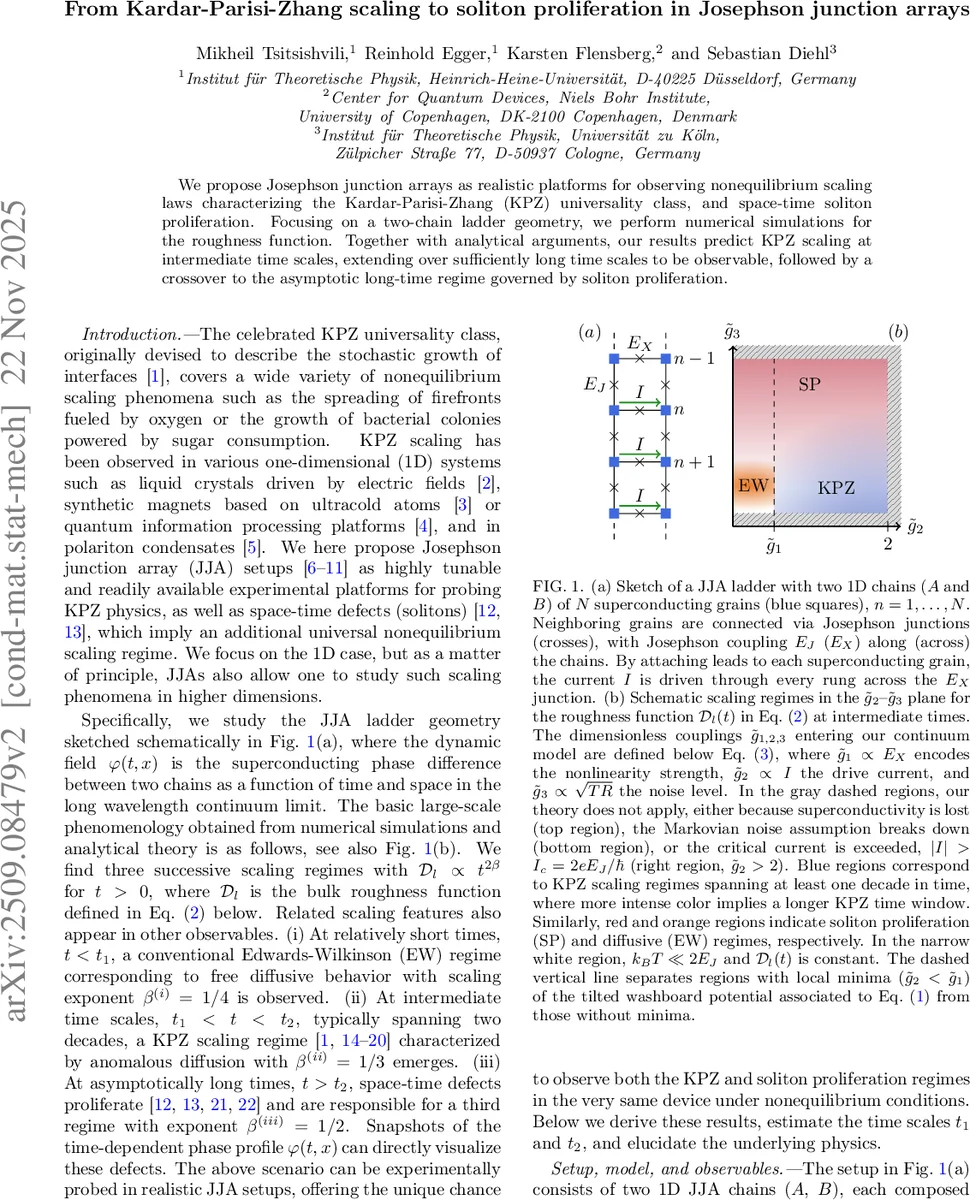
We propose Josephson junction arrays as realistic platforms for observing nonequilibrium scaling laws characterizing the Kardar-Parisi-Zhang (KPZ) universality class, and space-time soliton proliferation. Focusing on a two-chain ladder geometry, we perform numerical simulations for the roughness function. Together with analytical arguments, our results predict KPZ scaling at intermediate time scales, extending over sufficiently long time scales to be observable, followed by a crossover to the asymptotic long-time regime governed by soliton proliferation.
💡 Research Summary
The authors propose a realistic experimental platform—Josephson‑junction arrays (JJAs) arranged in a two‑chain ladder geometry—to study nonequilibrium scaling phenomena belonging to the Kardar‑Parisi‑Zhang (KPZ) universality class and a subsequent regime dominated by space‑time soliton proliferation. Starting from the microscopic circuit, they derive an overdamped stochastic sine‑Gordon equation for the superconducting phase difference φ(t,x) between the two chains: η ·φ − D ∂ₓ²φ + 2Eₓ sin φ − α I = ξ, where η is the Ohmic damping set by the resistance to an underlying 2DEG, D is the diffusion constant proportional to the intra‑chain Josephson energy E_J, Eₓ is the weaker inter‑chain coupling, I is a constant bias current, and ξ is Gaussian white noise with strength fixed by temperature T. The key observable is the bulk roughness Dₗ(t)= (1/l)∫_{central segment}dx
Comments & Academic Discussion
Loading comments...
Leave a Comment