Gravity-driven flux of particles through apertures
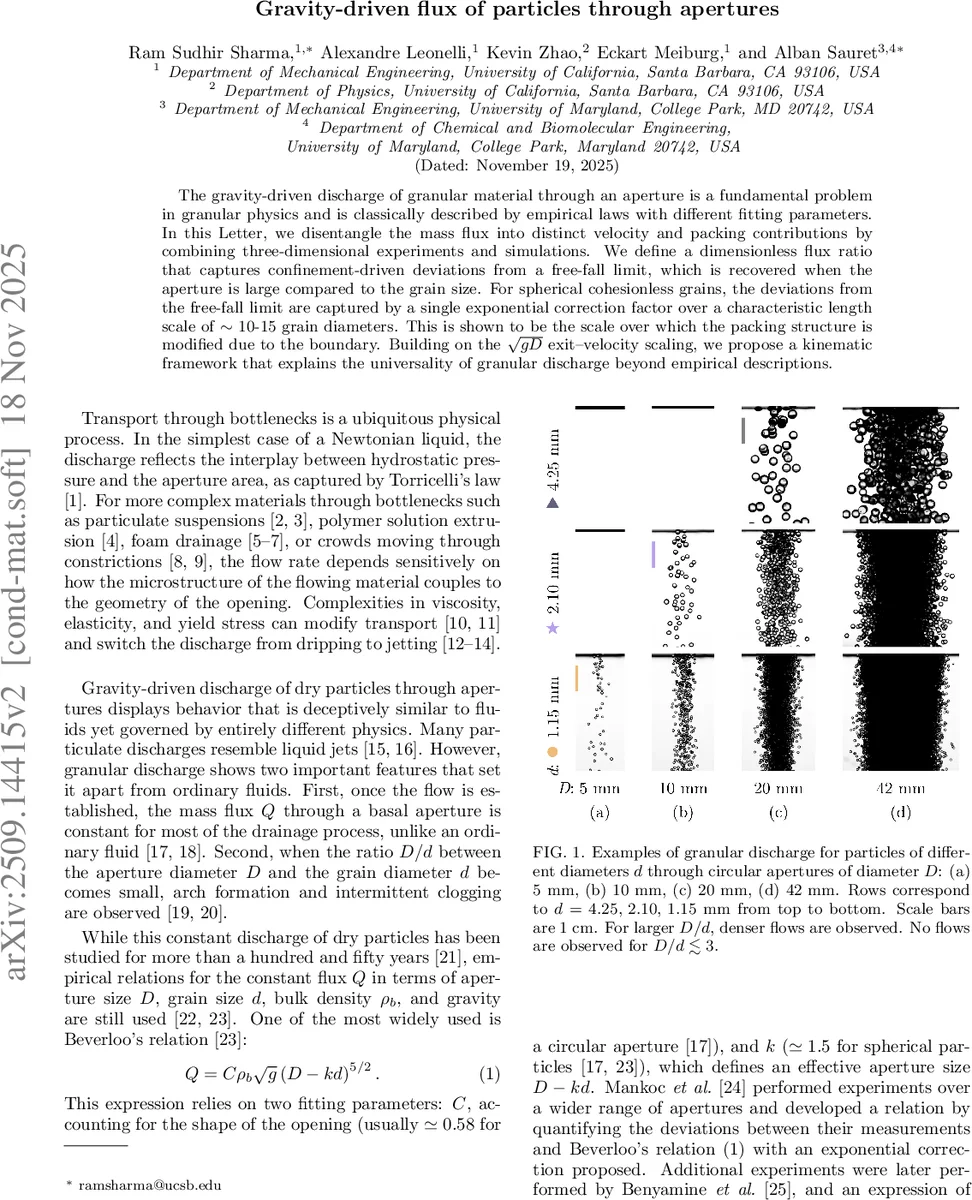
The gravity-driven discharge of granular material through an aperture is a fundamental problem in granular physics and is classically described by empirical laws with different fitting parameters. In this Letter, we disentangle the mass flux into distinct velocity and packing contributions by combining three-dimensional experiments and simulations. We define a dimensionless flux ratio that captures confinement-driven deviations from a free-fall limit, which is recovered when the aperture is large compared to the grain size. For spherical cohesionless grains, the deviations from the free-fall limit are captured by a single exponential correction factor over a characteristic length scale of $\sim$ 10-15 grain diameters. This is shown to be the scale over which the packing structure is modified due to the boundary. Building on the $\sqrt{gD}$ exit-velocity scaling, we propose a kinematic framework that explains the universality of granular discharge beyond empirical descriptions.
💡 Research Summary
In this paper the authors revisit the classic problem of granular discharge through an aperture, a phenomenon that has been described for more than a century by empirical relations such as Beverloo’s law. By combining a systematic set of three‑dimensional experiments with discrete‑element method (DEM) simulations, they decompose the mass flux Q into two physically distinct contributions: an average vertical velocity ⟨u_z⟩ and an average packing fraction ⟨ϕ⟩ evaluated over the aperture area. The general expression Q = A ρ g ⟨u_z ϕ⟩ is shown to be accurately approximated by the product ⟨u_z⟩⟨ϕ⟩ because the covariance term is negligible (≈1 % for the smallest D/d and <0.01 % for larger ratios).
The authors first identify a “free‑fall” regime that emerges when the aperture diameter D is much larger than the grain diameter d. In this limit, grains accelerate under gravity over a characteristic distance L ≈ D/2, leading to an average exit velocity ⟨u_z⟩_f ≈ √(g D). This scaling is confirmed by both experiments and DEM simulations: the nondimensional velocity ⟨u_z⟩/√(g D) remains between 0.7 and 1 for all D/d, approaching unity as D ≫ d.
For the packing fraction, the authors argue that the free‑fall state corresponds to the random‑loose packing limit of cohesionless spheres, ϕ_RLP ≈ 0.555. Using mass conservation at the aperture they extract an effective packing ϕ_f ≈ 0.54–0.56 for D ≫ d, which matches the DEM results (ϕ_f ≈ 0.56) and earlier measurements of dilute granular jets. Thus the free‑fall flux can be written as
Q_f = A ρ g √(g D) ϕ_f.
When the aperture becomes comparable to the grain size, the measured flux deviates strongly from Q_f. Detailed DEM analysis reveals a boundary layer of reduced packing that extends roughly 10–15 grain diameters from the wall. Within this layer the packing fraction drops below ϕ_f, while the velocity field is only mildly affected. The authors capture the combined effect of velocity and packing modifications with a single dimensionless flux ratio
F = Q/Q_f = ⟨u_z ϕ⟩/(ϕ_f √(g D)).
All experimental data collapse onto a universal curve when plotted as F versus D/d. Remarkably, the curve is well described by a simple exponential relaxation
F = 1 − exp(−D/λ),
with an effective relaxation length λ ≈ 10 d–15 d. This length scale coincides with the distance over which the packing profile recovers from the wall‑induced dilation to the bulk free‑fall value. Consequently, the full granular discharge law becomes
Q = A ρ g √(g D) ϕ_f
Comments & Academic Discussion
Loading comments...
Leave a Comment