An Integrated Fusion Framework for Ensemble Learning Leveraging Gradient Boosting and Fuzzy Rule-Based Models
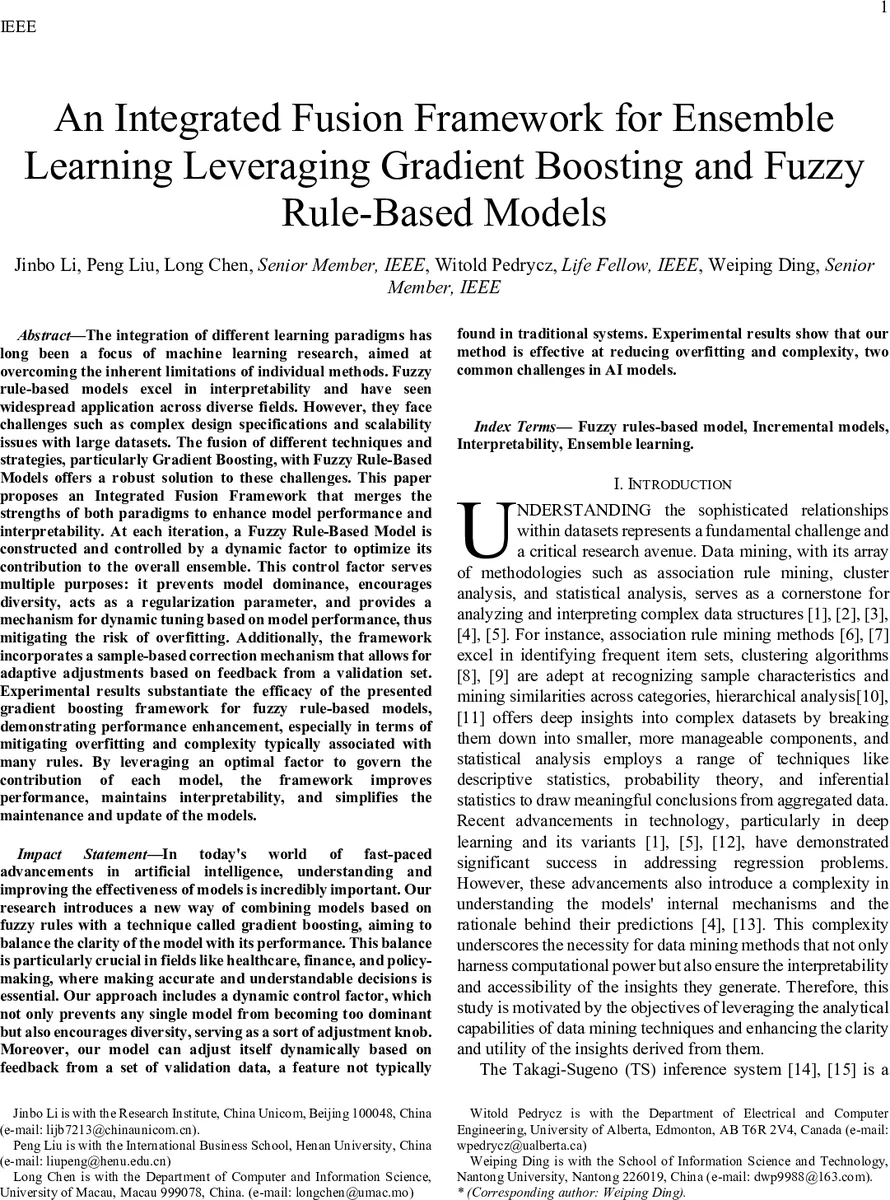
The integration of different learning paradigms has long been a focus of machine learning research, aimed at overcoming the inherent limitations of individual methods. Fuzzy rule-based models excel in interpretability and have seen widespread application across diverse fields. However, they face challenges such as complex design specifications and scalability issues with large datasets. The fusion of different techniques and strategies, particularly Gradient Boosting, with Fuzzy Rule-Based Models offers a robust solution to these challenges. This paper proposes an Integrated Fusion Framework that merges the strengths of both paradigms to enhance model performance and interpretability. At each iteration, a Fuzzy Rule-Based Model is constructed and controlled by a dynamic factor to optimize its contribution to the overall ensemble. This control factor serves multiple purposes: it prevents model dominance, encourages diversity, acts as a regularization parameter, and provides a mechanism for dynamic tuning based on model performance, thus mitigating the risk of overfitting. Additionally, the framework incorporates a sample-based correction mechanism that allows for adaptive adjustments based on feedback from a validation set. Experimental results substantiate the efficacy of the presented gradient boosting framework for fuzzy rule-based models, demonstrating performance enhancement, especially in terms of mitigating overfitting and complexity typically associated with many rules. By leveraging an optimal factor to govern the contribution of each model, the framework improves performance, maintains interpretability, and simplifies the maintenance and update of the models.
💡 Research Summary
The paper introduces an Integrated Fusion Framework that combines Gradient Boosting (GB) with Fuzzy Rule‑Based Models (FRBM) to address the complementary weaknesses of each technique. Traditional fuzzy rule‑based systems are prized for their interpretability—rules are expressed in human‑readable “if‑then” form—but they suffer from scalability problems when the number of rules grows, leading to complex design, high maintenance cost, and reduced efficiency on large datasets. Gradient boosting, on the other hand, builds a strong predictor by sequentially adding weak learners that fit the residual errors of the current ensemble; it achieves high predictive performance and includes built‑in regularization (learning rate, shrinkage) but typically produces black‑box models that are hard to interpret.
The proposed framework merges these paradigms by constructing a new FRBM at every boosting iteration. Each FRBM partitions the input space using membership functions (Gaussian, trapezoidal, etc.) and generates a set of linguistic rules whose consequent can be a constant or a linear expression. The key novelty is a Dynamic Factor (DF)—a weight assigned to each FRBM that is updated during training. DF serves several purposes: (1) it prevents any single fuzzy model from dominating the ensemble, (2) it encourages diversity among the weak learners, (3) it acts as a regularization term that penalizes overly complex rule sets, and (4) it provides a mechanism for adaptive tuning based on validation performance.
To compute DF, the authors combine three signals: the reduction in residual error achieved by the new FRBM, the complexity of its rule base (number of rules, parameter count), and the loss observed on a held‑out validation set. The factor is multiplied by the FRBM’s output before being added to the ensemble, effectively shrinking the contribution of models that are either too complex or insufficiently effective.
In addition to DF, the framework incorporates a Sample‑Based Correction (SBC) mechanism. After each iteration, the validation set is evaluated; if the loss exceeds a predefined threshold, the SBC adjusts both DF and the parameters of the membership functions to better align the ensemble with the validation distribution. This dynamic correction replaces the static learning‑rate schedule commonly used in boosting, allowing the algorithm to react to distribution shifts or noisy data in real time.
Mathematically, the ensemble prediction after M iterations is
\
Comments & Academic Discussion
Loading comments...
Leave a Comment